
Tax implications of selling property in New Zealand

TL;DR:Many New Zealand property sales are taxable under the bright-line test, especially when not qualifying as primary residences. Proper record-keeping, early tax planning, and understanding exemptions can significantly reduce liabilities. Consulting a professional before listing ensures strategic decisions that optimize financial outcomes and compliance.
Selling a property feels rewarding until the tax bill arrives. Many New Zealand homeowners assume their sale is tax-free, only to discover that the tax implications of selling property are more nuanced than they expected. Whether you are selling your family home, an investment property, or a rental you have held for years, understanding what triggers a tax liability, what exemptions you qualify for, and how to plan ahead can make a real difference to your financial outcome. This guide walks you through everything you need to know before you sign a sale and purchase agreement.
Table of Contents
- Key takeaways
- Tax implications of selling property: the basics
- Exemptions and reductions available to sellers
- Rental and investment property tax considerations
- Strategies to minimise your property tax when selling
- Common pitfalls that increase your tax bill
- My perspective on proactive tax planning
- Sell your property with confidence through Easysale
- FAQ
Key takeaways
| Point | Details |
|---|---|
| Not all sales trigger tax | Primary residences are generally exempt, but specific conditions must be met to qualify. |
| Rental properties carry extra tax | Investors face capital gains and depreciation recapture obligations that homeowners often overlook. |
| Record-keeping reduces your tax bill | Tracking improvements and selling expenses increases your cost basis and lowers taxable gain. |
| Timing your sale matters | Selling in a lower-income year can reduce your overall tax liability significantly. |
| Early planning saves money | Consulting a tax professional before listing is far more effective than acting after signing. |
Tax implications of selling property: the basics
Before anything else, it helps to understand how capital gains tax works in New Zealand and when it actually applies to you.
Capital gains tax (CGT) refers to the tax levied on the profit you make when you sell an asset for more than you paid for it. New Zealand does not have a formal, broad-based CGT regime in the same way some other countries do. However, that does not mean property sales are always tax-free. Property sale tax basics are more layered than most sellers realise, and getting this wrong can be costly.
The Inland Revenue Department (IRD) applies tax rules that effectively capture gains on certain property sales, particularly through the bright-line test. Under this rule, if you sell a residential property within a set period of purchasing it and it is not your main home, the gain is taxable as income. The current bright-line period has shifted over the years, so checking the latest IRD guidance before you sell is worth doing.
Here is a quick breakdown of when tax may apply to your sale:
- Main home sales: Generally exempt if the property is your primary residence and you meet the ownership and use requirements.
- Investment and rental properties: Subject to tax under the bright-line test and potentially under other income tax provisions.
- Inherited properties: Treated differently depending on how and when the property was transferred.
- Properties bought with intent to sell: If you purchased a property with the purpose of resale, the gain is taxable regardless of how long you held it.
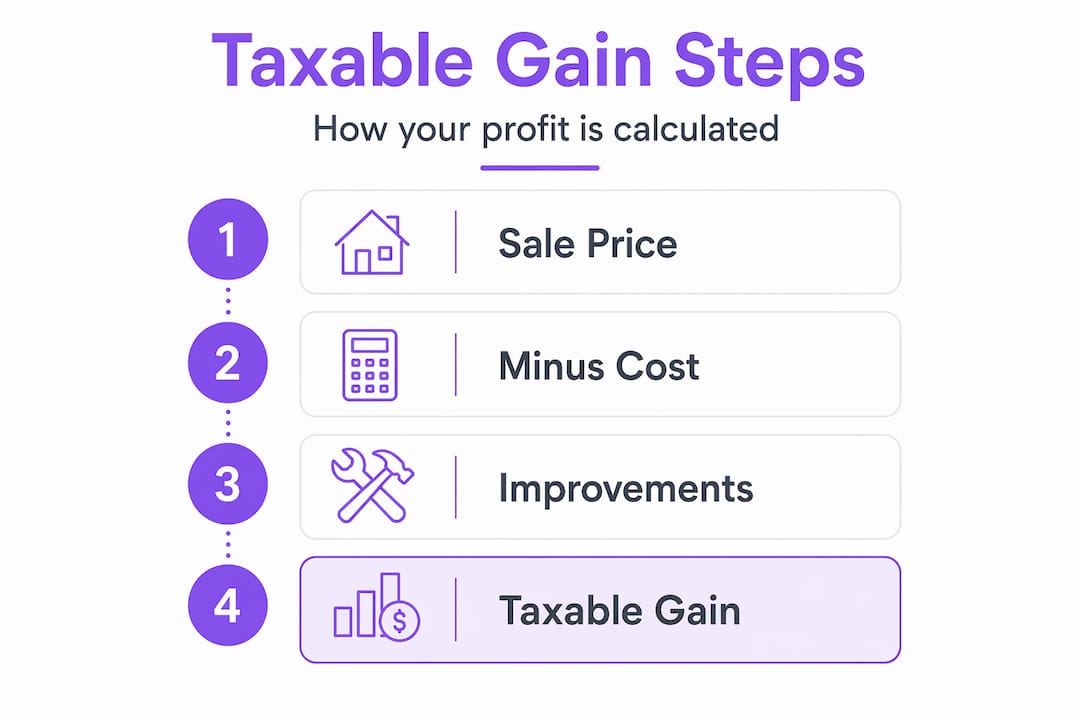
The taxable gain is calculated as your sale price minus your adjusted cost basis. Your cost basis is what you originally paid for the property, plus any capital improvements you made, plus allowable selling expenses like legal fees. The higher your cost basis, the lower your taxable gain.
Pro Tip: Start a simple folder, digital or physical, the day you buy any property. Keep every invoice for renovations, maintenance that qualifies as a capital improvement, and legal costs. This record becomes your financial defence if the IRD ever questions your cost basis.
Holding period matters too. Selling during a low-income year can reduce your capital gains tax liability significantly, which is something most sellers do not think about until it is too late.
Exemptions and reductions available to sellers
The most commonly misunderstood area of property tax in New Zealand is the main home exemption. It is real, it is valuable, and it is also conditional. Many sellers assume any home sale is tax-exempt, and that assumption leads to costly filing errors.
To qualify for the main home exemption under the bright-line test in New Zealand, you generally need to satisfy the following:
- Primary use: The property must have been your main home for the majority of the time you owned it.
- One property at a time: The exemption applies to one main home at a time. If you own multiple properties, only the one that genuinely functions as your primary residence qualifies.
- No regular pattern of buying and selling: If the IRD identifies a pattern of frequent property transactions, it may treat your gains as taxable income regardless of residence status.
- Frequency limit: The main home exclusion can only be claimed once every two years per taxpayer, so repeat sellers need to plan carefully.
There are partial exemptions and special circumstances worth knowing. If you used part of your home for business or rented out a portion of it, only the residential portion qualifies for the exemption. Inherited properties have their own rules. Generally, the bright-line test does not apply to property you inherit, but if you later sell it and it was not your main home, other income tax provisions may still apply.
Record-keeping is not optional here. To substantiate a main home exemption claim, you need documentation showing occupancy, such as utility bills, correspondence addressed to the property, and evidence of the dates you lived there. Without this, an IRD audit becomes difficult to defend.
Pro Tip: If you have rented out a room or used a portion of your property as a home office, get advice before selling. A tax professional can calculate what portion of your gain remains exempt and what may be taxable, potentially saving you thousands.
Rental and investment property tax considerations
If you own a rental or investment property, the property sale tax consequences go further than a straightforward capital gains calculation. There are two main layers to understand: the capital gain itself and depreciation recapture.
Depreciation recapture is the part that catches most investors off guard. When you own a rental property, you may have claimed depreciation deductions against your rental income over the years. When you sell, the IRD (or in other jurisdictions, the relevant tax authority) effectively “recaptures” those deductions by taxing the depreciation you previously claimed. In many tax systems, depreciation recapture is taxed at a flat 25% rate, regardless of your ordinary income rate. This is a fixed cost that investors must factor into their pre-sale calculations.
Ignoring depreciation recapture is one of the most expensive mistakes rental property owners make. It is not a maybe or a sometimes. If you claimed depreciation, you will face recapture. The question is only how much and whether you planned for it.
Common mistakes investors make when managing tax liabilities on a rental sale include:
- Not keeping records of depreciation claimed: Without accurate records, you cannot calculate recapture correctly, and you risk underpaying or overpaying tax.
- Conflating rental income tax with CGT: These are separate calculations with different rules.
- Assuming the bright-line test does not apply: It applies broadly to residential properties that are not main homes, including long-term rentals.
- Underestimating total tax owed: Overlooking local tax interactions and depreciation recapture consistently causes unexpected tax burdens for sellers.
For landlords preparing for a sale, starting your tax planning process early is not advice. It is a necessity. Easysale has put together a practical resource on simplifying property sales for landlords that covers many of the procedural side of selling rental properties efficiently.
Strategies to minimise your property tax when selling

Knowing how to minimise property tax when selling is not about avoidance. It is about using every legitimate tool available to you so you do not pay more than you legally owe.
| Strategy | What it involves | Best for |
|---|---|---|
| Timing your sale | Selling in a year when your income is lower reduces total tax | Sellers with variable income |
| Tracking capital improvements | Every qualifying renovation raises your cost basis | All property owners |
| Pre-sale tax consultation | Engaging a tax adviser before listing identifies savings early | Investors and complex sales |
| Like-kind exchange | Deferring gains by reinvesting into qualifying property | Active investors |
| Partial exemption planning | Calculating the exempt portion if mixed-use applies | Home office or rental room owners |
Pre-sale tax planning is the single most effective way to manage capital gains and depreciation recapture liabilities. It is far easier to structure a sale tax-efficiently before you list than to try to manage the consequences after the contract is signed.
Tracking capital improvements is equally underrated. Renovations, agent fees, and legal costs all raise your cost basis when properly documented, directly reducing your taxable gain. A kitchen renovation you did five years ago could reduce your tax bill today, but only if you kept the receipts.
Like-kind exchange strategies, where you defer capital gains by reinvesting the proceeds into a qualifying property, have strict deadlines. Strict 45-day identification and 180-day closing deadlines apply, and missing either window disqualifies the deferral entirely. These tools require professional guidance to execute correctly.
Pro Tip: Do not wait until you have a signed sale agreement to call a tax adviser. By that point, your options narrow considerably. The best time to discuss selling real estate tax considerations is six to twelve months before you plan to list.
Common pitfalls that increase your tax bill
The gap between what sellers expect to pay and what they actually owe often comes down to a handful of avoidable mistakes. Here are the most common ones:
- Assuming the main home exemption is automatic: It is not. You must meet the criteria, and you must be able to prove it with documentation.
- Ignoring depreciation recapture: If you ever claimed depreciation on a rental property, that amount will be recaptured on sale. There is no getting around it.
- Failing to track capital improvements: Every dollar of qualifying expenditure that goes undocumented is a dollar added to your taxable gain unnecessarily.
- Waiting until after signing to get tax advice: Once a sale is unconditional, your ability to restructure the transaction for tax efficiency is almost zero.
- Overlooking local and additional taxes: Additional taxes at state or local level can affect your total tax owed. In New Zealand, the IRD is your primary concern, but always verify the full picture with a professional.
One more that rarely gets mentioned: the lock-in effect. Economists note that high tax bills cause owners to hold properties longer than they otherwise would, which can work against your broader financial goals. Sometimes the cost of not selling is higher than the cost of the tax itself. Your strategy should account for both.
My perspective on proactive tax planning
I have spoken with a lot of property sellers over the years, and the pattern I keep seeing is the same. Someone receives a tax bill they were not expecting and says, “I had no idea it worked that way.” And honestly, that is not entirely their fault. The tax implications of selling property in New Zealand are not covered in everyday conversation, and the rules shift regularly enough that what was true three years ago may not apply today.
What I find genuinely frustrating is that most of these surprises are avoidable. The sellers who come out ahead are not necessarily the ones who made the most money on the sale. They are the ones who understood their tax position before they sold. They kept their records, they got advice early, and they made decisions with full information.
My view is that tax planning is not a separate task you do after deciding to sell. It is part of the decision to sell. Asking “what will I net after tax?” is just as important as asking “what will the property sell for?” If you are an investor or a homeowner thinking about selling in the next year or two, start the conversation with a tax professional now. The earlier you plan, the more options you have.
— Aaron
Sell your property with confidence through Easysale
If you are working through the tax side of a property sale and also want a fast, straightforward selling experience, Easysale is worth knowing about.

Easysale is a New Zealand property buying service that purchases homes directly, with no agents, no commissions, and no drawn-out timelines. Whether you are downsizing or selling for retirement and want to manage your financial outcome carefully, or you simply need a fast, certain sale without the complexity of a traditional listing process, Easysale offers a clear three-step process. Submit your property details, receive a fair cash offer, and settle on a timeline that suits you. For sellers who want to move quickly and reduce uncertainty, it is a genuinely practical option.
FAQ
What triggers tax when selling property in New Zealand?
Tax is triggered on property sales primarily through the bright-line test, which applies to residential properties that are not your main home and are sold within a specified period of purchase. Properties bought with the intention of resale are also taxable regardless of holding period.
Is my main home sale always tax-free?
Not always. The main home exemption applies when you have genuinely used the property as your primary residence for the majority of the time you owned it. Partial rental use, frequent sales, or failing to meet documentation requirements can reduce or remove the exemption.
How is depreciation recapture calculated on a rental property?
Depreciation recapture is based on the total amount of depreciation you claimed during ownership. It is taxed at a flat rate of 25% in many tax systems, separate from your normal income or capital gains rate, and must be reported when you file after the sale.
When is the best time to get tax advice before selling?
The best time is six to twelve months before you plan to list the property. Pre-sale tax planning gives you time to structure the transaction, gather documentation, and explore strategies like timing your sale or tracking capital improvements to reduce your taxable gain.
Can I defer capital gains tax by reinvesting sale proceeds?
Like-kind exchange strategies allow you to defer capital gains tax by reinvesting into qualifying property, but they come with strict deadlines. You have 45 days to identify a replacement property and 180 days to close. Missing either deadline disqualifies the deferral entirely.
Recommended
