
Understand property sale tax basics for a fast, stress-free sale

TL;DR:Many New Zealand homeowners mistakenly believe that quick property sales automatically result in high taxes, which is often not the case for long-held primary residences. Tax liability depends on specific rules like the bright-line test, resale intention, or business activity, with most owner-occupiers owing no tax after two years. Understanding these exemptions and reporting obligations helps sellers make informed, confident decisions during urgent property transactions.
Many New Zealand homeowners assume that selling a property quickly automatically means a large tax bill. That assumption is wrong, and it stops people from making sound decisions when they need to move fast. Whether you are dealing with financial pressure, a damaged home, or a sudden life change, understanding exactly which tax rules apply to your situation can save you considerable stress and money. This article covers the bright-line test, intention-to-resell rules, main home exemptions, GST obligations, and how to report your sale correctly so you can act with confidence.
Table of Contents
- Key property sale taxation rules in New Zealand
- Bright-line test explained: exemptions and how it affects urgent sales
- Main home, damaged property, and mixed-use: nuanced exclusions and pitfalls
- Declaring profits, losses and GST: your reporting obligations
- Tax rates, allocation rules and practical tips for urgent sellers
- What most urgent sellers miss about property taxation
- How we make urgent, tax-smart sales easier for you
- Frequently asked questions
Key Takeaways
| Point | Details |
|---|---|
| Bright-line test basics | The bright-line rule applies to most fast residential sales within two years and can trigger tax unless exemptions apply. |
| Exemptions and exclusions | Main home, specified disaster-damaged, and a few other categories enjoy partial or full exemption from property tax. |
| Reporting obligations | Declare profit or loss from property sales in your annual tax return and follow required forms for bright-line sales. |
| Ring-fencing losses | Losses from taxed property sales are ring-fenced and can only be offset against future property profits. |
| GST and sale scenarios | GST is only required for property businesses and does not apply to typical main home sales, even urgent ones. |
Key property sale taxation rules in New Zealand
Not every property sale triggers income tax. New Zealand does not have a general capital gains tax, which means most homeowners who have held their property for a long time and lived in it as their main home will not owe tax when they sell. However, several specific rules do apply, and it is worth knowing each one clearly.
Income tax on property sales applies under rules like the bright-line test, intention to resell, or if the sale is part of a property business. No general capital gains tax applies to long-held personal homes outside these rules. Understanding the legal aspects for selling property in New Zealand is a helpful starting point before you proceed.
The three main tax triggers are:
- Bright-line test: Tax applies if you sell residential property within two years of buying it (for sales after 1 July 2024).
- Intention to resell: If you bought a property with the intention of selling it for a profit, tax applies regardless of how long you hold it.
- Business or commercial activity: If you are in the business of buying and selling property, GST and income tax obligations arise once turnover exceeds $60,000 per year.
| Tax trigger | When it applies | Rate |
|---|---|---|
| Bright-line test | Sold within 2 years of purchase (post 1 July 2024) | Marginal rate (up to 39%) |
| Intention to resell | Bought with intent to sell for profit, any timeframe | Marginal rate (up to 39%) |
| Business/GST threshold | Property business with turnover over $60,000/year | 15% GST plus income tax |
| No tax | Main home held beyond bright-line, no resale intent | Nil |
This table shows that the majority of owner-occupiers selling their main home after two years owe no tax at all. If you are exploring fast sale options in NZ, knowing this distinction gives you a clearer picture of what to expect financially.
Bright-line test explained: exemptions and how it affects urgent sales
The bright-line test was designed to discourage short-term property speculation. It works by taxing the profit on any residential property sold within a set period after purchase. For properties sold after 1 July 2024, that period is two years. Before that date, a ten-year rule applied to investment properties acquired from 27 March 2021.

The bright-line test taxes profit on residential property sold within two years of purchase. It excludes the main home if used as a residence for more than 50% of the time and more than 50% of the floor area. It also excludes business premises, farmland, inherited property, and North Island weather-damaged properties sold to authorities.
Here are the main exemptions in order of how commonly they apply:
- Main home exemption: The property must have been your primary residence for more than half the time you owned it and more than half of its usable area.
- Inherited property: Properties passed down through a deceased estate are not subject to the bright-line test at the time of inheritance.
- Business premises: If the property is genuinely used for running a business (not a rental), it falls outside the residential property rules.
- Farmland: Agricultural land is specifically excluded from the bright-line test.
- North Island disaster-damaged properties: Homes damaged by specified weather events (such as the 2023 floods and Cyclone Gabrielle) sold to a local authority or the Crown receive an exemption.
Pro Tip: If you have been living in your home and need to sell within two years due to a relationship breakdown, job loss, or health issue, you may still qualify for the main home exemption provided the residence criteria are met. Document your time of occupancy carefully.
For sellers in difficult circumstances, it is reassuring to know that the exemptions focus on how you used the property, not on why you are selling. Exploring stress-free sale solutions alongside this information can help you plan an exit that minimises financial impact. Understanding the full property sale process NZ from offer to settlement also reduces surprises along the way.
Main home, damaged property, and mixed-use: nuanced exclusions and pitfalls
The exemptions above sound straightforward, but the reality for many homeowners is more complex. Partial use, extended absences, or mixed rental arrangements can all affect how much of your sale is tax-free.
For main home sales, a partial exclusion applies through apportionment based on the time and area used as your main home. Up to 12 months of non-use is allowed in specific circumstances, such as construction delays or North Island flood repairs. There are no specific exemptions for financial stress or general urgent life changes, though damaged properties do qualify if the damage resulted from a specified event.
Key points to keep in mind for mixed-use and partial exemption scenarios:
- Proportional time apportionment: If you rented your property for six months and lived in it for eighteen months during a two-year ownership period, only three-quarters of the gain may be exempt.
- Area apportionment: If you rented out a self-contained granny flat on your property, that portion of the floor area is treated separately, and the corresponding gain is taxable.
- The 12-month grace period: IRD allows up to twelve months of non-occupancy if you were building your home on the land, relocated temporarily for work, or were unable to return due to disaster repairs. This grace period is not automatic and must be supported by evidence.
- Financial hardship is not an exemption: If you are selling because you cannot afford your mortgage, that urgency alone does not remove any tax liability that would otherwise apply.
“Many sellers in urgent situations assume that their circumstances automatically reduce their tax burden. They do not. The exemptions are based on property use, not personal hardship. Getting clarity on this early can prevent costly assumptions.” — easySale.co.nz
Pro Tip: Keep records of utility bills, council correspondence, and tenancy agreements to clearly document which portions of your property were used as your main home versus rented out. These records are essential if IRD ever reviews your sale.
Protecting your property privacy for urgent sellers is another consideration, particularly if you are dealing with a sensitive personal situation. And if you are unsure which sale structure suits your circumstances, reviewing the quick sale types NZ available to you can open up options you may not have considered.
Declaring profits, losses and GST: your reporting obligations
Once you know whether your sale is taxable, the next step is understanding how to report it correctly. This is where many sellers make mistakes, either by failing to declare a taxable profit or by not claiming a legitimate loss for future use.
Profits from property sales are reported in the “Profit/loss from sale of property” section of your income tax return. For bright-line sales specifically, you need to complete form IR833. GST is generally not payable by homeowners unless they are in a property business with turnover exceeding $60,000 per year.
For losses on bright-line sales, ring-fencing rules mean those losses can only offset future property profits, not your salary or other income. Rental excess deductions are carried forward and can be offset against taxable sale proceeds. If you have claimed depreciation on a rental property and sell it for more than its adjusted tax value, the depreciation recovered is taxed.
Here is a step-by-step reporting checklist for urgent sellers:
- Determine taxability: Confirm whether the bright-line test, intention rule, or business activity applies to your sale.
- Calculate your profit or loss: Subtract your adjusted cost base (purchase price plus eligible improvements and legal costs) from your sale price.
- Complete IR833 if required: This form is mandatory for bright-line sales and provides IRD with the details of the transaction.
- Declare in your income tax return: Enter the taxable profit in the appropriate box. A loss goes in the same place and is automatically ring-fenced.
- Check GST obligations: If you are a registered property trader, include GST in your return. Most homeowners will not need to do this.
- Carry forward any losses: Ring-fenced losses from this sale can reduce tax on future taxable property sales.
Pro Tip: If you used a portion of your home for a home office or rental, ask a tax adviser to calculate the apportioned cost base before you file. Getting this right the first time saves you from IRD amendments later.
Understanding private sale reporting NZ obligations is especially important if you sell without a real estate agent, since there is no intermediary to guide you through the paperwork. Also, factoring in transaction fees in NZ such as legal costs and settlement charges helps you calculate a more accurate net return from your sale.
Tax rates, allocation rules and practical tips for urgent sellers
Understanding that a sale is taxable is one thing. Knowing exactly how much tax you will pay, and how to structure your sale agreement correctly, is another.
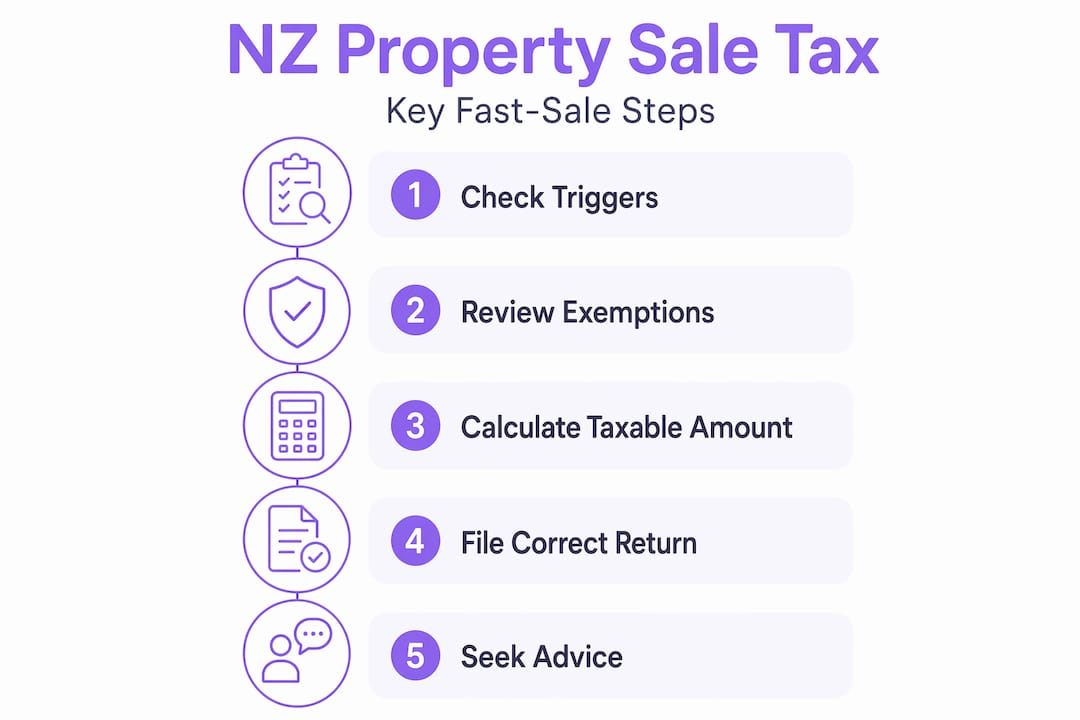
Tax on taxable property profits is charged at marginal income tax rates, up to 39% for the highest earners. This means the amount of tax you pay depends on your total income for the year, not just the property profit. Allocation rules under GC20 and GC21 also bind both the buyer and seller to the agreed price splits specified in the sale and purchase agreement for tax purposes.
Key points for urgent sellers to consider before signing:
- Know your marginal rate: If your combined income including the property gain puts you in the 39% bracket, nearly four dollars in every ten of profit go to IRD. Planning your sale timing around the tax year can sometimes reduce this.
- Specify allocations in the sale agreement: If you are selling a property with chattels (appliances, light fittings, and so on), the agreed value of chattels affects both your income tax and the buyer’s depreciation position. Both parties are bound by the figures in the agreement.
- No distressed-sale discount from IRD: IRD does not offer reduced rates because you are selling under financial pressure. The standard rules apply regardless of urgency.
- Ring-fencing prevents loss offsetting: If your property sale results in a loss, you cannot use it to reduce your salary tax that year. The loss waits until you have a future taxable property gain.
Pro Tip: To minimise fees when selling your home, consider direct sale options that avoid agent commissions. Combining this with accurate tax planning means more money stays in your pocket after settlement.
What most urgent sellers miss about property taxation
After working with many homeowners in difficult situations, we have observed a consistent pattern: most people focus on the bright-line test and forget about the intention-to-resell rule entirely.
The intention-to-resell rule is particularly far-reaching. If you bought a property with the purpose of selling it for a gain, that intention triggers tax regardless of how long you hold it. A seller who bought a rundown property two years ago, renovated it while living there, and now needs to sell due to illness could face tax liability if their original intention was to profit from the sale, even if it has become their main home. The bright-line exemption does not override a proven intention to resell.
Mixed-use properties create another layer of confusion. A property that was partly rented and partly owner-occupied must be apportioned carefully. Many sellers guess at the split or use the wrong basis, leading to either an underpayment (which IRD will catch) or an overpayment (which means leaving money on the table). Neither outcome is acceptable when you are already under financial strain.
Ring-fencing of losses is also regularly misunderstood. Sellers who make a loss on an urgent sale sometimes expect it to reduce their overall tax bill for the year. It does not. The loss is preserved for future property gains, which may never eventuate. For someone exiting the property market permanently, that ring-fenced loss is effectively unused.
The hard truth is that immediate financial hardship does not change the tax rules. What it should do is prompt you to get specialist advice early, document your property use accurately, and structure your sale agreement thoughtfully. Reviewing a no-agent sale guide NZ can help you understand your options before you commit to any particular sale method.
How we make urgent, tax-smart sales easier for you
Navigating property tax rules while managing financial stress or property damage is genuinely challenging. You need a sale process that is fast, transparent, and supportive of your specific circumstances.

At easySale.co.nz, we work with homeowners across New Zealand who need to sell quickly and with confidence. Whether you are planning a retirement or downsizing sale or simply need a stress-free sale process that removes the uncertainty of the open market, we provide a direct cash offer with no agent commissions and no hidden costs. Our three-step process means you submit your property details, receive a no-obligation offer, and settle on a timeline that works for you. We buy properties in any condition, so damage or urgency is never a barrier to getting a fair outcome.
Frequently asked questions
What triggers tax on a New Zealand property sale?
Bright-line rules, intention to resell, and business activity are the primary tax triggers, not simply how quickly you sell. Most main home sellers who have owned their property for more than two years will owe nothing.
Are urgent or distressed sales automatically exempt from property tax?
No, hardship is not a special exemption. Only specific circumstances such as main home use or disaster-damaged properties qualify for relief under the bright-line test.
How are mixed-use properties taxed when sold urgently?
Taxes are apportioned based on main home and rental use, and only the main home portion may be exempt. You must calculate the split carefully using both time and floor area.
What happens if you make a loss on an urgent property sale?
Losses from bright-line sales are ring-fenced and can only offset profits from future taxable property sales, not your wages or other income in the current year.
Do you need to pay GST when selling your main home quickly?
Not unless you are in a property business where turnover exceeds $60,000 per year. Standard homeowner sales are outside the GST system entirely.
Recommended
