
Selling inherited NZ property: Probate, timeline, and cash-out

TL;DR:Selling inherited property in New Zealand requires obtaining probate, a legal process confirming the executor’s authority. Probate is mandatory for sole-owned real estate, regardless of estate size, and no sale can legally proceed without it. Proper preparation during the probate wait can significantly speed up the estate settlement and property sale process.
Many inheritors are surprised to learn that selling a deceased loved one’s property in New Zealand is not as straightforward as listing and accepting an offer. Most people assume they can list and sell immediately after a family member passes. The reality is that probate is mandatory for selling inherited property in NZ if the deceased owned real estate in their sole name, regardless of the estate’s total value. This article explains exactly what probate is, when it applies, how it shapes your sale timeline, and what you can do right now to prepare for a fast, clean cash sale the moment legal authority is granted.
Table of Contents
- What is probate and why does it matter for NZ property?
- When is probate required for inherited New Zealand property?
- How the probate process affects property sales: Timeline and pitfalls
- Streamlining the sale: What you can do while waiting for probate
- A fresh take: What most guides miss about probate and fast property sales
- Bridging inheritance and a speedy property sale
- Frequently asked questions
Key Takeaways
| Point | Details |
|---|---|
| Probate is mandatory | Most sole-owned inherited NZ property cannot be sold until probate is granted by the High Court. |
| Timeline delays inevitable | Probate and estate administration usually add weeks to months before a sale and cash-out is possible. |
| Some exceptions exist | Jointly owned property and very small estates may bypass probate, but this is uncommon for homes and land. |
| Preparation speeds up sale | Getting legal documents and property ready during probate makes for the fastest post-grant sale. |
| Cash buyers streamline process | Engaging experienced agents or direct cash buyers post-probate can cut selling time down to weeks. |
What is probate and why does it matter for NZ property?
Probate is a legal process that most inheritors and executors encounter for the first time during an already stressful period. Understanding it clearly makes the entire process far less overwhelming.
Probate is a High Court order confirming the validity of a will and granting the executor the legal authority to administer the estate. This includes paying debts, distributing assets, and dealing with any property the deceased owned. Without that court order, an executor has no formal legal standing to act on behalf of the estate, particularly when real estate is involved.
“Probate provides the formal legal framework that allows an executor to manage and ultimately sell or transfer real property on behalf of a deceased estate.”
The stakes are high when property is concerned. Property cannot be sold until probate is granted, and certified copies of the probate order are needed for Land Information New Zealand (LINZ) to transfer the title into the buyer’s name. Without those certified copies, no title transfer can occur, meaning no settlement can take place, no matter how eager the buyer is.
This is the part that catches most people off guard. You might have an interested buyer lined up, or even a cash offer in hand, but you cannot legally complete the sale until probate is in place. For more details on how this works step by step, see this guide on probate and property sale explained.
Key powers that probate grants the executor include:
- The legal authority to sign sale and purchase agreements on behalf of the estate
- The right to instruct solicitors to transfer title at LINZ
- The ability to access bank accounts, pay outstanding rates, and settle mortgages
- The authority to distribute net proceeds to beneficiaries in accordance with the will
Without these powers confirmed by the court, every action you take as an executor is technically unauthorised. That is why probate is not optional paperwork, it is the legal foundation of the entire sale process.
When is probate required for inherited New Zealand property?
Knowing whether probate is required in your specific situation saves you time and avoids unnecessary legal costs. The rules are clear in most cases, though there are some important exceptions worth understanding.
When probate is always required:
Probate is mandatory for selling inherited property in NZ when the deceased owned real estate in their sole name. It does not matter how small or large the estate is. A single residential property, even a modest one, triggers the probate requirement the moment it is solely owned by the deceased.
When probate is not required:
Jointly owned property passes automatically to the surviving owner and bypasses probate entirely. This is called joint tenancy, and it operates by the principle of survivorship. The surviving owner simply provides a death certificate to update the title at LINZ. No court order is needed.
It is also worth noting that the $40,000 per institution threshold applies only to financial assets like bank accounts. Real property is always subject to probate if solely owned, regardless of its value. A $150,000 bach and a $2 million Auckland home are treated exactly the same way under this rule.
| Ownership type | Probate required? | Notes |
|---|---|---|
| Sole ownership (land or house) | Yes, always | Regardless of property value |
| Joint tenancy | No | Passes to survivor automatically |
| Tenancy in common | Yes | Each owner’s share requires probate |
| Property held in a trust | No | Trust deed governs, not probate |
| Māori land | Different process | Māori Land Court has jurisdiction |
| Financial assets under $40k per institution | No | Does not apply to real property |
Step-by-step: Determining if you need probate
- Identify how the property was legally owned. Check the property title at LINZ or ask a solicitor.
- Confirm whether the title shows sole ownership, joint tenancy, or tenancy in common.
- If sole ownership or tenancy in common, probate is required before any sale.
- If joint tenancy, notify LINZ with the death certificate to update the title.
- For Māori land or trust-held properties, seek specialist legal advice specific to those structures.
Pro Tip: Get a copy of the property title early. It is available from LINZ and clearly shows the ownership type. This single document tells you immediately whether probate is required and saves time at the first solicitor’s meeting.
For a more detailed walkthrough, review the steps to sell inherited home in New Zealand.
How the probate process affects property sales: Timeline and pitfalls
Understanding the timeline involved helps you plan realistically and avoid expensive mistakes. Many executors underestimate how long the full process takes, or make decisions too early that create legal and financial complications.

| Stage | Typical timeframe | Key action |
|---|---|---|
| Death to probate application | 2 to 6 weeks | Gather will, assets list, death certificate |
| Probate grant from High Court | 2 to 8 weeks | Court processes application |
| Post-probate property marketing | 4 to 12 weeks | List property or engage cash buyer |
| Conditional sale and due diligence | 2 to 4 weeks | Buyer satisfies conditions |
| Claims period | 6 months from probate | Do not distribute before this ends |
| Final distribution to beneficiaries | After claims period | Net proceeds divided per will |
A straightforward probate grant takes 2 to 8 weeks, but the full estate administration, including the legally required six-month claims period, typically runs 6 to 12 months from the date of probate. This longer window exists to allow anyone with a valid claim against the estate to come forward. Creditors, dependants, and others with a legal interest have the right to file claims during this time.
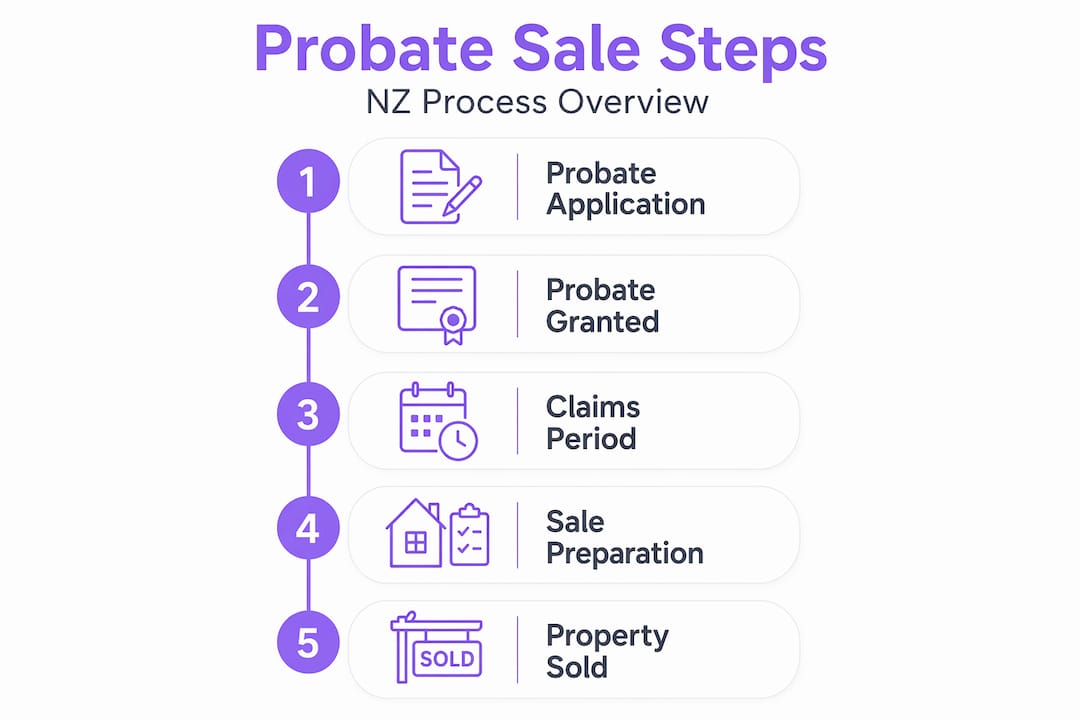
Executors risk personal liability if they distribute assets before the six-month claims period has elapsed. This means even if the property sells quickly, distributing the proceeds to beneficiaries too soon can expose the executor to personal financial risk if a claim surfaces afterward. The executor would then be personally responsible for meeting that claim.
Equally, signing a sale and purchase agreement before probate is granted is risky and not advised by legal professionals. If probate is delayed or complicated, you could find yourself in breach of a signed contract with a buyer.
Common mistakes to avoid as an executor:
- Signing any sale contract before the probate grant is in hand
- Paying beneficiaries from sale proceeds before the six-month claims period ends
- Failing to maintain the property during the probate wait, which can affect sale value
- Not paying ongoing property costs like rates and insurance from estate funds
- Assuming the process will be simple if the will appears straightforward
To keep the process on track, work with a solicitor experienced in estate administration from the outset. Review the fast-track sale timeline and understand the property sale speed factors that most affect inherited properties.
Streamlining the sale: What you can do while waiting for probate
The probate wait does not have to mean wasted time. Smart executors use this period to prepare the property thoroughly, so the moment probate is granted, they are ready to move quickly.
For quick cash sales of inherited NZ property, the probate wait is unavoidable for sole-owned real estate, but effective preparation during this time can significantly reduce delays after legal approval arrives. Cash buyers can typically settle within 2 to 4 weeks of making an offer, making them a highly efficient option for executors who want to close the sale and move toward final distribution as soon as possible.
Here is what you can do right now:
- Clear and clean the property. Remove personal belongings, arrange for furniture disposal or storage, and ensure the property is presentable. This makes it easier to assess value and attract buyers quickly.
- Complete basic maintenance. Fix obvious issues such as leaking taps, broken windows, or overgrown gardens. You do not need to renovate, but a well-maintained property attracts stronger interest.
- Gather all relevant paperwork. Collect the Certificate of Title, rates notices, insurance documents, any building consents or compliance certificates, and records of recent work done on the property.
- Get a property valuation. An independent valuation gives you and the beneficiaries a realistic price expectation and helps you evaluate any offers you receive post-probate.
- Research your sale options. Understand the difference between traditional agency sales, private sales, and direct cash buyers. Each has different timeframes, costs, and processes.
- Identify a preferred buyer type early. If speed and simplicity are priorities, engaging a cash buyer before probate is finalised means you can accept and settle an offer very quickly once legal authority arrives.
- Notify relevant parties. Inform utility companies, the council, and the property insurer of the change in ownership situation. Ensure the property remains insured throughout the estate administration period.
Explore your property sale options and consider reading about why sell inherited property fast to understand the financial and practical reasons many executors choose a direct cash sale over a traditional listing.
A fresh take: What most guides miss about probate and fast property sales
Most articles about probate and inherited property sales focus heavily on the legal steps, and understandably so. But there is a practical reality that legal guides rarely address directly: the biggest delay in most inherited property sales is not the probate process itself. It is the time lost after probate is granted because the executor was not prepared.
We have seen estates where the probate grant arrived within five weeks, but the property did not sell for another six months. The reason was not the law. It was that nobody had cleared the property, there were unresolved maintenance issues, and the executor had not yet decided between an agent and a direct sale. All of that preparation work then had to happen after probate, adding months to the timeline.
The executors who move fastest are the ones who treat the probate waiting period as an active preparation phase, not a pause. They clear the property, gather documents, get a valuation, and often already have a cash buyer engaged and informed, so the moment the probate order arrives, a sale can proceed within days rather than months.
There is also a nuance around the six-month claims period that most guides present purely as a risk and a delay. That framing is accurate but incomplete. The claims period is also protection for you as an executor. If you distribute everything quickly and a valid claim surfaces, your personal liability can be significant. Honouring the claims window is not just legally required; it is genuinely in your interest.
The executors who achieve the best outcomes treat probate not as a bureaucratic obstacle but as a structured process with a clear end point. They use fast solutions for probate sales to plan around the timeline intelligently, rather than being caught off guard by each stage.
Bridging inheritance and a speedy property sale
If you are navigating probate and want to move from legal approval to a completed sale as efficiently as possible, a direct cash buyer can make a significant difference. Once your probate is granted, the process of settlement does not need to take months.

At easySale.co.nz, we work specifically with executors and inheritors across New Zealand who want a straightforward, no-commission cash sale. You submit your property details, receive a fair no-obligation offer, and settle on a timeline that suits your estate administration. There are no open homes, no agent negotiations, and no drawn-out conditional processes. Whether the property needs work or is in excellent condition, we can make an offer. If you are ready to explore a direct NZ house sale for inheritors or simply want to understand your options, visit easySale.co.nz to get started today.
Frequently asked questions
Can inherited property in NZ be sold before probate is granted?
No, property cannot be legally sold until probate is granted, as certified copies are needed for Land Information NZ to transfer the title to a buyer.
How long does it usually take to get probate for NZ property?
A straightforward grant takes 2 to 8 weeks, but full estate administration including the six-month claims period typically runs 6 to 12 months before distribution can occur.
Does joint ownership of property require probate in NZ?
No, jointly owned property passes automatically to the surviving owner under joint tenancy and does not require a probate order.
What if there is no will for the deceased’s NZ property?
If there is no will, Letters of Administration must be obtained instead, following a process very similar to probate before any property sale can proceed.
Are there exceptions where probate is not required to sell NZ property?
Only jointly owned property and small estates without real estate may avoid probate, as the $40,000 financial asset threshold does not apply to real property, which always requires probate when solely owned.
Recommended
