
The role of chattels in property sales: a 2026 guide


TL;DR:Chattels are movable personal items not automatically transferred in property sales unless explicitly listed in the contract. Fixtures are permanently attached items that transfer with the property by default, and accurate listing prevents disputes. Sellers should carefully review and specify all included or excluded items to ensure clear legal responsibilities and avoid costly settlement conflicts.
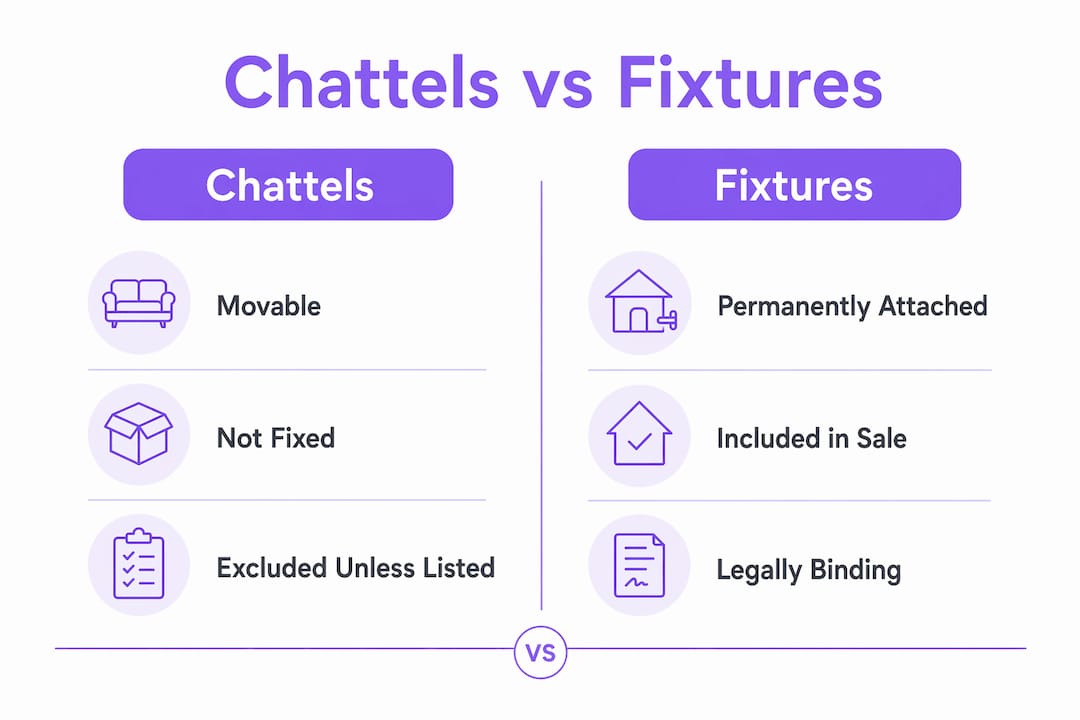
Chattels are defined as movable personal property items that do not automatically transfer to a buyer when a property is sold. In New Zealand property law, the role of chattels in property sale contracts is to identify exactly which movable items are included or excluded from a transaction. Without an explicit listing in the signed contract, chattels legally remain the seller’s property and can be removed before settlement. Fixtures, by contrast, are permanently attached to the property and transfer with it by default. Common chattels include freestanding appliances, furniture, rugs, and potted plants. Fixtures include built-in ovens, taps, light fittings, and sheds. Getting this distinction right protects both sellers and buyers from costly disputes at settlement.
How do chattels affect property sale contracts and legal obligations?
The foundational legal principle governing chattels in New Zealand is straightforward: fixtures are included in a sale unless explicitly excluded, and chattels are excluded unless explicitly included. This single rule is the source of most settlement disputes, and understanding it saves you real money and stress.
The Schedule of Chattels is the section of a sale and purchase agreement where all movable items to be included in the sale are listed by name. If a chattel does not appear on this schedule, it has no legal standing in the transaction. Marketing materials do not constitute legal promises. A freestanding washing machine photographed in a listing brochure carries no contractual weight unless it appears in the Schedule of Chattels. Buyers who rely on photos or verbal assurances from agents risk arriving at settlement to find those items gone.
Common disputes arise from items that seem obvious but are legally ambiguous:
- A freestanding fridge included in marketing photos but not listed in the contract
- Curtains and blinds that a buyer assumed were staying
- A garden shed that the seller intended to take
- A spa pool sitting on a deck but not bolted down
Contract terms override informal understandings or marketing presentations without exception. Misclassification or vague wording in the schedule can expose sellers to legal claims if a buyer argues an item was represented as included. For sellers, the safest approach is to list every item you intend to include and every item you intend to remove, leaving no room for interpretation.
Pro Tip: Review your Schedule of Chattels before signing, not after. Walk through the property with your solicitor and physically note every item you plan to take or leave. This takes 20 minutes and can prevent weeks of legal dispute.
You can read more about your legal obligations when selling to understand how contract clauses interact with chattel schedules in practice.
What is the difference between chattels and fixtures, and why does it matter?
The legal test for distinguishing a chattel from a fixture comes down to two questions: how fixed is the item, and what was the intended purpose of attaching it? These are known as the degree of annexation and the purpose of annexation tests.

Degree of annexation asks how physically attached an item is to the property. An item bolted to the wall, plumbed into the water supply, or wired into the electrical system is more likely to be a fixture. An item resting on the floor under its own weight is more likely to be a chattel. Purpose of annexation asks whether the item was attached to improve the property permanently or simply for the item’s own use. Items bolted or plumbed in to improve the property are classified as fixtures; otherwise they are chattels.
The grey areas are where disputes happen. Split-system air conditioners are a classic example. The outdoor compressor unit is bolted to an exterior wall and connected to refrigerant lines, which suggests a fixture. The indoor unit is mounted on an interior wall. Most legal practitioners treat split-systems as fixtures due to their permanence, but this is not universal. Curtain poles present a similar problem: the pole itself is screwed into the wall (fixture-like), but the curtains hanging from it are clearly chattels.
The table below shows how common household items are typically classified:
| Item | Classification | Reason |
|---|---|---|
| Built-in oven | Fixture | Permanently wired or plumbed in |
| Freestanding fridge | Chattel | Not attached to the property |
| Light fittings | Fixture | Wired into electrical system |
| Curtains and blinds | Chattel | Hung and removable without damage |
| Split-system air conditioner | Fixture (usually) | Bolted and plumbed in for permanence |
| Potted plants | Chattel | Movable, not planted in ground |
| Garden shed (bolted down) | Fixture | Attached to a concrete base |
| Freestanding bookshelf | Chattel | Resting under its own weight |
The practical implication for sellers is clear. If you want to take an item that could reasonably be interpreted as a fixture, list it as excluded in the contract. If you want a buyer to receive an item that could be interpreted as a chattel, list it as included. Grey area items commonly cause settlement disputes, and the only reliable protection is explicit contract wording.
Pro Tip: If you are unsure whether an item is a chattel or a fixture, treat it as disputed and list it explicitly in the contract either way. The cost of a brief legal conversation is far less than the cost of a settlement dispute.
How do chattels affect property sale taxation and valuation?
The impact of chattels on property taxation is a point many sellers overlook until it is too late. In New Zealand, the total sale price of a property must be apportioned between the real property value and the value of any chattels included in the sale. This apportionment affects the calculation of Land Transfer Tax obligations and is subject to scrutiny by Inland Revenue.
Chattels are valued separately from the property for tax calculations, and this separation is a legal requirement. The apportionment must be “just and reasonable,” meaning it must reflect genuine open market values for each item. You cannot assign $40,000 worth of value to a freestanding dishwasher and a set of curtains to reduce the taxable property value. Tax authorities review valuations against open market comparisons, and inflated chattel values are a known audit trigger that can result in penalties for both parties.
The table below illustrates how chattel valuation affects a hypothetical sale:
| Sale component | Assigned value | Notes |
|---|---|---|
| Real property (land and building) | $850,000 | Subject to Land Transfer Tax |
| Chattels (appliances, blinds, furniture) | $15,000 | Valued at open market rates |
| Total sale price | $865,000 | Apportionment must be documented |
Sellers sometimes receive advice to inflate chattel values as a tax-reduction strategy. This approach carries serious risk. Inland Revenue requires that valuations reflect genuine market value, and a chattel schedule that assigns $30,000 to a second-hand fridge and a set of curtains will not survive scrutiny. Work with your solicitor or a registered valuer to assign accurate, defensible values to included chattels. You can find a useful overview of your property sale tax obligations to help you prepare accurate documentation before settlement.
One further point worth noting: real estate commissions are typically calculated on the real property value, not the total sale price including chattels. Including a fridge and a washing machine in your sale may add perceived value for buyers, but it will not increase the commission your agent earns.
What practical steps should sellers take regarding chattels?
Getting chattels right in a property sale comes down to preparation and documentation. The following steps give you a clear process to follow before you sign anything.
- Walk through the property and make a list. Before you engage an agent or solicitor, physically walk through every room and note every item you intend to take and every item you are willing to leave. Be specific. “Fridge” is not enough. Write “Samsung side-by-side fridge, model RF28R7351SR, located in kitchen.”
- Verify ownership before listing. If an item is on hire purchase, leased, or subject to a finance agreement, you cannot include it as a chattel in the sale without the financier’s consent. Listing an item you do not fully own creates a legal liability at settlement.
- Confirm condition and working order. Chattels are sold without warranty by default, meaning the legal standard is possession, not guaranteed function. If you want to protect yourself from post-settlement claims, include a condition clause in the contract specifying that chattels are sold as-is.
- Negotiate inclusion or exclusion clearly. If a buyer wants an item you planned to take, that is a negotiation point with real dollar value. Do not give it away informally. Have your solicitor document any agreed changes to the chattel schedule in writing before the contract is signed.
- Never rely on marketing photos or verbal promises. Reliance on marketing photos or verbal assurances carries no legal weight at settlement. If it is not in the signed contract, it does not exist as a legal obligation.
- Get your solicitor to review the schedule. A property solicitor can identify ambiguous items, flag ownership issues, and confirm that your chattel schedule is legally sound before you sign. This is not an optional step.
For sellers considering a sale in any condition, understanding how chattels interact with the overall transaction is covered in detail in this guide to selling property in any condition.
Key takeaways
The signed Schedule of Chattels is the only legally binding document that determines which movable items transfer with a property at settlement.
| Point | Details |
|---|---|
| Chattels require explicit inclusion | Any movable item not listed in the contract stays with the seller, regardless of marketing or verbal agreements. |
| Fixtures transfer by default | Permanently attached items like built-in ovens and light fittings are included in the sale unless explicitly excluded. |
| Valuation must be accurate | Chattel values must reflect genuine open market rates to satisfy tax authority requirements and avoid penalties. |
| Grey areas need explicit listing | Items like split-system air conditioners and curtain poles should always be named in the contract to prevent disputes. |
| Condition is sold as-is | Unless the contract states otherwise, chattels are delivered without a warranty of working condition. |
Chattels are where deals quietly fall apart
I have seen more settlement disputes trace back to chattels than to any other single issue in a property sale. Not price. Not building reports. Chattels. And almost every one of those disputes was preventable.
The pattern is always the same. A seller assumes the buyer knows they are taking the freestanding spa pool. The buyer assumes it is staying because it was in every marketing photo. Neither party says anything until three days before settlement, and suddenly you have lawyers involved, a delayed settlement, and two people who were perfectly happy with the deal now genuinely angry at each other.
What I have found is that sellers tend to underestimate how much buyers attach emotional significance to items they saw during open homes. A buyer who fell in love with a property partly because of the built-in bookshelves in the study will feel genuinely deceived if those shelves disappear before settlement, even if they were technically chattels all along. That emotional reaction turns into a legal dispute faster than most people expect.
The fix is not complicated. It is just discipline. List everything. Be specific. Do not leave a single item to assumption. Your solicitor’s job is to make the contract airtight, but they can only work with the information you give them. If you walk into that conversation with a detailed list, you walk out with a clean contract. If you walk in assuming “the obvious stuff is obvious,” you are setting yourself up for a problem.
My honest advice: treat the chattel schedule as seriously as you treat the sale price. Both have real financial consequences, and both deserve your full attention before you sign.
— Aaron
Sell your property without the chattel headaches
If you are selling a property and want to avoid the complexity of chattel negotiations, condition disputes, and contract fine print, Easysale offers a straightforward alternative. Easysale buys properties across New Zealand in any condition, with a clear cash offer and no agent commissions involved.

There is no need to worry about what stays and what goes. When you sell to Easysale, the process is transparent and the terms are agreed upfront. You choose the settlement timeline, and Easysale handles the rest. Whether your property has items you want to leave behind or a situation that makes a traditional sale complicated, Easysale’s fair cash offer service is built for exactly that kind of sale.
FAQ
What are chattels in a property sale?
Chattels are movable personal property items that do not automatically transfer to a buyer when a property is sold. They must be explicitly listed in the sale and purchase agreement to be legally included at settlement.
Do chattels affect the sale price of a property?
Yes. Chattels included in a sale add to the total transaction value, but they must be valued separately from the real property. The apportionment between property value and chattel value must be just and reasonable to satisfy tax authority requirements.
What happens if a chattel is not listed in the contract?
If a chattel is not listed in the Schedule of Chattels, it legally remains the seller’s property and can be removed before settlement. Marketing photos and verbal promises carry no legal weight without contract documentation.
Are chattels sold with a warranty of working condition?
No. The legal default is that chattels are sold as-is without a warranty of working condition. If you want condition protections, these must be written into the contract explicitly.
How do I know if an item is a chattel or a fixture?
Apply the two-part test: how physically attached is the item, and was it attached to permanently improve the property? Items bolted or plumbed in for the property’s benefit are generally fixtures. Items resting under their own weight or easily removed are generally chattels. When in doubt, list the item explicitly in the contract either way.


