
The role of legal advice in property sale

TL;DR:Many Kiwi homeowners mistakenly believe legal advice is only necessary at settlement, risking costly errors. Engaging a lawyer early in the property sale process can identify legal risks, review contracts, and protect your interests before binding commitments are made. Proper legal guidance throughout each stage ensures smoother transactions, especially in complex situations like trusts or disputes.
Most Kiwi homeowners assume legal advice only matters when the paperwork is piling up at settlement. That assumption is one of the most common and costly mistakes you can make. The role of legal advice in property sale is not a final-step formality. It shapes your outcomes from the moment you decide to sell. Many homeowners miss risks early because they bring in legal support too late, leaving themselves exposed to binding obligations they didn’t fully understand when they signed.
Table of Contents
- Key takeaways
- The NZ property sale process and legal milestones
- Why legal advice before signing matters
- Lawyers vs conveyancers: who do you need?
- Legal support for sellers: from listing to settlement
- My perspective on legal advice in property sales
- Sell your property with the right support
- FAQ
Key takeaways
| Point | Details |
|---|---|
| Engage legal advice early | Get a lawyer involved before you sign any agreement, not just at settlement. |
| Know the legal milestones | Property sales in NZ move through distinct stages where legal errors can be costly. |
| Lawyers vs conveyancers differ | Conveyancers handle simple transfers; lawyers manage complex situations like trusts. |
| Pre-signing review saves money | A lawyer can spot red flags before you’re locked into a binding contract. |
| Sellers have specific legal duties | Understanding your obligations around agency agreements and disclosure protects you. |
The NZ property sale process and legal milestones
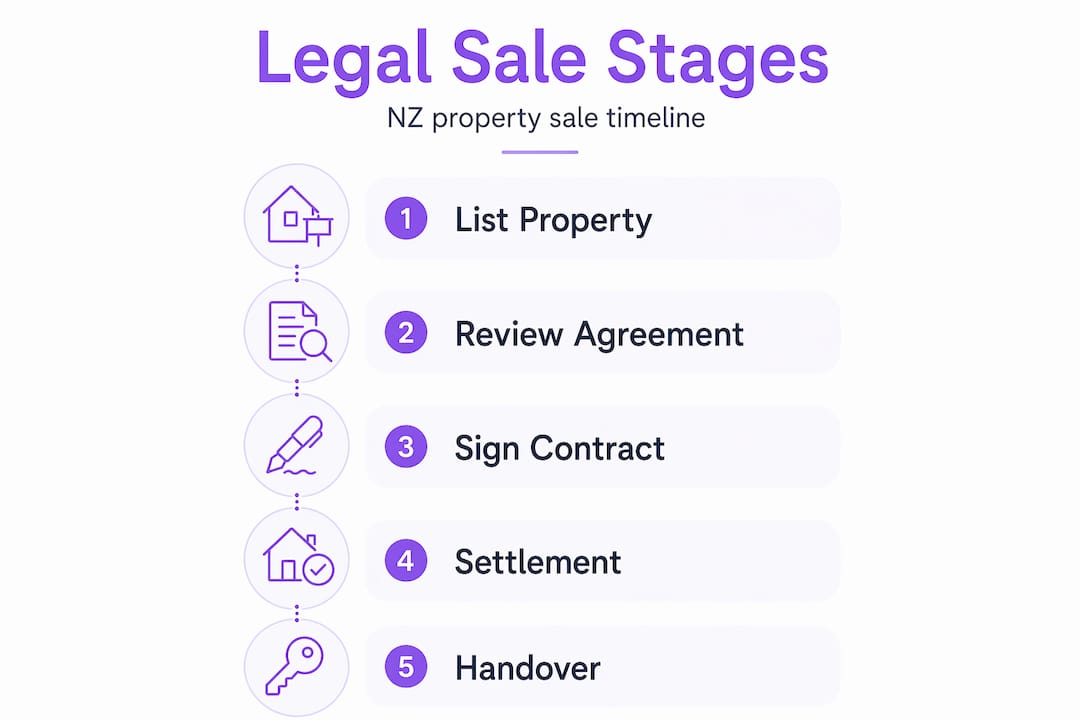
Understanding where legal issues can surface starts with understanding the overall process. A typical NZ property sale moves through six key stages, each carrying its own legal weight.
- Listing and agency agreement. Before your property hits the market, you sign an agency agreement with a real estate agent. This is a legally binding document that sets out your obligations, commission structure, and the agent’s authority to act on your behalf.
- Marketing and offers. Buyers view your property and submit offers. Each offer typically arrives as a Sale and Purchase Agreement, which is the most important document in the entire transaction.
- Negotiation and conditions. Offers are often conditional, meaning they include conditions such as finance approval or a satisfactory building inspection. Both parties negotiate terms before agreeing.
- Due diligence period. Once conditional agreement is reached, the buyer carries out checks. This is where building reports, LIM reports, and title searches happen.
- Going unconditional. When all conditions are met, the agreement becomes unconditional. At this point, both parties are legally bound to complete the sale.
- Settlement. The final stage involves transferring the title, discharging any mortgage, and exchanging funds.
NZ property conveyancing typically takes between 12 and 20 weeks, with delays often caused by property chains or missing documentation. That’s a significant window of time during which legal issues can emerge at any stage.
The Sale and Purchase Agreement deserves special attention. It is not a casual form. It is a contract with specific clauses, conditions, and legal obligations attached to every line. The conditions you include or exclude at this stage will directly affect your rights if something goes wrong later.
| Stage | Legal consideration | Consequence if missed |
|---|---|---|
| Agency agreement | Seller obligations and commission terms | Unexpected fees or locked-in obligations |
| Offer and negotiation | Contract terms and conditions | Binding terms you didn’t intend to accept |
| Due diligence | Title issues, covenants, easements | Delayed or collapsed sale |
| Unconditional agreement | Both parties fully bound | No exit without significant cost |
| Settlement | Title transfer and mortgage discharge | Ownership disputes or financial loss |
Why legal advice before signing matters
This is where the role of legal advice in property sale becomes genuinely powerful, and where most sellers miss out by acting too late.

Once a contract becomes unconditional, it is binding. Errors are expensive to fix. A lawyer who reviews the Sale and Purchase Agreement before you sign can catch problematic clauses, suggest protective conditions, and flag terms that don’t serve your interests. After you sign, your options narrow sharply.
Here is what a lawyer will typically assess before you sign:
- Finance and building inspection conditions. A lawyer advises on whether these conditions are worded to genuinely protect you, or whether they’re vague enough to create disputes.
- Settlement date and possession terms. If the settlement timeline doesn’t work for your situation, your lawyer can negotiate adjustments before you’re locked in.
- Title issues. Lawyers review title, LIM, and agreement for covenants, easements, and unconsented works that could complicate or even collapse the sale.
- Price and retention clauses. If a building report reveals defects, lawyers negotiate price reductions or retention of funds to cover remediation costs. This is where legal support delivers real financial value.
- Seller warranties. Every Sale and Purchase Agreement includes representations about the property. A lawyer helps you understand what you’re warranting and where you might be exposed.
For sellers considering private house sales, knowing your legal obligations when selling property is not optional reading. It’s the foundation of a well-managed transaction.
Pro Tip: If you’re selling at auction, engage your lawyer before the auction date. Auction contracts are unconditional from the moment the hammer falls, so there is no opportunity to add protective conditions after the fact.
Lawyers vs conveyancers: who do you need?
Many sellers assume a conveyancer and a lawyer do the same job. They don’t. The distinction matters, and choosing the wrong one for your situation can leave you exposed.
Under the Lawyers and Conveyancers Act 2006, both professionals are qualified and licensed to handle property conveyancing. However, their scope of practice differs significantly.
| Professional | Scope of work | Best for |
|---|---|---|
| Licensed conveyancer | Standard title transfers and settlement documentation | Simple, straightforward property sales |
| Property lawyer | Full legal advice, contract review, disputes, trusts, relationship property | Complex ownership, contested sales, trust-held property |
Licensed conveyancers offer cost-effective services for simple transactions but cannot advise on broader legal matters. If your property is held in a trust, involves relationship property, or if a dispute arises during the sale, a conveyancer cannot help you. You need a lawyer.
Complex ownership situations legally require a lawyer rather than a conveyancer, particularly where trusts or relationship property are involved. This is not a preference. It’s a legal restriction on what conveyancers are authorised to do.
Pro Tip: If you’re unsure whether your sale is “simple,” err on the side of engaging a lawyer. The cost difference is often modest, and the protection is substantially greater.
One practical consideration worth raising: electronic signatures are legally valid under the Contract and Commercial Law Act 2017 in New Zealand. This means you can work with a lawyer or conveyancer remotely without losing any legal standing on your documents, which is convenient if you’re selling a property in a different region from where you live.
Legal support for sellers: from listing to settlement
The role of legal advice in property sale does not pause between signing and settlement. As a seller, you have specific legal duties at each stage that deserve proper attention.
Here’s how legal guidance supports you throughout the process:
- Reviewing the agency agreement. Before you authorise an agent to sell your property, a lawyer can review the agency agreement for any clauses that limit your flexibility or impose financial obligations you’re not aware of. Sole agency agreements, for instance, can lock you into paying commission even if you find your own buyer.
- Evaluating offers. When offers arrive, your lawyer reviews the terms with you. This includes checking the deposit conditions, settlement dates, and any special clauses the buyer’s solicitor has added.
- Responding to conditional offers. If a buyer’s building inspection raises concerns, your lawyer advises on whether to proceed, renegotiate, or exercise your rights under the contract. A lawyer’s most valuable work often happens here, well before settlement day.
- Preparing for settlement. Your lawyer coordinates mortgage discharge with your bank, prepares the transfer documents, and confirms the settlement statement is accurate. A small discrepancy in the settlement figures can cause delays that cost you money.
- Managing unexpected issues. Titles occasionally reveal surprises. Encumbrances, caveats, or disputes with neighbours can emerge late in the process. Your lawyer manages these issues without derailing the transaction.
For a detailed look at the NZ property sale timeline, knowing each stage in advance puts you in a far stronger position before anything goes wrong.
My perspective on legal advice in property sales
I’ve spoken with enough sellers to know that most people think legal advice in a property sale is just about paperwork. Get the documents signed, transfer the title, job done. That thinking costs people money, time, and sometimes the sale itself.
What I’ve learned is that the most useful thing a property lawyer does is work through the “what ifs” before they become “what happened.” What if the building report finds unconsented work? What if the buyer can’t meet the settlement date? What if the title has a restrictive covenant that affects how the next owner can use the property? A good lawyer doesn’t just process your transaction. They stress-test it before you’re committed.
I’ve seen sellers sign agency agreements without reading them, then find themselves liable for commission after a deal fell through under circumstances they assumed were excluded. I’ve seen sellers go unconditional without understanding what they’d warranted about the property, then face a dispute post-settlement. None of these situations were inevitable. They were entirely preventable with a single pre-signing consultation.
My honest take: the sellers who treat their lawyer as a strategic partner from day one consistently have smoother sales. Not because legal advice removes all problems, but because it means you go into each stage knowing exactly where you stand. That confidence is worth a great deal.
— Aaron
Sell your property with the right support
If the complexity of contracts, legal timelines, and settlement obligations feels like a lot to manage, you’re not alone. Many Kiwi homeowners want to sell without the paperwork marathon.

Easysale works with homeowners across New Zealand to make property sales genuinely straightforward. Whether you’re dealing with a challenging property, a time-sensitive situation, or simply want to avoid the traditional process, Easysale offers a fast, fair cash offer with no agent commissions and no drawn-out negotiations. The process is clear: submit your details, receive your offer, and settle on your timeline. Visit Easysale to get started, or explore the dedicated retirement and downsizing service if you’re selling as part of a life change.
FAQ
When should I get legal advice when selling my home?
Engage a lawyer before you sign anything, including the agency agreement and the Sale and Purchase Agreement. Early legal involvement identifies risks before they become binding obligations.
What is the difference between a lawyer and a conveyancer in NZ?
Both are licensed under the Lawyers and Conveyancers Act 2006, but conveyancers can only handle standard title transfers. Lawyers can advise on trusts, relationship property, disputes, and complex ownership situations.
Can I sell my house without a lawyer?
While there is no law requiring you to use a lawyer, skipping legal advice exposes you to significant risk. Contracts are binding once signed, and errors can be costly to fix after the fact.
How long does the legal process take in a NZ property sale?
NZ property conveyancing typically takes 12 to 20 weeks from start to settlement, though delays from property chains or missing documents can extend this.
Does the role of legal advice in property sale apply to auction sales?
Yes, and it’s more urgent for auctions. Auction contracts are unconditional from the moment the hammer falls, so your lawyer must review the auction pack and terms before the auction date, not after.
Recommended
