
Understanding property compliance: a quick guide for Kiwi sellers

TL;DR:Selling property in New Zealand requires understanding council records, disclosures, and compliance issues. Sellers must disclose known defects and unconsented work to avoid legal and financial risks, with ordering a LIM report being the first crucial step. Options for quick sales include full disclosure, selling as-is to cash buyers, or targeted repairs and consents.
When you’re selling a property in New Zealand, understanding property compliance comes down to four things: your LIM report, building consents and Code Compliance Certificate (CCC), any known defects or unconsented work, and full disclosure to buyers and your agent. Get those four right and you’re in a strong position, regardless of how fast you need to settle.
Your fastest realistic options are:
- Sell with full disclosure — keep your buyer pool wide, but be prepared for price negotiation on any issues found.
- Sell as-is to a cash buyer — fastest path, fewer conditions, no agent commission, though typically at a lower price.
- Do targeted repairs or obtain retrospective consents — worthwhile only when fixing a specific issue unlocks a meaningful price uplift.
Authoritative guidance on each of these steps comes from the Real Estate Authority (REA), Settled, the New Zealand Law Society, and Easysale for fast cash-sale options.
Pro Tip: Before you do anything else, order your LIM. It’s the single document that tells you — and every serious buyer — what the council has on record for your property.
Table of Contents
- What does ‘property compliance’ actually cover in New Zealand?
- What you must disclose as a seller and why honesty matters
- Fast checks you can run before you list
- If you find problems: your realistic options for a fast sale
- How the sale and purchase agreement affects your liability
- Your one-page checklist to prepare for a fast sale
- Key takeaways
- Why honesty is the most practical strategy
- Easysale: a fast, no-agent path for Kiwi homeowners
- Useful New Zealand sources to check next
What does ‘property compliance’ actually cover in New Zealand?
Property compliance, in the New Zealand context, refers to the set of council records, legal obligations, and seller disclosures that buyers, their lawyers, and their lenders check before committing to a purchase. It’s not one document — it’s a collection of formal records and seller-known facts.
Formal council records buyers check:
- LIM report (Land Information Memorandum) — everything the council holds on your property: zoning, consents, drainage, hazards, and compliance history.
- Building consents and CCC — a building consent is the council’s permission to carry out work; the CCC is the council’s confirmation that the finished work met the New Zealand Building Code.
- Resource consents — required for certain land use changes or developments.
- Body corporate / unit title disclosures — under the Unit Titles Act 2010, sellers must provide pre-contract and pre-settlement disclosure statements; missing these can allow a buyer to cancel even an unconditional agreement.
Seller-known issues (not always on council records):
- Weathertightness problems or leaky-building history
- Unconsented alterations or additions
- Boundary disputes or encroachments
- Known structural defects
A LIM only records what the council has been told or has on file. If you’ve carried out work without a consent, or you know of a defect that was never reported, that information won’t appear on the LIM — but you’re still legally obliged to disclose it to buyers.
Settled guidance makes this clear: a clean LIM does not mean a clean slate for the seller.
What you must disclose as a seller and why honesty matters
Sellers and their agents are legally obliged to share all material information about a property. That includes weathertightness issues, unconsented work, natural-hazard damage, and anything else a buyer would reasonably want to know before signing.
Failing to disclose material information can lead to contract cancellation or court action. Settled.govt.nz is direct on this point: vendors and agents who withhold relevant information expose themselves to serious legal and financial consequences.
The risks of non-disclosure are real and worth taking seriously:
- Contract cancellation — a buyer who discovers undisclosed defects can walk away, even after going unconditional in some circumstances.
- Damages claims — misleading or false information can lead to re-negotiation or legal claims against you.
- Finance and insurance difficulties for buyers — which reduces your buyer pool and can collapse a sale at the last minute.
- Reputational risk — agents are bound by the REA Code of Professional Conduct; a seller who misleads an agent creates problems for everyone involved.
The govt.nz selling guide is equally clear: if you have doubts about what to disclose, get legal advice before you start marketing.
Fast checks you can run before you list
You don’t need weeks to get a clear picture of your property’s compliance position. A focused sequence of checks, done in the right order, gives you and your buyers confidence.
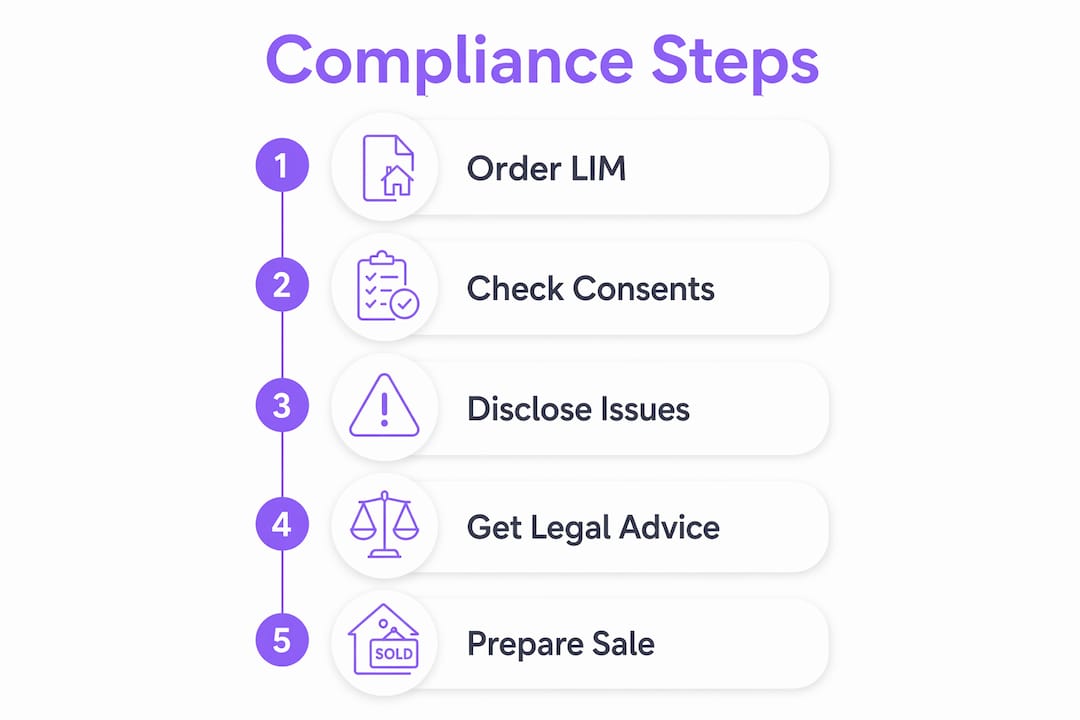
- Order a LIM report from your local council. This is the starting point recommended by govt.nz. Processing times vary by council, so order early.
- Request a consent and CCC search — ask the council for a list of all building consents issued for your property and whether each has a CCC. Any consent without a CCC will be flagged on the LIM.
- Pull your title and rates information from Land Information New Zealand (LINZ) or through your lawyer.
- Run a basic visual check — roof condition, gutters, signs of moisture or leaks, drainage around the foundation. You don’t need a builder for this first pass; you’re looking for anything you already know about.
- Gather your paperwork — consent certificates, CCC documents, warranties for appliances or roofing, body corporate minutes if relevant, and any tenancy agreements.
Results that require action before listing:
- Unconsented structural work (additions, garages, decks built without consent)
- Any building consent with no CCC issued
- Active council notices or requisitions on the property
Results that are usually manageable quickly:
- Minor chattels not in working order (disclose and adjust price)
- Rates arrears (settle before settlement)
Statistic callout: The REA Sale and Purchase Agreement guide notes that a deposit of around 10% of the purchase price is common in New Zealand transactions — understanding this upfront helps you plan your settlement timeline.
Pro Tip: If you want a quick sense of how compliance issues might affect your asking price, a free home valuation can give you a useful baseline before you commit to any repairs.
If you find problems: your realistic options for a fast sale
Finding a compliance issue doesn’t mean your sale is derailed. It means you need to choose the right path forward.

| Factor | Sell with full disclosure | Sell as-is to a cash buyer | Targeted repair / retrospective consent |
|---|---|---|---|
| Speed | Moderate (4 weeks typical) | Fast (can settle in days to weeks) | Slower (weeks to months depending on scope) |
| Likely price impact | Minimal if issues are minor; negotiation likely on major ones | Lower price, but certain | Best outcome if fix removes a finance barrier |
| Buyer accessibility | Broad buyer pool | Cash buyers only | Broad buyer pool post-fix |
| Paperwork required | Full disclosure documentation | Disclosure still required | Consent applications, builder records |
Option A — Sell with full disclosure. You keep access to the widest buyer pool, including those using mortgage finance. Price flexibility on known issues is usually preferable to legal exposure later. This works well when issues are minor or already documented.
Option B — Sell as-is to a cash buyer. Missing a CCC can prevent buyers from securing mortgage finance or insurance, which shrinks your buyer pool significantly. A cash buyer sidesteps that problem entirely. Settlement can happen on your timeline, with no agent commission.
Option C — Targeted repairs or retrospective consents. Worth considering when a specific fix, such as obtaining a CCC for an unconsented addition, would materially widen your buyer pool or remove a finance barrier. Get a builder’s quote and a realistic council timeline before committing.
Pro Tip: You still need to disclose known defects to a cash buyer. Transparency protects you legally regardless of the sale method.
How the sale and purchase agreement affects your liability
The Sale and Purchase Agreement is not a formality. It’s the document that defines your warranties as a seller and allocates risk between you and the buyer. New Zealand Law Society guidance is unambiguous: do not sign without independent legal advice.
Clauses that commonly create seller liability:
- LIM and consent conditions — buyers often include conditions requiring a satisfactory LIM; a missing CCC can trigger these.
- Chattels warranties — the standard agreement warrants that chattels are in reasonable working order at settlement.
- Building work warranties — the standard REINZ/ADLS agreement includes a warranty that all works comply with building codes and that required consents and CCCs have been obtained.
- Access for inspections — sellers must allow reasonable access; restricting this raises red flags.
- Unconditional offers — accepting an unconditional offer without legal review removes your ability to negotiate on issues discovered later.
Your single most important action before signing anything is to get independent legal advice. A property lawyer will review the agreement, identify warranty risks, and negotiate protections where needed.
Your one-page checklist to prepare for a fast sale
Use this before you list or accept any offer.
Documents to gather:
- LIM report (ordered from your local council)
- All building consents and CCC documents
- Title search and rates information
- Body corporate minutes and financial statements (if applicable)
- Warranties and receipts for significant work (roofing, plumbing, electrical)
- Tenancy agreements and bond lodgement receipts (if tenanted)
- Survey plan if boundary issues are a possibility
On-site checks:
- Roof, gutters, and downpipes (visible condition)
- Signs of moisture, staining, or leaks inside and out
- Condition of all chattels listed in the agreement
- Any additions or alterations you’re aware of (consented or not)
Disclosure to your agent or buyer:
- All known defects, even if not on the LIM
- Any unconsented work, regardless of age
- Any active council notices or disputes
- Weathertightness history if relevant
For document ordering: contact your local council for LIM and consent searches, LINZ for title information, and your body corporate manager for unit-title records. Allow extra time for LIM processing during busy periods.
Key takeaways
Transparency is your strongest legal protection when selling: disclose known issues early, get your LIM first, and never sign a Sale and Purchase Agreement without a lawyer’s review.
| Point | Details |
|---|---|
| Order your LIM first | It’s the primary record buyers and their lawyers check — get it before you market. |
| Lawyer review is non-negotiable | The Sale and Purchase Agreement defines your warranties; independent legal advice is the highest-impact step you can take. |
| Missing CCC affects your buyer pool | Without a CCC, buyers may struggle to get mortgage finance or insurance, which reduces demand and price. |
| Disclose everything you know | Settled guidance is clear: failing to disclose material information can lead to contract cancellation or legal claims. |
| Easysale offers a fast as-is path | For sellers who need speed, Easysale buys properties in any condition with no agent fees and flexible settlement. |
Why honesty is the most practical strategy
There’s a version of this story that plays out badly. A seller finds an unconsented deck addition during their pre-sale checks, says nothing, and lists the property. The buyer’s lawyer orders the LIM, spots the outstanding consent, and the buyer either walks or demands a price reduction far larger than the original fix would have cost. Worse, if the seller had already signed an agreement with building-work warranties, they’re now in breach.
The version that works is simpler. You find the unconsented work, you disclose it upfront, and you either price accordingly or get a builder’s quote to resolve it. Buyers who know about an issue before they sign are far less likely to use it as leverage after they’ve gone unconditional. The transparency role in home sales isn’t just ethical — it’s the more practical commercial strategy.
The fear of losing a few thousand dollars on price is real. The legal and transactional cost of a collapsed sale or a damages claim is almost always larger.
Easysale: a fast, no-agent path for Kiwi homeowners
If your checks have turned up compliance issues and you need to sell quickly, a cash-buyer service removes the most common friction points. Easysale buys residential properties across New Zealand in any condition, with no agent commission and settlement on your preferred timeline. You submit your property details, receive a no-obligation cash offer, and choose when to settle.

The trade-off is straightforward: you accept a price below open-market value in exchange for speed, certainty, and no fees. You still need to disclose known defects — transparency is required regardless of who you sell to — but Easysale’s process is built to handle properties with compliance issues, unconsented work, or missing CCCs without the delays a traditional sale would involve.
Ready to see what your property is worth? Get a fast cash offer from Easysale today, with no obligation and no agent involved.
Useful New Zealand sources to check next
These are the primary official sources for LIM orders, consent searches, disclosure guidance, and legal advice.
| Source | What it covers | Where to find it |
|---|---|---|
| Settled.govt.nz | Seller disclosure obligations, LIM guidance, unit-title rules | settled.govt.nz |
| Real Estate Authority (REA) | Agent licensing, Sale and Purchase Agreement guide, Code of Conduct | rea.govt.nz |
| New Zealand Law Society | Finding a property lawyer, legal obligations when selling | lawsociety.org.nz |
| MBIE / building.govt.nz | CCC requirements, homeowner rights and obligations, Building Act | building.govt.nz |
| govt.nz selling guide | Step-by-step selling overview, LIM ordering, agent obligations | govt.nz |
For LIM and consent searches, contact your local territorial authority directly. Processing times vary, so build this into your pre-listing timeline. For unit-title records, your body corporate manager is the first point of contact.
Recommended
