
What is a deemed value sale? A plain guide for NZ homeowners


TL;DR:A deemed value sale occurs when Inland Revenue treats property transfers as though they occurred at market value, regardless of the actual price received.Getting an independent valuation and documenting purchase-price allocation before transferring property is essential to protect your tax position.
A deemed value sale occurs when Inland Revenue (IRD) treats a property disposal as though it happened at full market value, regardless of what you actually received. If you transferred your home to a family member for $1, IRD can still assess you on the market value as if you sold it at arm’s length. The single most important step you can take before any transfer is to get an independent market valuation in writing before settlement.
Table of Contents
- What does “deemed market value” actually mean under NZ law?
- When does a deemed value sale apply to you?
- What taxes can you face when a sale is deemed at market value?
- How does Inland Revenue find and enforce deemed values?
- Homeowner checklist: what to do before you transfer or sell
- Valuation options in NZ: what they cost and how long they take
- What to do if Inland Revenue queries your sale
- How Easysale handles valuation and documentation in a fast cash sale
- Key takeaways
- The part most sellers get wrong
- Easysale: fast NZ cash offers with proper documentation
What does “deemed market value” actually mean under NZ law?
The Income Tax Act 2007 contains specific provisions that override the price you and a buyer agree on. Under sections GC 1 and FC 2, if you dispose of property for less than market value, the law deems you to have received an amount equal to that market value. The bright-line test, set out in IRD’s IR1229 guide, adds another layer: any residential land disposed of within the bright-line period may be taxed as income, and where the transfer is below market value, the deemed amount applies.
Key legal points to know:
- Section GC 1 deems the consideration received to equal market value when a disposal is for less than that amount.
- Section FC 2 treats certain transfers (including distributions in kind) as disposals and acquisitions at market value.
- The bright-line rules treat gains from residential land disposed of within the relevant period as taxable income.
- Rollover relief can prevent a deemed disposal becoming taxable in limited circumstances, such as certain relationship property transfers.
For a broader look at NZ property sale tax basics, it helps to understand these rules before you sign anything.
When does a deemed value sale apply to you?
Several common events trigger IRD’s deemed market value rules. Many homeowners are caught off guard because the trigger is not always an obvious “sale.”
- Associated-person transfers: Selling or gifting to a spouse, parent, child, or family trust at below market value. IRD treats these as disposals at full market value.
- Bright-line disposals: Transferring residential land within the bright-line period without an applicable exclusion triggers income tax on any deemed gain.
- Gifts and non-monetary transfers: A gift of property is still a disposal. No cash changing hands does not mean no tax.
- Changes of trustees: IRD Interpretation Statement IS-22-03 confirms that changes of trustees can constitute a disposal under the land sale rules, catching many homeowners by surprise.
- Co-ownership changes: Reducing your ownership share, even partially, can be a disposal to the extent of that reduction.
- Transfers on death: Under subpart FI, distributions and transfers on death are generally treated as disposals at market value unless rollover relief applies.
- Mixed-asset sales: When land and chattels are sold together, purchase-price allocation rules require the total price to be split across asset classes at relative market values. If you don’t record this in writing, IRD can impose its own allocation.
If your situation involves a family trust, understanding family trust property sales in NZ is worth reading before you proceed.
What taxes can you face when a sale is deemed at market value?
The tax consequences depend on whether the bright-line test or another land sale rule applies, but the mechanism is consistent: IRD calculates a deemed gain based on market value minus your cost base, and that amount becomes assessable income.
- Income tax on the deemed gain. If you transferred a property worth $800,000 to a family member for $400,000, IRD can deem you to have received $800,000. Your taxable gain is the difference between the market value and your original purchase price plus allowable costs.
- GST exposure. Where a property is used in a taxable activity or is a mixed supply (land plus commercial chattels), GST can apply to part of the deemed consideration. Careful allocation between asset classes matters here.
- Penalties and use-of-money interest (UOMI). If IRD reassesses your return, shortfall penalties of 20–40% of the unpaid tax can apply, plus UOMI on the outstanding amount from the original due date.
Worked example: You transfer your rental property (purchased for $500,000) to your adult child for $300,000 within the bright-line period. IRD deems the sale price to be $750,000 (market value). Your deemed gain is $250,000. At a marginal income tax rate of 33%, the tax liability is $82,500, before any penalties or interest.
Warning: Shortfall penalties and UOMI can add significantly to the base tax owed. Acting before settlement is always cheaper than responding to a reassessment.
How does Inland Revenue find and enforce deemed values?
IRD’s enforcement capability is more sophisticated than many homeowners expect. Baker Tilly Staples Rodway warns that IRD uses automated data matching and associated-person checks to identify below-market related-party transfers, and these transactions are a frequent audit trigger.
Common signs a transaction will attract scrutiny:
- No written purchase-price allocation when land and chattels are sold together.
- A sale price well below council valuation or recent comparable sales.
- A transfer between family members or to a trust within the bright-line period.
- No independent valuation on file at the time of transfer.
Enforcement outcomes IRD can impose include reassessment of income, shortfall penalties, and UOMI from the original return date. Adviser case notes show that chain transactions involving associated-party transfers have been taxed at market value with penalties applied after the fact.
Pro Tip: Keep a contemporaneous file note explaining why the price was set as it was. IRD looks for valuation evidence dated at or close to the transaction date; older valuations or informal agent estimates are far less defensible.

Homeowner checklist: what to do before you transfer or sell
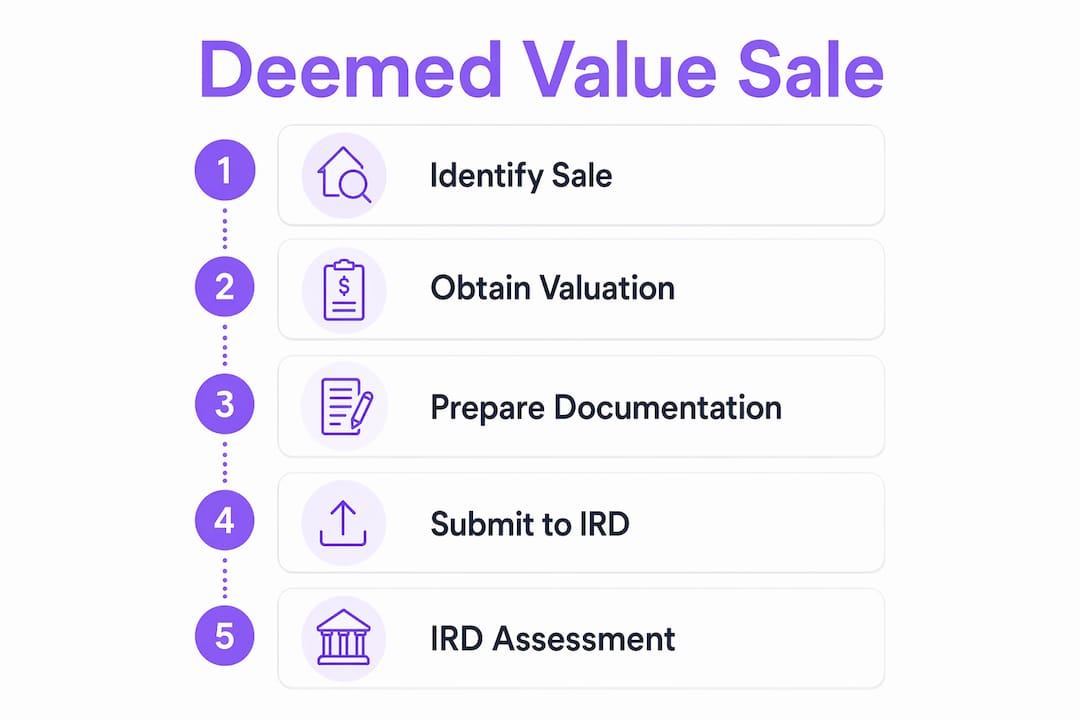
Follow these steps before you sign any agreement or transfer any property.
- Get an independent market valuation. Commission a registered valuer to produce a written report dated as close to the transaction date as possible.
- Document your purchase-price allocation. If the sale includes chattels, record the allocation across asset classes in writing at the time of contract, not after settlement.
- Gather comparable sales evidence. Collect recent sales data for similar properties in your area and keep it on file.
- Seek tax advice. Engage a chartered accountant or tax adviser before the transaction, particularly if an associated person or bright-line period is involved.
- Record the allocation in the sale agreement. The New Zealand Law Society’s standard agreement (ASPRE) includes Schedule 4 for agreed purchase-price allocation; use it.
- Retain all documents post-settlement. Keep valuation reports, allocation schedules, and correspondence for at least seven years.
Pro Tip: Time your valuation to the date of contract, not settlement. IRD treats the contract date as the disposal date for most bright-line purposes, so a valuation dated weeks later may not be accepted as contemporaneous.
Additional items to keep on file:
- Written agent appraisal or broker price opinion as supporting evidence.
- Any correspondence with the buyer about how the price was determined.
- A copy of the signed allocation schedule from the sale agreement.
Valuation options in NZ: what they cost and how long they take
| Option | Typical cost (NZD) | Typical turnaround | Best use |
|---|---|---|---|
| Registered valuer report | typical cost and turnaround vary | 3–5 business days | IRD enquiries, associated-person transfers, court proceedings |
| Agent broker price opinion (BPO) | typical cost and turnaround vary | 1–3 business days | Supporting evidence alongside a registered report |
| Desktop/comparables report | typical cost and turnaround vary | same day to a few days | Initial guidance only; rarely sufficient alone for IRD |
A registered valuer’s written report is generally considered the strongest evidence with IRD and provides an independent opinion of market value. For guidance on how property valuation works in NZ, including what to expect from each type, that article covers the process in detail.
For fast sales where pricing accuracy matters, how to price an as-is home correctly offers practical techniques that complement a formal valuation.
The single most common error practitioners flag is failing to record purchase-price allocations in writing when property and chattels are sold together. A desktop report alone will not fix that gap.
What to do if Inland Revenue queries your sale
- Acknowledge the inquiry promptly. Respond within IRD’s stated timeframe, even if only to confirm you have received the query and are gathering documents.
- Gather your valuation and allocation documents. Pull together the registered valuer report, the signed allocation schedule, comparable sales evidence, and any agent appraisals.
- Contact a tax adviser or chartered accountant immediately. Do not respond substantively to IRD without professional advice. A qualified adviser can frame your response correctly and avoid admissions that complicate your position.
- Structure your written response clearly. Address each point IRD raises, attach supporting documents, and state your legal basis for the price used.
- Understand the timeline. IRD typically allows 20–30 working days for an initial response. Disputes can take months if they escalate to a Notice of Proposed Adjustment (NOPA).
If IRD issues a NOPA, you have the right to lodge a Notice of Response (NOR) within two months. At that point, engaging a tax barrister or a specialist tax lawyer is worth considering.
Key documents to have ready:
- Registered valuation report dated at or near the transaction date.
- Signed purchase-price allocation schedule from the sale agreement.
- Comparable sales evidence from the same period.
- Any written advice from your tax adviser obtained before the transaction.
How Easysale handles valuation and documentation in a fast cash sale
When you sell to a cash buyer like Easysale, the documentation process still matters for your tax position. Easysale’s offer is based on an assessment of the property’s current market condition, and the purchase price is recorded in a written sale and purchase agreement that includes allocation details where chattels are involved.
Before accepting any cash offer, ask your buyer these questions:
- How did you calculate this offer, and what market evidence supports it?
- Will the allocation between land and chattels be recorded in the contract?
- Can you provide written documentation of the valuation basis if IRD asks?
Pro Tip: Even in a fast, as-is sale, ask for the offer rationale in writing. A cash buyer who cannot explain their pricing in documented terms is a risk to your tax position, not just your sale price.
A well-documented cash sale can actually reduce your deemed-value risk, because the written contract and allocation schedule give you contemporaneous evidence of market value at the date of disposal. For more on fair market value guidance for urgent sellers, that article walks through how to set a defensible price quickly.
Key takeaways
A deemed value sale in NZ means IRD can tax you on market value even when you received less, so getting a written valuation and documented purchase-price allocation before any transfer is the single most effective way to protect yourself.
| Point | Details |
|---|---|
| Deemed market value is statutory | Sections GC 1 and FC 2 of the Income Tax Act override the agreed price when a transfer is below market value. |
| Common triggers include family transfers | Associated-person sales, trustee changes, and bright-line disposals are the most frequent causes of IRD scrutiny. |
| Written allocation is non-negotiable | Failing to record purchase-price allocation in writing is the most common error that invites IRD to impose its own values. |
| Registered valuation is your best defence | A written report from a registered valuer, dated at the transaction date, is the strongest evidence in an IRD inquiry. |
| Easysale documents fast sales properly | Easysale records the offer basis and allocation in the sale agreement, giving sellers contemporaneous evidence for tax purposes. |
The part most sellers get wrong
Most homeowners who face a deemed-value assessment did not set out to avoid tax. They simply did not know the rules applied to them. A transfer to a family trust, a co-ownership change, a gift to a child — none of these feel like a “sale,” yet each can trigger the same tax consequences as a market-rate disposal. The documentation gap is where things go wrong. Sellers who get a valuation and record the allocation in writing rarely end up in an IRD dispute. Those who rely on a handshake price or an informal agent estimate often do.
If you are in a hurry to sell, that urgency does not reduce your tax obligations. What it does mean is that you need a buyer who moves fast and documents properly at the same time.
Easysale: fast NZ cash offers with proper documentation
If you need to sell quickly and want the process handled cleanly, Easysale buys residential properties across New Zealand in any condition, with no agent fees and no commission. The offer is based on a clear assessment of your property’s current market value, and the sale agreement records the purchase-price allocation where chattels are included, giving you the written evidence you need if IRD ever asks questions.

Settlement can happen on your timeline, often within days. For sellers facing financial pressure, a relationship change, or a property in poor condition, that speed matters. Get a no-obligation cash offer from Easysale today and know exactly where you stand before you commit to anything.


