
How property valuation works: A clear guide for NZ homeowners

TL;DR:Council rating values are outdated snapshots and often diverge from current market prices.Independent registered valuers assess market value based on recent sales and property condition.In urgent sales, rely on recent comparable sales and quick appraisals rather than outdated council figures.
The number on your rates notice is not what your home would sell for today. Many New Zealand homeowners assume their council rating value (RV or CV) is a reliable guide to their property’s current worth, but this assumption can lead to costly decisions, especially when you need to sell quickly. Council RV/CV can diverge from what you could actually sell for because it is a snapshot taken at a fixed point in time, updated only every few years, while the market moves constantly. This guide cuts through the confusion so you can make informed, confident decisions about your property.
Table of Contents
- Why property values differ: Council rates vs. market value
- How property valuation is actually done in New Zealand
- Common valuation pitfalls for urgent or distressed sellers
- Applying valuation insights: Selling fast and getting fair offers
- Why the usual rules break down when you need to sell quickly
- Need a fast, fair sale? How we can help you move forward
- Frequently asked questions
Key Takeaways
| Point | Details |
|---|---|
| Council value vs. market price | The value on your rates notice often lags behind what you could actually sell for right now. |
| How valuation works | Registered valuers use recent sales and property details, but mass appraisals can miss unique changes to your home. |
| Pitfalls for urgent sellers | Relying only on rateable value or poor timing can mean losing out, especially in fast or distress sales. |
| Getting a fair offer quickly | You can get prompt, fair offers by combining current market data, honest buyer discussions, and professional advice. |
Why property values differ: Council rates vs. market value
With the misconception challenged, let’s break down the practical difference between council figures and what you can actually sell for in today’s market.
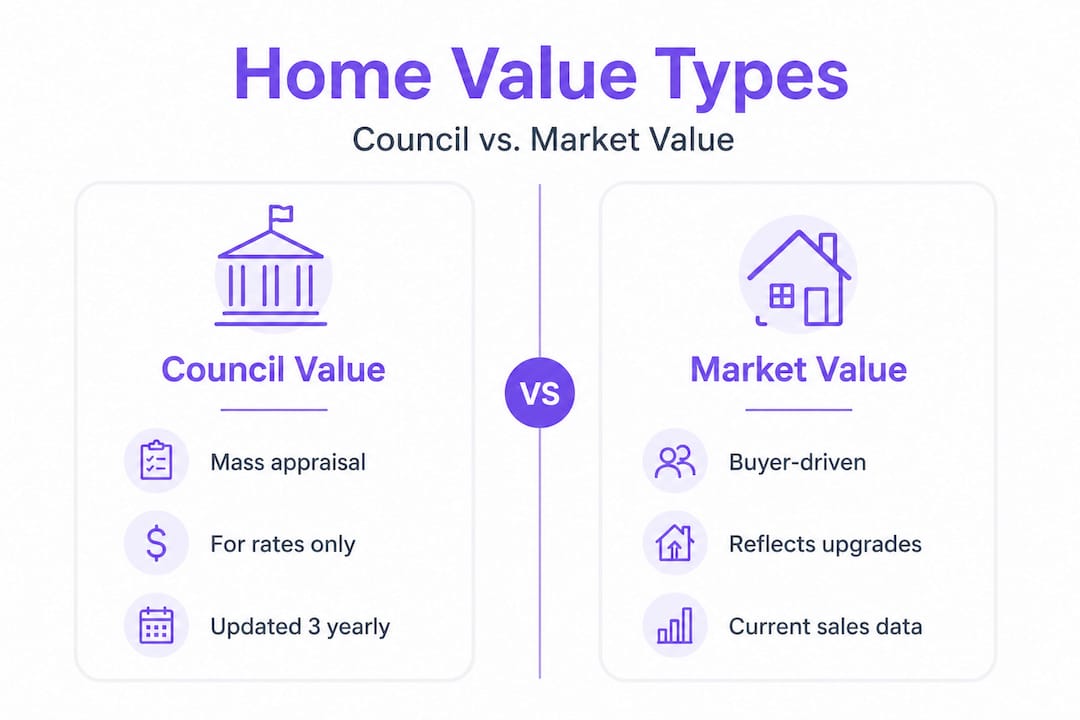
Council rating value (RV or CV) is a figure set by your local council primarily to calculate how much rates you owe. It is not designed to tell you what your home is worth on the open market. Council values are set on a three-year cycle and may lag well behind the current market price, particularly in fast-moving regions like Auckland, Wellington, or Christchurch.
Market value, by contrast, is what a willing buyer would actually pay for your property in current conditions. It accounts for recent comparable sales in your street or suburb, current buyer demand, the condition of your home right now, and broader economic factors like interest rates and housing supply.
Here is a straightforward comparison to illustrate the key differences:
| Feature | Council rating value (RV/CV) | Market value |
|---|---|---|
| Purpose | Calculating rates | Reflecting actual sale price |
| Set by | Local council | Buyers, sellers, registered valuers |
| Update frequency | Every three years | Continuously, based on sales |
| Includes chattels? | No | Sometimes, by negotiation |
| Useful for urgent sales? | Rarely | Yes |
There are several practical reasons why these two figures can diverge significantly:
- Market movement: Property prices in New Zealand can shift dramatically within a single year. If your RV was set two years ago during a peak, it may now be higher than what buyers will pay.
- Property improvements: A new kitchen, bathroom renovation, or deck added after the last valuation cycle will not be reflected in your RV.
- Property damage or deterioration: Conversely, earthquake damage, weather tightness issues, or deferred maintenance will not reduce your RV either.
- Local demand changes: A new motorway, school rezoning, or commercial development nearby can shift buyer interest quickly, well before the next council revaluation.
“The council rating value is a useful tool for rates administration, but it should never be your only guide when making a major financial decision like selling your home.”
Understanding the reasons NZ homes sell below value often comes back to this exact confusion. Sellers who anchor their expectations to an outdated RV can either overprice and stall, or underprice and lose money. If you want to understand your full range of fast property sale options, knowing the difference between these two figures is the essential first step.
It is also worth noting that this challenge is not unique to New Zealand. Overseas property valuation differences between official figures and actual sale prices are common in many markets, particularly where government assessments are infrequent or use mass-appraisal methods.
How property valuation is actually done in New Zealand
Now that you understand the gap between council and market values, let’s look at how independent property valuation happens and where it matters most for urgent or time-sensitive sales.
A registered valuer in New Zealand is a licensed professional who assesses the market value of your property using a structured methodology. Their process typically involves the following steps:
- Gathering property data: The valuer collects information about your property including land area, floor area, age, construction type, and legal description from council and LINZ (Land Information New Zealand) records.
- Analysing recent comparable sales: They identify recent sales of similar properties in your area, usually within the last three to six months, and adjust for differences in size, condition, and location.
- Inspecting the property: A full valuation involves a physical inspection to assess condition, layout, and any features or defects not visible in records. Some valuers offer desktop-only assessments for lower-risk situations, but these carry more uncertainty.
- Applying a valuation method: Most residential valuations use the direct comparison method, matching your property to recent sales. For unique or complex properties, the income capitalisation or depreciated replacement cost methods may also be used.
- Producing a written report: The final report states the market value as at a specific date, with supporting evidence and any caveats.
Rating values are mass-appraised and exclude chattels. They may not track the market value used for lending or insurance, which is why banks always require an independent registered valuation before approving a mortgage, regardless of what the council says.
Valuations can also be updated outside the standard three-year cycle. Events like building consents, significant renovations, a recent sale, a formal inspection, or a homeowner’s written request can all trigger a review. This means your RV is not entirely static, but the process takes time and does not happen automatically.
One important edge case: mass appraisals used by councils cannot account for individual property upgrades or deterioration. If you have invested $80,000 in a kitchen and bathroom renovation since the last cycle, your RV will not reflect that added value. Similarly, if your home has sustained damage, the council figure will not drop to match.
You can learn more about the full property sale steps NZ process and how valuation fits into the broader picture, or explore no-commission private sales as an alternative to the traditional agent route.
Pro Tip: For urgent sales, buyers often pay for speed and certainty, not for perfection. A direct cash buyer may offer slightly below the top of the market, but they remove the risk, cost, and delay of a traditional sale. For many sellers in difficult circumstances, that trade-off is genuinely worthwhile.
Common valuation pitfalls for urgent or distressed sellers
Having covered how valuations are calculated, here is what to watch for if you are facing pressure to sell quickly in the New Zealand market.
Sellers in urgent situations are particularly vulnerable to valuation-related mistakes. Recognising these pitfalls early can save you significant time and money.
- Relying solely on an outdated RV/CV: If your council value is two years old and the market has softened since then, you may be asking too much and losing genuine buyers. Equally, if the market has risen sharply, you could be underselling without realising it.
- Failing to disclose relevant changes: Not mentioning a recent renovation, consented addition, or damage to a valuer or buyer limits their ability to make a fair assessment. Transparency leads to better, more accurate offers.
- Ignoring recent comparable sales: Agent appraisals are useful, but they can be optimistic. Rating values can be updated after certain events like consents, sales, or inspections, so the figure on your rates notice may lag behind changes that are directly relevant to buyers.
- Accepting the first offer without context: Distressed sellers are sometimes targeted by buyers who make low offers, knowing the seller is under time pressure. Always check any offer against recent actual sales in your area.
- Overlooking timing: A property sold in winter or during a market downturn will often achieve a lower price than the same property sold in spring during strong demand. If you have any flexibility, timing your sale strategically can make a real difference.
Here is a quick reference table showing how different scenarios can affect your valuation outcome:
| Scenario | Impact on market value | Action to take |
|---|---|---|
| Recent renovation (consented) | Likely increase | Request updated appraisal |
| Storm or water damage | Likely decrease | Disclose fully, price accordingly |
| Market has risen since last RV | RV understates value | Use recent sales as your guide |
| Market has fallen since last RV | RV overstates value | Adjust expectations downward |
| Urgent sale needed | Buyer may discount for speed | Weigh certainty against top dollar |
Understanding the quick property selling steps available to you in New Zealand can help you move forward with confidence. It also helps to be familiar with selling terminology NZ so you can read contracts and offers clearly without being caught off guard.
Pro Tip: Gather recent private sale results from your suburb, not just agent appraisals or RV data. Actual sale prices from the past three months are the most reliable indicator of what buyers will pay right now. Your local council’s property search tool or QV.co.nz can help you find these figures quickly.
Applying valuation insights: Selling fast and getting fair offers
With the pitfalls in mind, here is how you can practically use your understanding of property valuation to get prompt, fair offers when you need to move quickly.
The goal here is not to become a valuation expert. It is to gather enough reliable information to make confident decisions and avoid being taken advantage of when time is short.
- Gather recent comparable sales data. Use your council’s property search tool, QV.co.nz, or ask a registered valuer for a brief desktop assessment. Focus on sales from the last three to six months within one kilometre of your property. This gives you a realistic price anchor.
- Request a quick independent appraisal. A registered valuer can often turn around an urgent appraisal within a few days. This costs between $500 and $1,000 but gives you a defensible, evidence-based figure to negotiate from.
- Communicate your timeline candidly. If you need to sell within four weeks due to a relationship breakdown, financial pressure, or a job relocation, say so clearly. Direct cash buyers and property investors can often act within days when they understand your situation. Hiding your urgency rarely helps and can slow the process down.
- Compare offers against your market data. The number on your rates notice may lag behind changes relevant to buyers, so do not use it as your benchmark. Use actual comparable sales instead.
- Understand the full cost of a traditional sale. Agent commissions, staging, marketing, and holding costs during a lengthy campaign can easily add up to $20,000 or more. A slightly lower direct offer may actually net you more in the end.
Understanding the full property buying process NZ from a buyer’s perspective also helps you anticipate what questions and checks a serious buyer will carry out, so you can prepare accordingly and speed up the process.
Pro Tip: Always confirm any offer against current market comparables before accepting or rejecting it. A quick online search of recent sales in your suburb takes less than 30 minutes and could save you tens of thousands of dollars.
Why the usual rules break down when you need to sell quickly
Let’s step back for a moment. Most valuation guides focus on ideal scenarios: a well-maintained home, a patient seller, a buoyant market, and plenty of time to run a full campaign. Real life is rarely that tidy.
When you are facing a divorce, a job loss, a health crisis, or mounting mortgage arrears, the standard advice about “maximising your sale price” can feel not just unhelpful but actively misleading. The mainstream model assumes you have months to prepare, the budget to present your home well, and the emotional bandwidth to negotiate hard. Many sellers simply do not have those things.
Here is the uncomfortable reality: in a distressed or urgent sale, the true value of your property is not what a valuer writes in a report. It is what a committed, capable buyer will actually pay you within your timeframe. Those two numbers are often different, and pretending otherwise does not serve you.
This does not mean you should accept any offer. It means you should be honest with yourself about what certainty and speed are worth to you in your specific situation. A guaranteed settlement in two weeks at a modest discount may be far more valuable than a higher asking price that takes four months to achieve, if it ever does.
We have seen sellers hold out for top dollar, only to face additional mortgage payments, legal fees, and emotional strain that wiped out any potential gain. The fast sale choices available in New Zealand today are genuinely competitive and transparent. Using them is not a sign of desperation. It is a practical, informed decision.
The best outcome is one that fits your life, not just your spreadsheet.
Need a fast, fair sale? How we can help you move forward
If you are facing a big change or tight timeline, you do not have to navigate it alone. At easySale.co.nz, we work with New Zealand homeowners every day who need a straightforward, honest path forward, without agents, commissions, or drawn-out negotiations.
We make a direct cash offer based on current market comparables, not outdated council figures. You choose the settlement date that works for you, whether that is two weeks or two months. There are no open homes, no marketing costs, and no surprises. Our process is simple: share your property details, receive a no-obligation offer, and settle on your terms. If you want to understand your options clearly and get a fair, evidence-based offer fast, get in touch with our team today for a no-obligation conversation.
Frequently asked questions
How often are council property valuations updated in NZ?
Most councils update rating values every three years, based on the market as at 1 September in the revaluation year, so your current RV could be nearly three years out of date.
Why can my official rateable value differ from my likely sale price?
Rateable values are mass-appraised and may not reflect changes, upgrades, or market shifts since the last cycle, meaning the gap between your RV and actual sale price can be substantial.
What triggers an updated valuation outside the main cycle?
Events like building consents, major renovations, sales, or a homeowner’s formal request can all prompt a council re-valuation outside the standard three-year schedule.
Do buyers accept council values as a fair market price?
No. Most buyers and their banks use current market comparisons, not the council value, to assess what your home is worth, particularly when applying for mortgage finance.
How can I get a property valuation done fast?
You can request an urgent registered valuation from a licensed valuer, which can often be completed within a few days, or seek a direct cash buyer’s instant offer based on current market comparables for the fastest possible result.
Recommended
