
Gazumping in property sales: what every Kiwi needs to know

TL;DR:Gazumping occurs when a seller accepts a higher offer after agreeing to sell to another buyer, creating risks for the initial buyer. It is legal in New Zealand until the sale becomes unconditional, and moving quickly during this period can reduce the chance of losing the property. Protecting yourself involves instructing a solicitor early, securing mortgage pre-approval, and requesting an exclusivity agreement.
Gazumping is defined as the practice where a seller accepts a higher offer on a property after already agreeing to sell to another buyer. The initial buyer loses out, often after spending money on legal fees, building inspections, and mortgage applications. This is not a rare edge case. It is a real risk in any property market where offers are not legally binding until contracts are formally exchanged. For Kiwi buyers and sellers, understanding how gazumping works, why it happens, and what you can do about it is the first step toward protecting yourself in a property transaction.
How does gazumping occur in property sales and why does it happen?
Gazumping follows a predictable pattern. A buyer makes an offer, the seller accepts it verbally or in writing, and both parties begin preparing for settlement. Then a second buyer arrives with a higher offer. The seller accepts the new offer, and the first buyer is left with nothing except a bill for the work they have already done.
The process typically unfolds in these stages:
- Offer accepted. The seller agrees to the buyer’s offer, often verbally or via email. No binding contract exists yet.
- Due diligence begins. The buyer instructs a solicitor, orders a building report, and applies for a mortgage. These steps cost money and take time.
- A competing offer arrives. A new buyer, aware the property is under offer, submits a higher bid. Estate agents have a legal duty to present all offers to the seller, even after an initial acceptance.
- The seller accepts the new offer. Because no contract has been exchanged, the seller is legally free to do so. The first buyer has no recourse.
- The first buyer absorbs the loss. All fees paid during due diligence are gone.
The conveyancing period creates a window of vulnerability that typically runs 8–12 weeks after offer acceptance. That is a long time for a better offer to appear. Sellers are also motivated by certainty. Sellers often prefer buyers who can complete quickly and without a long property chain, even over a higher offer. This means a cash buyer or someone without a property to sell first holds a real advantage.
Pro Tip: If you are a buyer, tell the seller and their agent upfront that you are chain-free and have finance ready. That certainty can matter more than a slightly higher number.

What is the legal position on gazumping in New Zealand?
New Zealand property law follows a similar principle to England and Wales. An offer is not legally binding until both parties have signed a sale and purchase agreement and any conditions have been met or waived. Until that point, either party can walk away or a seller can accept a competing offer.
In England and Wales, property transactions are not binding until exchange of contracts, which typically occurs 8–12 weeks after offer acceptance. This long gap is where gazumping lives. Scotland operates differently. Scotland’s conclusion of missives creates an earlier binding agreement, which effectively prevents traditional gazumping. The Scottish system is often cited as a model for reform in other jurisdictions precisely because it closes the vulnerability window much sooner.
New Zealand’s property sale process shares more in common with the English model than the Scottish one. Offers made verbally or even in a signed document with conditions attached are not fully binding until all conditions are satisfied and the agreement becomes unconditional. That is the moment the risk of gazumping ends.
Gazundering is the mirror image of gazumping. It occurs when a buyer lowers their offer just before contract exchange, knowing the seller has already committed emotionally and financially to the sale. Both practices are legal. Both are disruptive. Sellers face gazundering risk just as buyers face gazumping risk.
| Jurisdiction | Legal binding point | Gazumping risk |
|---|---|---|
| New Zealand | Unconditional agreement signed | High until conditions cleared |
| England and Wales | Exchange of contracts | High for 8–12 weeks |
| Scotland | Conclusion of missives | Low, binding happens earlier |
Pro Tip: Ask your solicitor to clarify exactly when your agreement becomes unconditional. Knowing that date gives you a clear target to work toward and helps you understand when you are truly protected.
Understanding the legal considerations when selling in New Zealand is worth doing before you sign anything, not after.
What are the financial and emotional impacts of gazumping?
Gazumping causes real financial harm. Research from the UK property market shows that 37% of homebuyers have experienced gazumping, with an average financial loss of around £2,400 per case from non-refundable expenses. While New Zealand figures are not publicly listed, the cost categories are identical: legal fees, building inspection reports, LIM reports, mortgage application costs, and travel expenses all add up quickly.
The financial losses are only part of the picture. The emotional toll is significant too. Buyers often spend weeks imagining life in a property, planning renovations, and telling friends and family about their purchase. When gazumping occurs, that emotional investment is lost along with the money.
The impacts on buyers include:
- Non-refundable fees. Solicitor costs, building reports, and LIM reports are paid regardless of whether the sale proceeds.
- Mortgage costs. Some lenders charge application or valuation fees that are not returned if the sale falls through.
- Lost time. Weeks or months of searching, negotiating, and preparing are wasted. In a rising market, that delay can mean higher prices for the next property.
- Emotional stress. The disappointment of losing a property you had already mentally moved into is genuinely distressing.
Sellers are not immune either. Accepting a higher offer can damage their reputation with agents and in their community. It can also delay settlement if the new buyer needs more time to arrange finance. The short-term financial gain sometimes comes with longer-term friction.
How can buyers and sellers reduce the risk of gazumping?
The most effective protection against gazumping is speed. The faster you move from accepted offer to unconditional agreement, the shorter the window during which a competing offer can displace you.
Practical steps for buyers include:
- Instruct a solicitor immediately. Do not wait until the offer is accepted to find legal representation. Have a solicitor ready to act the day you make an offer.
- Secure mortgage pre-approval. A mortgage agreement in principle shows the seller you are a serious, finance-ready buyer.
- Maintain regular communication. Stay in contact with the agent and seller throughout the process. Buyers who communicate clearly and consistently are harder to replace.
- Request an exclusivity agreement. A lockout or exclusivity agreement can legally bind the seller not to negotiate with others for a fixed period, usually 4–6 weeks. Sellers often resist signing these, but it is worth asking.
- Move quickly on due diligence. Book your building inspection and order your LIM report within days of offer acceptance, not weeks.
Instructing solicitors quickly, securing a mortgage agreement, and maintaining communication are the three actions that most reduce the opportunity for gazumping to occur. Each one shortens the vulnerable window.
If you are gazumped despite these steps, the advice is clear. Avoid overpaying beyond market value or your lender’s valuation just to win the property back. Paying above valuation creates immediate negative equity and can cause mortgage complications. Walking away and finding a better fit is often the wiser choice.
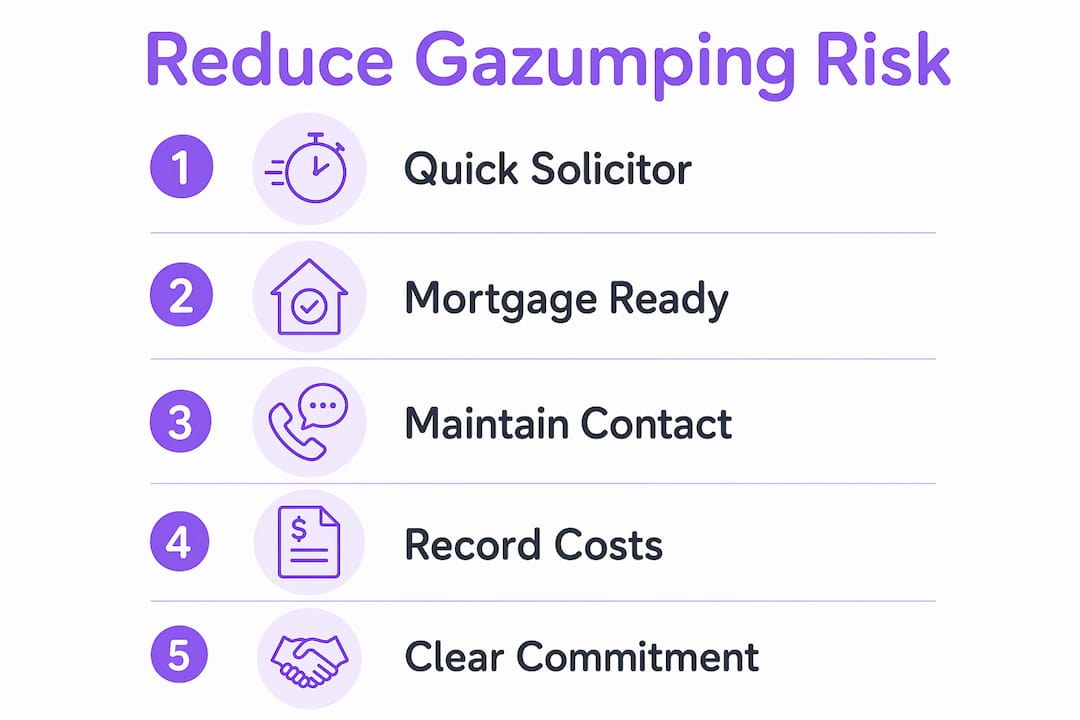
Pro Tip: Keep a record of every cost you incur after an offer is accepted. If a sale falls through due to gazumping, that record helps your solicitor assess whether any costs are recoverable and gives you a clear picture of your actual loss.
For sellers, the property buying process works best when you commit to a buyer and communicate that commitment clearly. Accepting a higher offer may seem attractive in the moment, but it can complicate your own timeline and reputation.
Key takeaways
Gazumping is legal until a sale and purchase agreement becomes unconditional, and the best protection is shortening the time between offer acceptance and that unconditional date.
| Point | Details |
|---|---|
| Gazumping definition | A seller accepts a higher offer after agreeing to sell to another buyer, before contracts are binding. |
| Legal window of risk | In New Zealand, risk exists until the sale and purchase agreement becomes unconditional. |
| Financial impact | Non-refundable costs including legal fees, building reports, and mortgage applications are lost if gazumped. |
| Best buyer protection | Instruct a solicitor immediately, secure mortgage pre-approval, and request an exclusivity agreement. |
| Gazundering risk | Sellers face the reverse risk of buyers lowering offers before the agreement becomes unconditional. |
My honest view on gazumping in the New Zealand market
Gazumping does not get talked about enough in New Zealand property circles. Most buyers only learn the word after it has already happened to them. By then, they are out of pocket and frustrated, wondering why nobody warned them.
What I have observed is that the buyers who get gazumped are usually the ones who move slowly. They take a week to find a solicitor. They wait for the building report before applying for finance. They assume a verbal agreement means something legally. It does not. The window between accepted offer and unconditional agreement is genuinely dangerous, and treating it casually is a costly mistake.
The emotional side is real too. Losing a property you had already committed to mentally is hard. But the worst response is to panic and overbid on the same property just to get it back. Experts are clear that patience after being gazumped often leads to a better purchase. The market always has more properties.
For sellers, I would say this plainly: accepting a higher offer after agreeing to sell is legal, but it is not without consequence. The buyer you drop will remember. Agents will remember. And the new buyer who gazumped their way in may be less committed than the one you let go.
The best advice I can give is to treat the period between offer acceptance and unconditional agreement as the most active phase of the transaction, not a waiting period. Move fast, communicate clearly, and get legal advice early.
— Aaron
Selling with certainty: how Easysale removes the risk
Gazumping thrives in drawn-out transactions where the outcome stays uncertain for weeks. Sellers who need a fast, confirmed sale do not have to accept that uncertainty.
Easysale offers New Zealand homeowners a direct cash offer with no agents, no commission, and no lengthy conditional period. The process is straightforward: submit your property details, receive a fair cash offer, and settle on a timeline that suits you. Because Easysale buys properties in any condition, there is no waiting for the right buyer to appear or worrying that a deal will fall apart at the last moment. If you want a sale that is certain from day one, find out how Easysale’s fast cash offer service works for properties across New Zealand.
FAQ
What is gazumping in simple terms?
Gazumping is when a seller accepts a higher offer from a new buyer after already agreeing to sell to someone else. The original buyer loses out, often after spending money on legal and inspection fees.
Is gazumping legal in New Zealand?
Yes, gazumping is legal in New Zealand until the sale and purchase agreement becomes unconditional. Before that point, sellers are free to accept competing offers.
What is the difference between gazumping and gazundering?
Gazumping is when a seller accepts a higher offer after agreeing to a sale. Gazundering is the reverse, where a buyer lowers their offer just before the agreement becomes unconditional. Both are legal and both are disruptive.
How can I protect myself from being gazumped?
Instruct a solicitor immediately after your offer is accepted, secure mortgage pre-approval, and ask for an exclusivity agreement. Moving quickly through due diligence shortens the window during which a competing offer can displace you.
What should I do if I am gazumped?
Do not overbid beyond your lender’s valuation to recover the property. Absorb the loss, review your costs, and continue searching. A better property at a fair price is a stronger outcome than overpaying under pressure.


