
Investor vs agent sale for NZ homes: What to expect

TL;DR:Selling directly to an investor offers faster settlement, fewer fees, and certainty, especially for urgent or damaged properties. In contrast, agent sales typically achieve higher prices but involve longer timelines, commissions, and preparation costs. The best choice depends on your financial needs, property condition, and how quickly you want to sell.
When you need to sell quickly, the last thing you want is to be locked into a months-long process that costs thousands in fees and ends with no guarantee of a sale. Many Kiwi homeowners assume that using a real estate agent is the only way to get a fair outcome. But for those facing financial pressure, property damage, or urgent life changes, a direct investor sale can be a genuinely better fit. This guide breaks down both options across speed, cost, and real-world practicalities so you can make a clear, confident decision.
Table of Contents
- What is an investor sale? What is an agent sale?
- Comparing speed, price, and fees: The reality for NZ sellers
- Pros and cons: Which selling method fits your situation?
- Common myths and lessons from both sides
- What most Kiwi sellers don’t realise about fast sales
- Sell fast and simply—explore your options today
- Frequently asked questions
Key Takeaways
| Point | Details |
|---|---|
| Speed vs price trade-off | Investor sales prioritise quick settlement while agent sales focus on maximising market price. |
| Upfront costs and fees | Agent sales have substantial commissions and often require spending on repairs and staging. |
| Certainty and stress | Selling to an investor reduces stress for urgent sellers, but may mean lower proceeds. |
| No universal best option | The right selling method depends on your urgency and the condition of the property. |
What is an investor sale? What is an agent sale?
Understanding the basics of each route is the first step to choosing the right one for your circumstances.
An investor sale means selling your property directly to a company or private buyer without listing it on the open market. The buyer, often a professional property investor or cash-buying service, makes an offer based on the property’s current condition and their own assessment of its value. You do not need to prepare the home, arrange viewings, or wait for a buyer to secure finance. The role of cash buyers in NZ sales is straightforward: they take the property as-is and handle the process from offer to settlement quickly.
An agent sale involves hiring a licensed real estate agent to list your home on the open market. The agent manages the marketing, open homes, negotiations, and paperwork. As noted in our guide on avoiding real estate agents, this route can attract higher offers but comes with 3-4% commission fees, repair and staging costs, and longer timelines of 8-14 weeks.
Here is a quick comparison of what each process looks like in practice:
- Investor sale: Direct contact with buyer, cash offer usually within 24-72 hours, no open homes, property sold as-is, settlement in days or weeks on your timeline.
- Agent sale: Agent appraises property, recommends repairs or staging, lists online, holds open homes over several weeks, negotiates with multiple buyers, settlement typically 8-14 weeks from listing.
- Paperwork and legal steps: In both cases, a solicitor handles the Sale and Purchase Agreement. With investor sales, the buyer often provides the contract directly.
- Who negotiates: With an agent, the agent negotiates on your behalf. With an investor sale, you deal directly with the buyer, though you can still have a lawyer review any offer.
The key distinction is control versus reach. Investor sales give you more control over timing, while agent sales reach a wider pool of buyers.
Comparing speed, price, and fees: The reality for NZ sellers
Once you understand the two routes, the numbers tell a compelling story. Here is how the two methods stack up across the factors that matter most to urgent sellers.
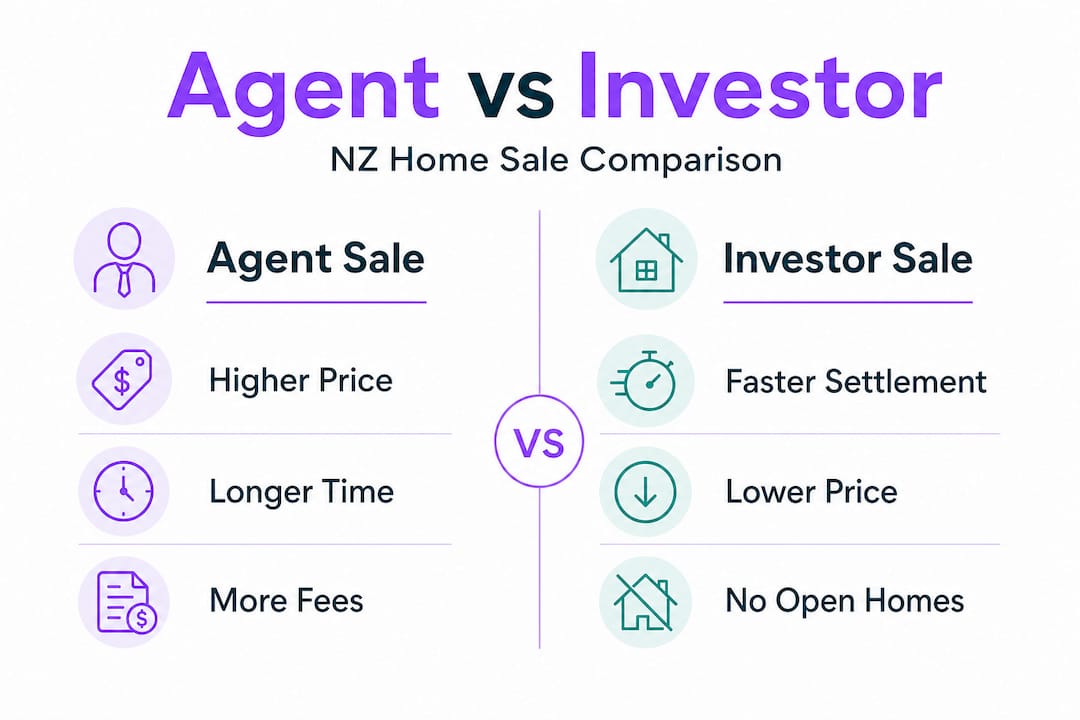
| Factor | Agent sale | Investor sale |
|---|---|---|
| Typical timeframe | 8-14 weeks | Days to 4 weeks |
| Median sale price (NZ, 2025) | $740,000 | $662,000 |
| Commission on $750k sale | ~$24,000 | $0 |
| Staging and repair costs | $3,000-$15,000+ | $0 |
| Certainty of sale | 76% success rate | Higher certainty once offer accepted |
| Open homes required | Yes | No |
| Finance risk | Buyers may fail finance | Cash offers, no finance condition |
The median sale prices and success rates above show that agent sales do tend to achieve higher prices. However, when you factor in commissions and preparation costs, the gap narrows considerably. On a $750,000 sale, agent commissions alone can reach around $24,000. Add repairs and staging and the net amount you actually receive drops further.

Investor offers are lower because the buyer factors in the cost of renovation and their own profit margin. But there are no commissions, no repair bills, and no drawn-out negotiation. For a seller who needs certainty and speed, these trade-offs can be very worthwhile.
Pro Tip: Think beyond headline price when comparing your options. Factor in agent commissions, repair costs, holding costs like mortgage payments and rates during a lengthy campaign, and the emotional toll of months of uncertainty.
The agent commissions explained in full show how significant these costs can be across different price brackets. Understanding commission fees in home sales is essential before you commit to any selling method. And if you are in a buyers market, the case for selling faster without agents becomes even more persuasive.
Pros and cons: Which selling method fits your situation?
Every seller’s situation is different. Your property condition, financial urgency, and personal bandwidth all influence which option makes more sense for you.
Agent sale pros and cons
- Pro: Higher potential sale price in most market conditions.
- Pro: Broad buyer reach through major online portals and open homes.
- Pro: Professional marketing that can lift perceived value.
- Con: Commissions of 3-4% reduce your net proceeds significantly.
- Con: No guarantee of sale, with only a 76% success rate over a ten-year period.
- Con: Requires time, effort, and often significant spending on repairs and presentation.
- Con: You may wait weeks or months with no confirmed outcome.
Investor sale pros and cons
- Pro: Fast settlement, sometimes within days of accepting an offer.
- Pro: No commissions, no staging, no open homes.
- Pro: Sold as-is, regardless of damage, disrepair, or structural issues.
- Pro: Certainty once an offer is accepted, particularly with reputable buyers.
- Con: Lower headline price than what an agent might achieve.
- Con: Some investors withdraw offers or reduce them at the last minute, so vetting your buyer matters.
- Con: Less competitive pressure on the price with only one buyer at the table.
The advantages of no-agent sales become especially clear for homeowners managing financial hardship, relationship breakdowns, or properties in poor condition. Reading up on cash buyers versus agents can help you weigh these in your specific context.
Pro Tip: If your home is damaged, has unpermitted work, or you need to move within weeks, the open market is unlikely to serve you well. Buyers on the open market expect near-perfect condition and will use any issues to negotiate hard against you.
“Your decision should be driven by what you need most right now. If you need certainty and speed, a lower offer in hand is worth more than a higher offer still weeks away. If you have time and a market-ready property, an agent campaign could deliver a better net result. Know your priority before you make your move.”
The risk of reneged offers from unscrupulous investors is real but manageable. Always work with buyers who provide transparent written offers, allow you independent legal review, and have a verifiable track record. Reputable services will never pressure you into signing on the spot.
Common myths and lessons from both sides
Misconceptions about both routes lead many sellers to make costly decisions. Here are the most common ones worth setting straight.
- “Agents always get the best result.” This is true in many standard market conditions but not in all cases. For damaged, tenanted, or urgently sold properties, the time and cost of an agent campaign can erode the price advantage significantly.
- “Investors only give outrageously low offers.” Some do, and that is why due diligence matters. Reputable cash buyers in New Zealand make fair offers that reflect current market realities and property condition. The gap is real but not always as dramatic as sellers fear.
- “Private sales are too risky.” This belief persists because some sellers confuse investor sales with unsupported DIY private sales. When you sell to an established investor or buying service, the process is professional and legally sound.
- “You will always lose money going to an investor.” Once you account for agent fees, repairs, mortgage payments during a lengthy campaign, and the risk of the sale falling through, the net difference can be smaller than expected.
- “Using an agent protects you from fraud or bad deals.” Agents work in their own commercial interest too. They earn commission only on completed sales, which creates incentives to push you toward accepting offers. Always use an independent lawyer regardless of which route you choose.
As noted by pro-agent sources and investor platforms alike, neither side tells the complete story. Pro-agent advocates point to higher prices and success rates. Investor-focused platforms highlight speed, convenience, and no fees. Both are accurate for different sellers in different situations.
“The best selling method is not a universal truth. It is a personal calculation based on your timeline, your property, and your financial position. Any advice that ignores your individual circumstances is incomplete.”
Avoiding real estate fees entirely is appealing, but it needs to be weighed honestly. And for some sellers, exploring fast cash sales in New Zealand is not a compromise. It is the most rational choice available to them.
What most Kiwi sellers don’t realise about fast sales
Here is an opinion most property guides skip over entirely: the true cost of a slow sale is almost always underestimated.
When we talk about the realities of agent sales, we are not just talking about commissions. We are talking about weeks of open homes in a property you may still be living in. We are talking about mortgage repayments and rates continuing to accumulate while you wait. We are talking about the emotional weight of uncertainty, especially if you are going through a separation, a health crisis, or financial stress.
Agents are professionals and many of them do excellent work. But they are the right tool for a specific kind of seller: one with time, a market-ready home, and the bandwidth to manage a campaign. For a seller in distress, forcing that process is like using a long-haul tool for an emergency repair.
The opportunity cost of waiting is something almost no one measures honestly. A seller who waits three months for an extra $40,000 on their sale price may have paid $8,000 in mortgage interest, spent $5,000 on repairs and staging, and spent weeks under enormous stress. The real gain narrows fast. For some sellers, it disappears entirely.
The uncomfortable truth is that certainty and speed have genuine financial value. They are not just emotional preferences. A clean, quick sale that frees you from holding costs and emotional drain is a financially sound outcome in many situations, not just a last resort.
Pro Tip: Ask not just what you will make, but what you stand to lose: time, energy, peace of mind, and ongoing costs. For many Kiwi sellers, a fast investor sale is not settling for less. It is choosing what actually serves them best.
No option is right for everyone. But for sellers under pressure, the framing of “agent = better outcome” ignores most of what matters most.
Sell fast and simply—explore your options today
If this guide has helped you realise that a traditional agent sale may not be the right fit for your situation, the next step is getting a clear, no-obligation offer to compare.

At easySale.co.nz, we buy properties across New Zealand in any condition, without agent fees or drawn-out timelines. Whether you are managing a damaged property you need to move quickly or navigating a retirement or downsizing transition, we can provide a fast cash offer on your terms. There are no commissions, no repairs required, and no pressure. You submit your property details, we make a fair offer, and you choose the settlement date. It is that simple.
Frequently asked questions
Will selling to an investor give me less money than using an agent?
Yes, investor offers tend to be lower than what an agent campaign might achieve, but there are no commissions, no repair costs, and no risk of the sale falling through, which narrows the real gap considerably.
How fast can I sell my home to an investor compared to using an agent?
Investor sales can settle in as little as a few days, while agent sales typically take 8-14 weeks from listing to settlement, and that timeline is not guaranteed.
What are the main risks of selling to an investor?
The main risks include receiving a lower offer than market value and, with some buyers, the possibility of an offer being withdrawn before settlement. Choosing a reputable, established cash buyer and having your lawyer review any contract greatly reduces this risk.
Can I avoid repairs and open homes with either method?
With an investor sale, your home is purchased as-is with no repairs or staging required. Agent sales generally require the property to be presented well, which often means spending money on repairs and attending multiple open homes before a buyer is secured.
Recommended
