
10–30% Discounts Explained: 2026 NZ Property Valuation for Homeowners

A cash buyer sets a price by starting with local recent sales, then subtracting itemised deductions for repairs, consent issues and the discount they need for taking on risk fast. Understanding this property valuation process for 2025 in NZ helps you decide if that trade is worth it.
TL;DR:Cash offers are usually 10% to 30% below market value, reflecting repairs, consent risks, and the buyer’s urgency margin.Buyers base their offer on recent comparable sales, deduct costs for repairs and risks, then apply an urgency discount to determine the final price.Most offers are made within 24 to 48 hours, with settlement possible in as little as seven days, provided all legal and document checks are completed.Preparing your documents and disclosing known issues upfront can speed up negotiations and help you secure a more accurate, favorable offer.Cash buyers often use comparables and replacement cost approaches and are less influenced by broader economic factors like interest rates, which can widen the gap from mortgage-based offers.
EasysaleSell Your Property With Less HassleEasysale helps New Zealand homeowners receive a fast, fair cash offer, including for properties needing repairs or a quick sale.Request a cash offer
Table of Contents
- How does the property valuation process work for a 2025 NZ cash sale?
- How do comparables and deductions turn into a cash offer?
- What’s the realistic timeline for paperwork and legal checks?
- How can you prepare before requesting or accepting an offer?
- How do you evaluate a cash offer before signing?
- Why do cash buyers offer below market value?
- What valuation methods do cash buyers actually use?
- How do interest rates and the wider economy affect cash offers?
- Common seller mistakes and what actually works
- If you want a quick no-obligation cash offer
- Sources
- FAQ
How does the property valuation process work for a 2025 NZ cash sale?
Before a cash buyer puts a number in front of you, they run through a short list of facts and visible clues about your home. This isn’t a formal registered valuation. It’s a fast, practical assessment built to produce a workable offer within a day or two.
The first thing any serious buyer checks is your title. They want to know who owns the property, whether there are caveats or encumbrances, and what the legal description says about boundaries. Alongside that comes the LIM report and Code Compliance Certificate history, because unconsented work or missing CCCs change the risk profile substantially. If your property is tenanted, the buyer will also want the tenancy agreement and rent roll early, since that affects both settlement flexibility and resale value.
Then it’s condition. A buyer working fast doesn’t commission a full building report before making an offer. Instead, they rely on:
- Photos you supply or a short site visit
- A drive-by review of the street and neighbouring properties
- A brief phone conversation about known issues, like leaks, rot, or drainage problems
- Recent comparable sales on the same street or within a few blocks
That street-level comparable data does most of the heavy lifting. A buyer isn’t guessing at suburb averages, they’re looking at what sold two doors down last month.
Pro Tip: Take clear, well-lit photos of every room, including any damage or wear you know about. Buyers price in unknowns conservatively, so hiding a stained ceiling only ends up costing you more once it’s found during due diligence.

How do comparables and deductions turn into a cash offer?
The maths behind a cash offer is more transparent than most sellers expect, once you see it laid out.
- Set the market estimate. The buyer pulls two to four recent, genuinely comparable sales nearby, adjusts for size and condition, and lands on an estimated current market value for your property.
- List the deductions. Repairs get costed individually. Consent risk (unconsented decks, garages, or additions) gets a dollar figure attached. If the property is tenanted, a tenant-risk adjustment goes in too, reflecting the hassle and time of managing a tenancy through to resale.
- Apply the urgency margin. This is the buyer’s own compensation for taking on the property fast, without the months of exposure a normal listing would carry. It typically sits somewhere in a 10–30% discount to market value, depending on condition and risk.
- Subtract, and that’s the offer. Market estimate, minus itemised deductions, minus the margin, equals your cash offer.
Say a comparable-backed estimate puts your home at $650,000. Repairs and consent risk might account for $40,000, and the urgency margin another $70,000. The offer comes in around $540,000, and a good buyer will show you those numbers rather than just naming a figure. Itemised deductions matter because they let you see exactly how the price was built, which is usually where negotiation room exists.
What’s the realistic timeline for paperwork and legal checks?
Most sellers underestimate how fast this can move, and overestimate how much paperwork it involves.
A genuine cash buyer typically turns an offer around within 24 to 48 hours of getting your property details. Negotiation, if there is any, usually wraps in one to three days. Settlement can happen in as little as seven days, though 10 to 14 days is more common once legal checks are done properly.
Expect the buyer to ask for:
- A copy of the title and LIM report
- CCCs for any consented work, where applicable
- Recent rates notices
- Tenancy agreement and bond details, if tenanted
- A fixed chattels list
Every offer should be formalised through a Sale and Purchase Agreement, and you should have an independent solicitor review it before signing anything. A conditional offer (subject to due diligence, finance, or LIM review) will always take longer to firm up than an unconditional one, so ask early which type you’re being given.
How can you prepare before requesting or accepting an offer?
Getting your documents in order before you even contact a buyer speeds up the whole property assessment process and tends to produce a tighter, more accurate offer.
- Gather your title, LIM, any CCCs, recent rates notices, and (if tenanted) the tenancy agreement.
- Take current photos of every room and the exterior, plus a floor plan if you have one.
- Write down known defects honestly, including anything you’ve patched rather than properly fixed.
- Sort access arrangements early, keys, alarm codes, or tenant notice periods, so inspections don’t stall the timeline.
Disclosing issues upfront reduces the risk of the buyer coming back to renegotiate after they’ve already made an offer, which is the single biggest cause of delay in fast sales. Expensive cosmetic staging rarely moves a cash buyer’s number. Structural or compliance-focused repairs are far more likely to lift an offer than a fresh coat of paint or new curtains.
Pro Tip: If you’re unsure whether a defect is worth mentioning, mention it. A buyer who finds an undisclosed issue during due diligence will usually deduct more than if you’d flagged it upfront.
How do you evaluate a cash offer before signing?
Once you have a number in hand, don’t just compare it to what you hoped for, compare it against what the market and the contract actually say.
- Check the offer against two or three genuinely comparable recent local sales, not suburb-wide averages.
- Confirm the settlement date works for your circumstances, not just the buyer’s.
- Read the conditions clause carefully: what has to happen before the offer becomes unconditional?
- Note exactly what’s included (chattels, fixtures) and what liabilities you’re expected to carry post sale.
- Ask for evidence of funds. A buyer who can’t show proof of funds is a buyer who might not settle.
Red flags include vague or shifting fee structures, unusually restrictive clauses, or reluctance to put deductions in writing. If the numbers feel off, or the buyer resists a solicitor review, that’s your cue to pause, negotiate, or ask for an independent valuation before you sign anything.
Why do cash buyers offer below market value?
Cash buyers are running a business, not doing you a favour, and understanding that helps explain the number they land on.
Most direct buyers plan to either renovate and resell, hold as a rental, or on sell to another investor. Every one of those paths has costs: renovation budgets, holding costs while consents come through, agent commission on the eventual resale, and the buyer’s own time and capital tied up in the meantime. The discount you see in a cash offer isn’t padding, it’s the buyer pricing in everything that has to happen between the day they buy your house and the day they get their money back out.
There’s also a liquidity constraint most sellers don’t think about. A cash buyer usually has a finite pool of capital deployed across several properties at once. They can’t chase every deal at full market price and still have funds free for the next one, so the margin they build into your offer is partly what keeps their business solvent enough to keep buying at all. That’s different from a bank-financed buyer competing on the open market, who’s borrowing against the property itself rather than deploying their own capital upfront.
None of this means every offer is fair. It means the discount has a logic to it, repairs, consent risk, holding costs, and margin, and a buyer who can’t explain that logic in plain figures is worth questioning.
What valuation methods do cash buyers actually use?
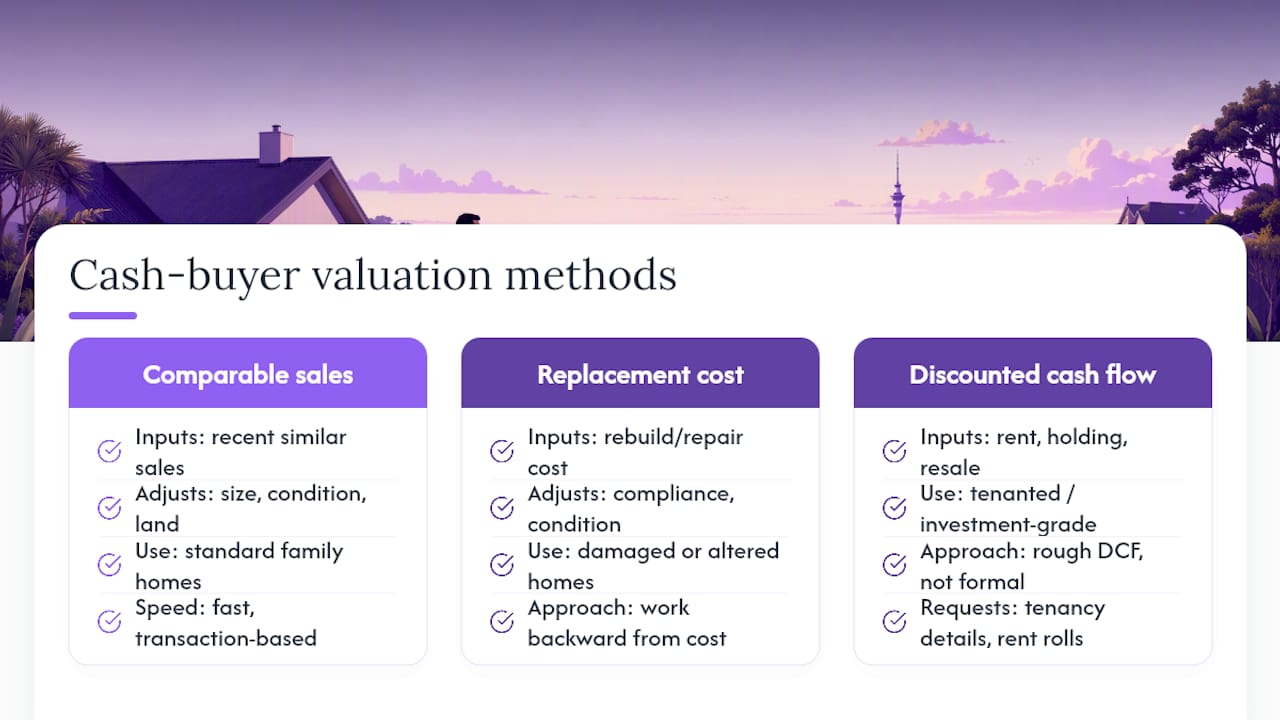
Two methods do most of the work behind a fast cash offer, and neither requires a formal registered valuation.
The first is a comparable sales approach, sometimes called sales comparison. The buyer finds recent, genuinely similar sales nearby, adjusts for size, condition and land value, and arrives at an estimated current market value. This is the backbone of almost every cash offer in NZ, because it’s fast and grounded in real transaction data rather than theory.
The second is a replacement cost approach, used more often on properties with significant damage, unconsented additions, or unusual layouts where clean comparables are hard to find. Here the buyer estimates what it would cost to rebuild or bring the property to a compliant, saleable standard, then works backwards from that figure.
A smaller number of buyers, particularly those planning to hold a property as a long-term rental, will run a rough discounted cash flow style calculation, weighing expected rental income against holding costs and eventual resale value. This tends to matter more for tenanted or investment-grade properties than for a standard family home, and it’s why tenancy details and rent rolls get requested early when a property is already tenanted.
In practice, most residential cash offers blend the comparable sales figure with a condition-based adjustment, rather than running a full formal model. It’s quick, defensible, and transparent enough that you can check the buyer’s working against real listings yourself.
How do interest rates and the wider economy affect cash offers?
Cash offers don’t exist in a vacuum. When interest rates rise, fewer buyers can secure finance at a price that competes with a cash offer, which can actually widen the gap between what a mortgaged buyer might pay and what a cash buyer offers, because the cash buyer faces less competition and less urgency to match market price.
Broader economic conditions, construction costs, material prices, how many properties are sitting on the market, all feed into a cash buyer’s risk margin too. When resale conditions are softer, buyers typically build in a slightly larger urgency discount because they’re carrying the property for longer before they can move it on. When the market’s moving quickly, that margin can tighten, because holding costs and resale risk drop.
This is worth knowing if you’re timing a sale: the discount you’re offered isn’t fixed. It shifts with borrowing costs, building costs, and how confident buyers feel about resale demand in your area over the next six to twelve months.
Common seller mistakes and what actually works
The biggest mistake sellers make is anchoring to a rushed online estimate and expecting a cash offer to match it. Cash offers price in speed and certainty, not just square metreage. The second mistake is holding back known defects, hoping they won’t surface, when disclosure almost always produces a cleaner, faster result. The third is skipping legal advice because the process feels informal. It isn’t. Get a solicitor to read the Sale and Purchase Agreement regardless of how straightforward the offer looks.
If you’re genuinely time pressed, take the discount seriously as the price of certainty, not as a loss. If you have a little more flexibility, ask for the itemised deductions and push back on any that seem inflated.
— Aaron
If you want a quick no-obligation cash offer
A fast, transparent cash offer is available without agent commissions, marketing costs, or months of open-home uncertainty, and you don’t need to fix a thing before you ask.

The process is simple: you submit your property details, Easysale assesses it using the same comparable-sales and condition-based approach outlined above, and you receive a no-obligation cash offer. Easysale purchases homes in any condition, damaged, unconsented, tenanted, or inherited, so there’s no need to renovate or stage anything first. Settlement happens on a timeline that suits you, sometimes within days. We’d always encourage you to have a solicitor review the Sale and Purchase Agreement before signing, and there’s never any obligation to accept what’s offered. If you’re weighing this against other routes, our complete guide to selling in New Zealand walks through the alternatives too. Ready to see a number? Get your no-obligation cash offer from Easysale today.
FAQ
How Long Does A Cash Offer Take In NZ?
Most cash buyers turn an offer around within 24 to 48 hours of receiving your property details, with settlement possible in as little as 7 days.
How Much Lower Is A Cash Offer Than Market Value?
Cash offers typically sit 10% to 30% below open-market value to account for repairs, consent risk and the buyer’s urgency margin.
What Documents Do I Need For A Fast Property Sale?
You’ll generally need your title, LIM report, any Code Compliance Certificates, recent rates notices, and a tenancy agreement if the property is tenanted.
Do I Need A Solicitor For A Cash Sale?
Yes. Every Sale and Purchase Agreement should go through independent solicitor review before you sign, even when the process feels straightforward.
Can I Sell A Damaged Or Unconsented Property For Cash?
Yes. Direct cash buyers like Easysale typically purchase properties in any condition, including damaged, unconsented, tenanted, or inherited homes.
Recommended
