
Role of property documents in NZ real estate sales

TL;DR:Property documents establish ownership, legal boundaries, and property hazards, preventing disputes during sales.Preparing and verifying these documents at least 30 days before listing helps avoid delays and costly errors.
Property documents are the legal evidence that confirm who owns a property, what rights attach to it, and whether a sale can proceed without risk. The role of property documents in any New Zealand real estate transaction is not administrative. It is foundational. Without a current Record of Title from Land Information New Zealand (LINZ), a valid Land Information Memorandum (LIM) report, and supporting consents, a sale can stall, fall over entirely, or expose you to legal liability. Whether you are selling a family home or an investment property, understanding what these documents do and how to prepare them is the difference between a smooth settlement and a costly dispute.
What are the key types of property documents?

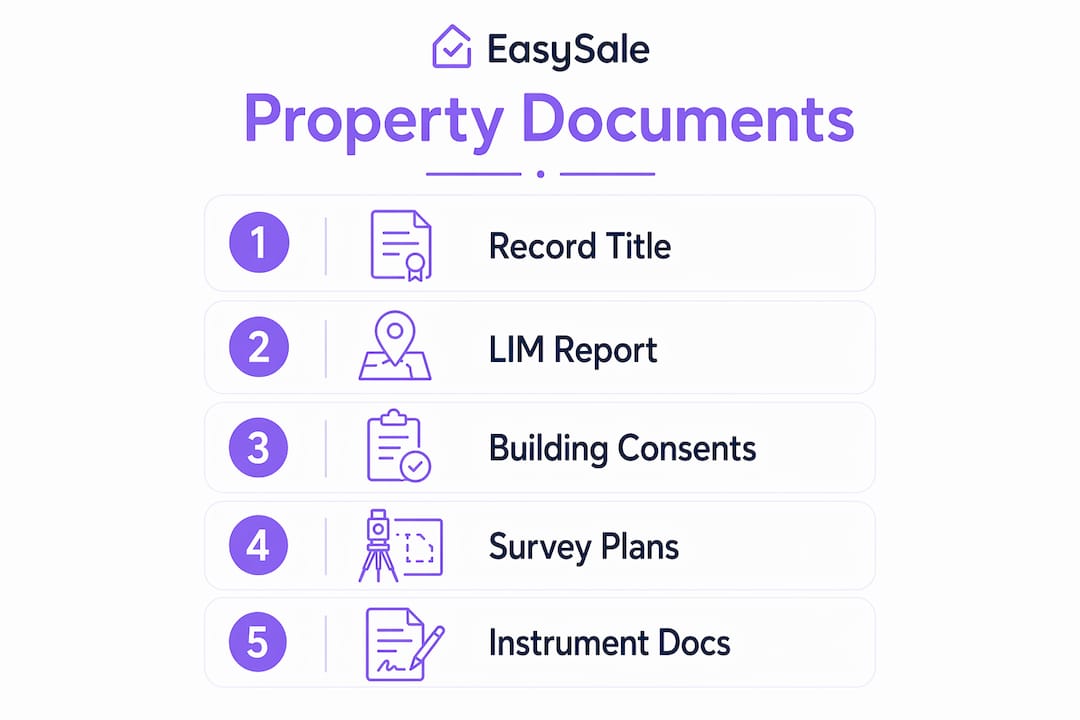
Property title documentation in New Zealand centres on a handful of core records. Each one answers a specific question a buyer, bank, or solicitor will ask before settlement.
Record of Title
The Record of Title is the primary ownership document. It shows the registered proprietors, the legal description of the land, and any encumbrances such as mortgages, easements, covenants, or caveats. Only registered proprietors can legally sell a property. If you are selling on behalf of another person, written authority is required. A standard title report costs approximately $42.90 NZD, while a Guaranteed Search costs $45.90 NZD and provides a state-backed assurance that the title is correct at the time of search. Banks and solicitors frequently require a Guaranteed Search before approving a mortgage or confirming settlement.
Land Information Memorandum (LIM) report
A LIM report is issued by your local council and summarises everything the council holds about your property. This includes building consents, resource consents, drainage information, flood and erosion hazard notices, and any unconsented works on record. LIM fees vary by council, but the report is one of the first documents a buyer’s solicitor will request.
Building consents and Code of Compliance Certificates
If your property has had any renovations, additions, or structural changes, you need the original building consent and the Code of Compliance Certificate (CCC) for each piece of work. A CCC confirms the work was inspected and met the New Zealand Building Code at the time of completion. Missing CCCs are a serious red flag for buyers and lenders alike.
Survey plans and instrument documents
Survey plans define the exact boundaries of your land. Instrument documents record legal interests such as easements (rights of way, drainage rights) and covenants (restrictions on how the land can be used). These sit behind the Record of Title and are referenced within it.
Here is how the core documents interrelate:
| Document | What it confirms | Who typically requires it |
|---|---|---|
| Record of Title | Ownership, encumbrances, legal boundaries | Buyer, solicitor, bank |
| LIM report | Council records, hazards, consents | Buyer, solicitor |
| Building consent and CCC | Compliance of physical works | Buyer, lender, insurer |
| Survey plan | Exact land boundaries | Solicitor, buyer |
| Guaranteed Search | Title accuracy at settlement | Bank, solicitor |
How do property documents protect buyers and sellers?
The protective functions of property records run in both directions. Sellers are protected from post-settlement disputes when their documents clearly establish what was disclosed. Buyers are protected from purchasing a property with hidden legal problems.
New Zealand operates under the caveat emptor (buyer beware) principle. Under this principle, buyers rely primarily on LIM reports and property documents for defect information. Sellers are not legally required to disclose most defects, but they must not misrepresent the property if they choose to make any statements. This makes the LIM report the buyer’s primary shield against undisclosed hazards, flooding risks, or unconsented works.
For sellers, the Record of Title does the heavy lifting. It verifies your authority to sell and discloses any mortgages, easements, or covenants that affect the property. A buyer’s solicitor will check the title against the sale and purchase agreement to confirm that what you are selling matches what is registered. Discrepancies here cause delays and, in serious cases, can void a contract.
- Fraud prevention: Verifying the seller’s identity against the Record of Title prevents fraudulent sales by parties who do not hold legal ownership.
- Mortgage disclosure: Any registered mortgage must be discharged before or at settlement. Undisclosed mortgages discovered late create significant legal complications.
- Easement clarity: Buyers need to know if a neighbour holds a right of way across the property. Undisclosed easements regularly lead to post-settlement disputes.
- Hazard transparency: LIM reports flag natural hazard zones. When buyers see hazard indicators, they increasingly commission Geotech reports to investigate further. Sellers who address these questions proactively maintain buyer confidence.
Pro Tip: Order your own LIM report before listing. Reading it yourself means you will not be caught off guard by a buyer’s solicitor raising issues you did not know existed.
What are common document errors and how can sellers avoid them?
Document problems are the leading cause of settlement delays in New Zealand property sales. Most are avoidable with early preparation.
Incorrect owner names, undischarged mortgages, missing easement documentation, boundary discrepancies, and covenant breaches are the most common title errors sellers encounter. Each one needs to be identified and corrected before you list, not after a buyer has signed a contract.
- Incorrect owner names on the title. This happens after marriage, divorce, or a deceased estate where the title was never updated. Correcting a name on the Register requires a formal application to LINZ and takes time. Start this process weeks before your intended listing date.
- Undischarged mortgages. If you have paid off a loan but the mortgage was never formally discharged from the title, it still appears as an encumbrance. Contact your lender and solicitor to arrange a formal discharge and have it registered with LINZ.
- Unconsented renovations. Unconsented work and missing CCCs are the top deal-killers found during due diligence. They cause costly delays or failed sales. Check your council file before listing to confirm every piece of work has a consent and a CCC on record.
- Boundary disputes. If your fences do not align with your survey plan, a buyer’s solicitor will raise it. Commission a registered surveyor to confirm boundaries if there is any doubt.
- Covenant breaches. If a covenant restricts land use (for example, no commercial activity or minimum floor area) and your property appears to breach it, you need legal advice before listing.
Pro Tip: Engage a property solicitor at least six weeks before your planned listing date. Legal review early in the process prevents you from signing a sale and purchase agreement that locks you into conditions you cannot meet.
How to prepare and organise your property documents for sale
Preparation is the single most effective thing you can do to protect a sale. Sellers should compile their core document package at least 30 days before listing. This gives time to identify and fix problems before a buyer is involved.
What to gather
- Current Record of Title: Order directly through LINZ or a registered title search provider. Confirm it reflects the correct owner names and shows no unexpected encumbrances.
- LIM report: Apply to your local council. Processing times vary, so allow at least 10 working days. Read the report carefully and note anything that may prompt buyer questions.
- Building consents and CCCs: Obtain copies from your council’s building records. If any are missing, investigate whether retrospective consent or a certificate of acceptance is possible.
- Mortgage discharge documentation: Confirm with your lender that any paid-off mortgages are formally discharged and registered.
- Survey plan: Obtain a copy of the deposited plan from LINZ. Cross-check boundaries against your physical fences and any shared access arrangements.
How to organise and share documents
Compile all documents into a single package. Share this with your solicitor first for review, then make it available to serious buyers through your agent or directly. A well-organised document package signals transparency and reduces the number of questions buyers raise during due diligence.
| Preparation step | Recommended timing |
|---|---|
| Order Record of Title and Guaranteed Search | 30+ days before listing |
| Apply for LIM report | 30+ days before listing |
| Collect building consents and CCCs | 30+ days before listing |
| Confirm mortgage discharge status | 30+ days before listing |
| Legal review of documents and sale agreement | Before signing any contract |
Submitting accurate property details from the outset reduces back-and-forth with buyers and their solicitors. The legal considerations for selling property in NZ go beyond documents alone, but documents are where most problems originate.
Pro Tip: Digital copies of your documents are now widely accepted. LINZ provides online access to title records, which speeds up the preparation process considerably.
Key takeaways
Property documents are the legal foundation of every New Zealand property sale, and preparing them at least 30 days before listing is the most reliable way to prevent settlement delays.
| Point | Details |
|---|---|
| Start document preparation early | Order your Record of Title, LIM report, and consents at least 30 days before listing. |
| Verify title accuracy first | Check owner names, mortgages, and easements on the Record of Title before any buyer sees it. |
| Missing CCCs cause failed sales | Confirm every renovation has a building consent and Code of Compliance Certificate on council record. |
| Legal review prevents costly errors | Engage a solicitor before signing a sale and purchase agreement to avoid locked-in liabilities. |
| Transparency builds buyer confidence | Sharing a complete document package early reduces due diligence delays and maintains buyer trust. |
My honest view on property documents in 2026
I have seen sellers lose buyers over problems that were entirely fixable. A missing CCC on a deck added ten years ago, an undischarged mortgage from a refinance that was never properly closed out, a fence sitting 400mm inside the legal boundary. None of these are catastrophic on their own. All of them become catastrophic when a buyer discovers them three days before settlement.
What I have noticed shift in recent years is buyer sophistication. Buyers in 2026 are more thorough than they were five years ago. They commission Geotech reports when a LIM flags a hazard. They instruct their solicitors to check instrument documents, not just the front page of the title. They ask about every consent. Sellers who treat document preparation as a formality get caught out. Sellers who treat it as a professional obligation sail through.
The other shift worth noting is digital access. LINZ’s online systems mean a solicitor can pull a current title in minutes. That is genuinely useful for sellers because it removes the excuse for not checking early. There is no reason to list a property without knowing exactly what your title says.
My practical advice is simple. Get your documents together before you talk to a single buyer. Read your LIM report yourself. Have your solicitor review the sale and purchase agreement before you sign it. These steps cost a few hundred dollars and a few hours. Skipping them can cost you a sale.
— Aaron
Selling your property without the paperwork stress
Getting your documents right is the hard part. Once they are in order, the sale itself should be straightforward.

Easysale works with New Zealand homeowners who want to sell their property privately without the drawn-out process of traditional listings. You submit your property details, receive a fair cash offer within 24 hours, and settle on a timeline that suits you. No agent commissions, no open homes, and no waiting for a buyer to sort their finance. Easysale handles the process with transparency and supports you through the document requirements from start to finish. If you want a faster path to settlement, Easysale is worth a conversation.
FAQ
What are property documents in a NZ sale?
Property documents are the legal records that confirm ownership, boundaries, consents, and encumbrances for a property. The core documents are the Record of Title, LIM report, building consents, and Code of Compliance Certificates.
Why is the Record of Title so important?
The Record of Title is the definitive proof of ownership in New Zealand. It shows who can legally sell the property and lists any mortgages, easements, or covenants that affect it.
What happens if a property has unconsented work?
Unconsented renovations without a Code of Compliance Certificate are a common cause of failed sales and settlement delays. Sellers should check council records before listing and seek legal advice if any consents are missing.
How early should I order a LIM report?
Apply for your LIM report at least 30 days before your intended listing date. Council processing times vary, and you need time to review the findings and address any issues before buyers begin due diligence.
Do I need a lawyer to review my property documents?
Legal review before signing a sale and purchase agreement is strongly recommended. Contracts become binding once signed, and a solicitor can identify title issues or conditions that could create liability before you are locked in.
Recommended
