
What is a forced sale? a clear guide for kiwis


TL;DR:A forced sale is an involuntary property transaction ordered by courts, lenders, or government agencies to recover debts or resolve disputes. It typically results in prices 20%–40% below market value due to limited marketing time and seller negotiations, and early legal advice can help owners protect their interests. Owners have rights to contest, negotiate, and seek exemptions before a formal sale process, with alternatives like voluntary sales and cash buyers available to prevent or manage the outcome.
A forced sale is an involuntary property transaction where a court, lender, or government agency compels an owner to sell their real estate to satisfy a debt, resolve a legal dispute, or pay unpaid taxes. In New Zealand, this situation affects homeowners facing mortgage defaults, relationship breakdowns, or serious financial hardship. The result is almost always a sale price well below what you would achieve on the open market. Understanding what a forced property sale means, and how the process works, puts you in a far stronger position to protect your interests.
What is a forced sale and how does it work in NZ?
A forced sale, known formally as a compulsory sale or judicial sale in legal contexts, occurs when you lose the right to sell your property on your own terms. Instead, a creditor, court, or government body takes control of that decision. Forced sale values are typically 20%–40% below what you would receive through a standard voluntary sale, because urgency removes your negotiating power entirely.
The forced sale process in New Zealand generally follows these steps:
- Default or dispute arises. You miss mortgage payments, fail to pay rates or taxes, or become involved in a co-ownership dispute with another party.
- Creditor or court issues a formal notice. Your lender, a co-owner, or a government body files a legal claim or issues a notice of default.
- Court approval is sought. In judicial sales, a judge reviews the application and approves the sale process. This step is designed to protect both parties from fraud or unfair outcomes.
- A sale manager or official is appointed. The court or lender appoints a third party, often a solicitor or real estate professional, to manage the sale.
- Property is listed and sold, usually at auction. The property is sold as-is, often with limited marketing time, to the highest bidder.
- Proceeds are distributed. Sale proceeds are prioritised for outstanding debts and costs first. Any surplus returns to you as the former owner.
Common triggers include mortgage foreclosure from missed payments, court-ordered partition actions in co-ownership or relationship property disputes, and tax lien enforcement by local councils. Non-judicial forced sales, such as mortgagee sales, can conclude within months. Judicial sales requiring full court proceedings take considerably longer.
Pro Tip: If you receive a formal default notice from your lender, contact a property lawyer within 48 hours. Early legal advice can open options that disappear once the formal sale process begins.

How does forced sale value differ from market value?
Forced sale value is the estimated price a property would achieve under compelled conditions, with restricted marketing time and a limited buyer pool. Market value is what a willing buyer pays a willing seller in an open, unrestricted transaction. The gap between the two is significant and consistently underestimated by homeowners.
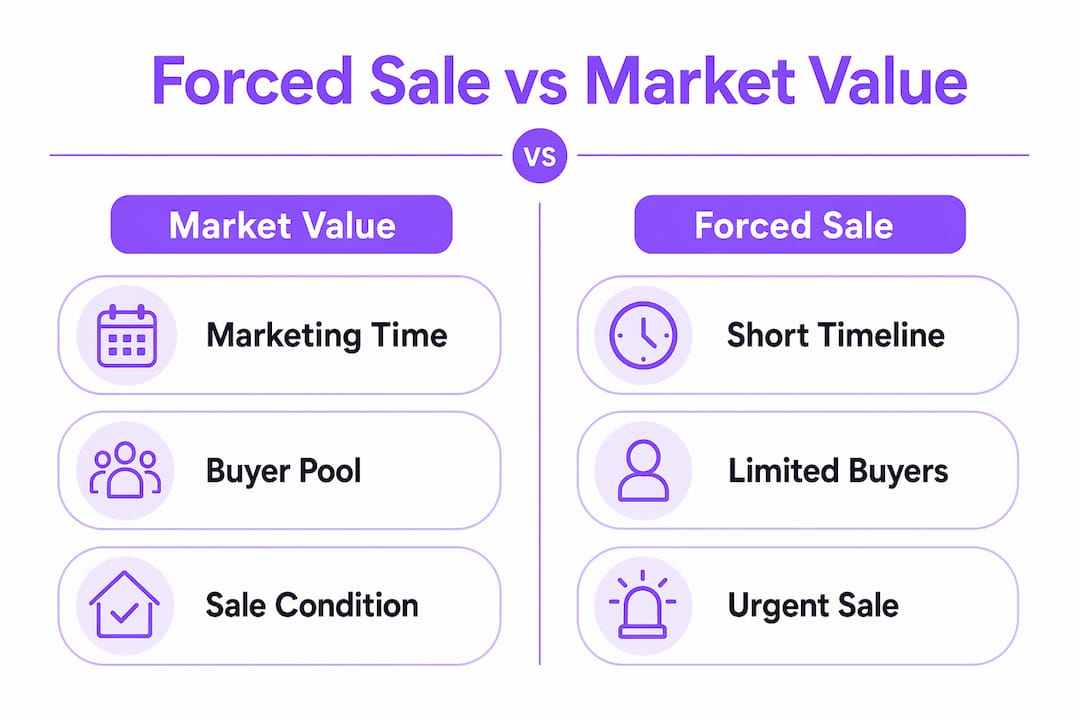
| Feature | Market Value | Forced Sale Value |
|---|---|---|
| Marketing time | Weeks to months | Days to a few weeks |
| Buyer pool | Broad, competitive | Restricted, often auction only |
| Seller negotiating power | Full | None or minimal |
| Property condition | Presented and prepared | Sold as-is |
| Typical price achieved | Full market potential | 60%–80% of market value |
| Emotional pressure on seller | Low to moderate | High |
Exposure time is the single biggest factor separating the two. A standard property sale in New Zealand allows you to prepare the home, run a marketing campaign, and negotiate with multiple buyers. A forced sale compresses all of that into a short window, which limits competition and drives the price down.
Valuation professionals describe forced sale value as a worst-case recovery figure, not a reflection of true market potential. Lenders use this figure when assessing loan risk, which is why your bank’s internal valuation of your property may look lower than what you expect. Lenders apply conservative discounts to cover auction fees, commissions, and transactional delays, making their recovery estimates intentionally cautious.
Pro Tip: Before accepting any forced sale outcome, commission an independent registered valuation from a New Zealand Institute of Valuers member. Knowing the gap between forced sale value and market value gives you a concrete figure to negotiate around.
For a broader understanding of how fair market offers are calculated in fast-sale scenarios, it helps to compare your property against recent comparable sales in your area.
What are the legal rights of owners facing a forced sale?
Facing a forced sale does not mean you are without rights. New Zealand law provides several protections, and understanding them can make a real difference to your financial outcome.
- Right to contest the sale. You can challenge a forced sale application in court, particularly if you believe the debt amount is incorrect or the process has not followed proper legal procedure.
- Right to negotiate with creditors. Lenders and creditors often prefer a negotiated outcome over a lengthy court process. You may be able to arrange a repayment plan, a voluntary sale at a better price, or a short sale agreement before the forced process begins.
- Possible equity exemptions. Homeowners may be entitled to exemptions from forced sale proceeds if their equity falls below certain legal thresholds. In some cases, creditors cannot compel a sale at all if your protected equity is sufficient.
- Right to legal representation. You are entitled to have a solicitor present at every stage of the process. A property lawyer familiar with New Zealand’s Property Law Act 2007 and the Credit Contracts and Consumer Finance Act 2003 can identify procedural errors that may delay or halt a sale.
- Judicial oversight as a safeguard. Court supervision is designed to prevent predatory practices and ensure the sale is conducted fairly. While this adds time, it also creates a formal record you can use if you need to appeal.
The practical consequences of accepting a forced sale price are significant. You may walk away with little or no equity after debts and costs are cleared. Your credit record will carry the impact for years. Acting early, before the formal process locks in, is the most effective way to preserve your financial position. Understanding the legal considerations when selling property in NZ is a strong starting point.
What alternatives can help you avoid or manage a forced sale?
You have more options than most people realise, especially if you act before the formal process is underway.
- Talk to your lender early. Banks and non-bank lenders in New Zealand are generally required to work with you before initiating a mortgagee sale. A hardship application under the Credit Contracts and Consumer Finance Act 2003 can pause proceedings while you explore options.
- Consider a voluntary sale first. Selling your property privately before a forced sale is triggered almost always produces a better price. A voluntary sale gives you control over timing, presentation, and negotiation. Review your property sale options in NZ to understand what suits your situation.
- Use a direct cash buyer. Specialised property buying services can settle within days, which may be fast enough to satisfy a creditor and avoid a forced auction. This approach removes agent commissions and the uncertainty of open market timing.
- Get a registered valuation before any negotiation. Knowing your property’s current market value and its forced sale value gives you a factual basis for every conversation with lenders, lawyers, and buyers.
- Seek legal and financial advice together. A property lawyer and a financial adviser working in tandem can identify options you would not find alone, including debt consolidation, refinancing, or structured repayment plans that remove the forced sale trigger entirely.
If your property has been damaged or neglected, a forced sale at auction is likely to produce the worst possible outcome. Selling directly to a buyer who purchases as-is removes that risk. Read more about selling after property neglect to understand your realistic options in that scenario.
Key takeaways
A forced sale almost always produces a price 20%–40% below market value, and acting early is the single most effective way to protect your equity and your options.
| Point | Details |
|---|---|
| Forced sale definition | A compulsory property sale ordered by a court, lender, or government to recover debts. |
| Price impact | Forced sale values are typically 60%–80% of market value due to restricted time and buyer competition. |
| Legal protections exist | Owners can contest sales, claim equity exemptions, and negotiate with creditors before proceedings lock in. |
| Alternatives are available | Voluntary sales, direct cash buyers, and hardship applications can all prevent a forced sale outcome. |
| Early advice is critical | Engaging a property lawyer and financial adviser at the first sign of default preserves the most options. |
The uncomfortable truth about forced sales most people learn too late
I have worked with enough homeowners in financial distress to know that the biggest mistake is waiting. People receive a default notice and assume they have time. They do not. The moment a lender or court takes formal control of your sale, your ability to influence the outcome drops sharply.
The second misunderstanding I see constantly is around pricing. Homeowners believe their property is worth what the neighbours sold for last year. In a forced sale, that number is irrelevant. What matters is what a buyer will pay at a compressed auction with no marketing, no styling, and no negotiation. That figure is almost always painful.
What actually helps is clarity. When you understand the forced sale definition, the process, and the likely price gap, you stop being reactive and start making decisions. I have seen owners negotiate directly with lenders and walk away with tens of thousands more than they would have received at auction, simply because they engaged early and came with facts.
My honest advice: get a registered valuation, call a property lawyer, and explore a voluntary sale before the process is taken out of your hands. The property sale process in NZ is manageable when you understand it. A forced sale is not the end of the road. It is a signal to act now, not later.
— Aaron
How Easysale can help you sell quickly and fairly
If you are facing financial hardship, property damage, or an urgent life change that requires a fast property sale, Easysale offers a direct, no-commission cash buying service across New Zealand.
Easysale buys properties in any condition, with no real estate agents involved and no commission fees to pay. You submit your property details, receive a fair cash offer within 24 hours, and settle on a timeline that works for you. This approach gives you control over the outcome before a lender or court removes that control entirely. Whether your property needs repairs or you simply need to move fast, Easysale’s process is built around your circumstances. Get a fair cash offer today and take the first step toward a clear resolution.
FAQ
What is the forced sale definition in plain terms?
A forced sale is when a court, lender, or government body compels a property owner to sell their real estate to recover an unpaid debt or resolve a legal dispute. The owner loses the right to set the terms, timing, or price of the sale.
Why is forced sale value lower than market value?
Forced sale prices are typically 20%–40% below market value because the compressed timeline limits marketing exposure, reduces buyer competition, and removes the seller’s negotiating power entirely.
Can you stop a forced property sale once it has started?
You can contest a forced sale in court, negotiate a repayment arrangement with your creditor, or complete a voluntary sale before the formal process concludes. Early legal advice significantly improves your chances of a better outcome.
What happens to the money from a forced sale?
Proceeds from a forced sale are applied first to outstanding debts, legal costs, and sale expenses. Any remaining surplus is returned to the former owner, though in many distressed cases little or nothing remains after costs.
What triggers a forced sale in new zealand?
The most common triggers are missed mortgage payments leading to a mortgagee sale, court-ordered partition actions from co-ownership or relationship property disputes, and unpaid local council rates or taxes resulting in enforcement action.


