
What is a no-chain sale? A plain guide for Kiwi sellers


TL;DR:A no-chain sale involves a property transaction where the buyer is not dependent on selling another home first. It proceeds through standard legal steps, with the key benefit of faster, more predictable settlement, especially for cash buyers or investors. While offering speed and certainty, no-chain sales may result in lower sale prices compared to agent-assisted deals.
A no-chain sale is a property transaction where the buyer does not need to sell another home first. Settlement does not depend on a linked sale completing elsewhere, which means you get a faster, more predictable result. For any New Zealand homeowner who needs cash quickly, that single difference changes everything.
Even in a no-chain sale, the standard NZ legal process still applies:
- A signed Sale & Purchase Agreement (prepared by your lawyer or using an ADLS form)
- The buyer’s deposit held in a solicitor’s trust account
- Electronic title transfer through LINZ (Land Information New Zealand)
- A formal settlement day coordinated by your lawyer
Table of Contents
- What does a property chain mean in New Zealand?
- How does a no-chain sale work in New Zealand?
- Who can complete a no-chain sale in NZ?
- What are the real pros and cons of a no-chain sale?
- What timeline and costs should you expect?
- Your seller checklist for a no-chain sale
- How do you vet a cash buyer and spot red flags?
- A week-by-week example of a no-chain sale
- Key takeaways
- When is a no-chain sale actually the right call?
- Easysale: a direct cash offer with no agent fees
- Useful New Zealand sources and next steps
What does a property chain mean in New Zealand?
A property chain forms when two or more transactions are linked. Your buyer needs their own sale to settle before they can pay you. If that sale falls over, yours does too.
New Zealand settlements are synchronised on a single day. Unlike some overseas markets where delays can be absorbed over weeks, NZ’s same-day settlement model means one broken link creates a waterfall effect across every connected transaction. Deposits can be held up, settlement dates collapse, and sellers are left scrambling.
Common sources of a chain include:
- A buyer who still needs to sell their current home before they can fund your purchase
- Conditional offers where the contract only goes unconditional once the buyer’s own property sells
- Buyers relying on bridging finance that is tied to another settlement
CoreLogic commentary notes that chain effects keep market volume below long-term averages, making chain-free deals genuinely valuable for sellers who need liquidity.
How does a no-chain sale work in New Zealand?
A no-chain sale still follows the standard NZ legal process. The difference is that the buyer arrives with funds ready, not contingent on another sale. Here are the mandatory steps:
- Prepare the Sale & Purchase Agreement. Your lawyer drafts or reviews this document. It sets the price, conditions, chattels, and settlement date.
- Buyer pays the deposit into a solicitor’s trust account. This protects both parties. The deposit sits in trust until settlement.
- Legal checks and due diligence. Your lawyer confirms title, checks for encumbrances, and handles AML/CFT compliance. The buyer may arrange a LIM report and building inspection.
- LINZ electronic title transfer. Your lawyer lodges the transfer with Land Information New Zealand. This is a legal requirement you cannot skip.
- Settlement day. Your lawyer and the buyer’s lawyer exchange funds and documents. If you have signed everything in advance, you have little to do on the day itself.
Before signing anything, ask your lawyer to check whether any prior agency agreement is still active. A past exclusive listing can create a commission claim even in a private sale.
Who can complete a no-chain sale in NZ?
The buyers most likely to deliver a genuine no-chain result are cash buyers, property investors, mortgage-free individuals, and property buying services like Easysale.
- Cash buyers and investors hold liquid funds and do not need a bank to approve a loan tied to another asset. They can commit to a settlement date without conditions.
- Mortgage-free individuals (often downsizers or retirees) have already sold or own outright, so no sale-to-fund dependency exists.
- Property buying services such as Easysale purchase in any condition using a three-step process: submit your details, receive a no-obligation offer, and settle on a timeline that suits you. No agent, no open homes, no waiting.
Whichever buyer type you deal with, ask for written proof of funds and insist on lawyer-to-lawyer communication from the start.
What are the real pros and cons of a no-chain sale?

A chain-free sale is the fastest route to certainty, but it usually involves a price trade-off. Weigh both sides before committing.
Pros:
- Faster settlement, often within weeks rather than months
- No commission payable if you sell privately without an agent
- Predictable timeline with no third-party dependencies
- Reduced risk of the sale falling through at the last moment
Cons:
- Cash buyers and investors typically offer below market value
- Limited exposure means fewer competing offers
- You carry more legal and due-diligence responsibility when selling privately
- Industry analysis suggests agent-assisted sales may achieve median prices moderately higher than private sales
The price gap is real. Agent-assisted sales may achieve median prices 10–13% higher than private sales, according to industry analysis. A no-chain sale saves commission but may not close that gap entirely.
What timeline and costs should you expect?
A genuine no-chain sale can settle quickly once both parties have signed the Sale & Purchase Agreement. Compare that to a chained sale, which can drag on for months if one link breaks.
Typical stage durations:
- Offer to signed S&P: 1–3 days (lawyer review included)
- Due diligence and legal checks: 5–10 working days
- LINZ title transfer lodgement: 1–2 working days
- Settlement day: single day, managed by your lawyer
Direct costs to budget for:
- Legal/conveyancing fees: typically NZ$1,500–$3,000 for a standard residential sale
- LIM report: ordered from your local council (cost varies by council)
- Building inspection: optional but recommended, cost varies by property size
- Agent commission: nil if you sell privately
The commission saving is meaningful, but weigh it against the potential 10–13% price uplift an agent might achieve. For sellers who need speed above all else, the maths often still favours a fast private settlement.
Your seller checklist for a no-chain sale
Preparation is what separates a smooth settlement from a stressful one. Work through this list before you accept any offer.
- Engage a lawyer or conveyancer before you market the property or accept an offer.
- Order a LIM report from your local council to identify any issues upfront.
- Gather title documents and confirm there are no encumbrances or caveats on the property.
- Collect recent rates and utility statements so the buyer can see outgoings clearly.
- List all chattels that will remain with the property and confirm with your lawyer.
- Check past agency agreements with your lawyer to rule out any outstanding commission obligations.
- Request proof of funds from the buyer before signing the S&P.
- Agree a settlement date in writing and confirm your mortgage discharge timeline with your bank.
Pro Tip: Ask your lawyer to search for any prior agency introductions before you sign. If an agent introduced your buyer to the property previously, that agency may still have a valid commission claim even if you arranged the sale yourself.
How do you vet a cash buyer and spot red flags?
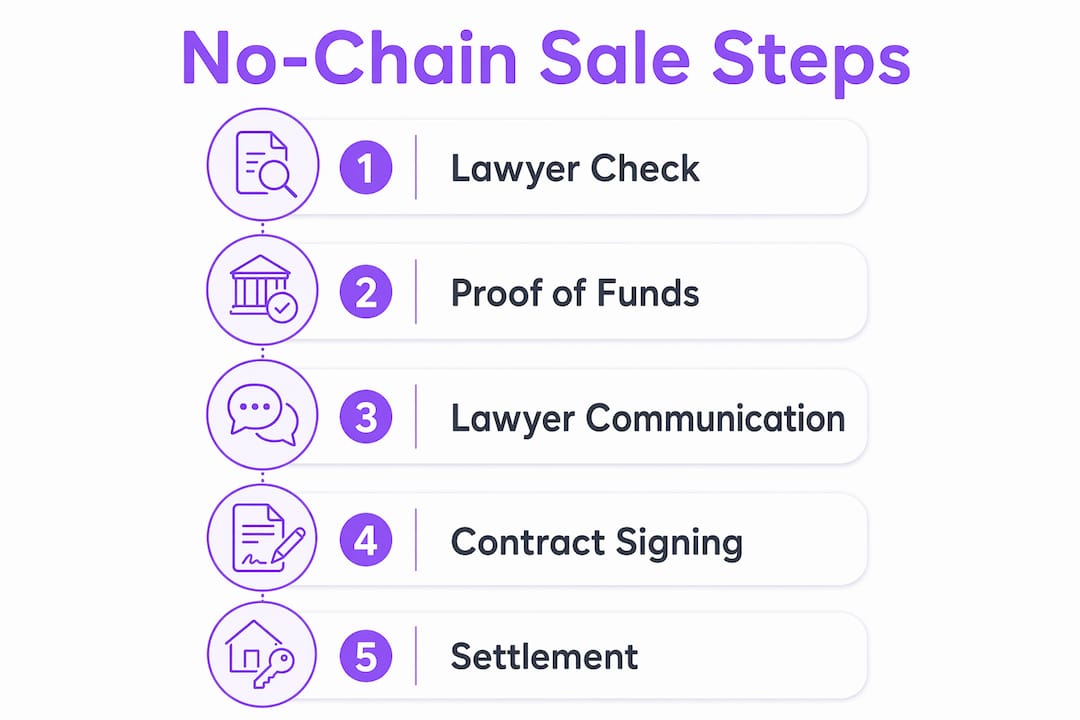
Always verify proof of funds and insist on lawyer-to-lawyer communication from the first offer. A genuine cash buyer will not hesitate on either point.
Questions to ask every buyer:
- Can you provide written proof of funds from your bank or solicitor?
- What is the source of those funds?
- Are you willing to pay the deposit into a solicitor’s trust account?
- What settlement date are you proposing, and is it firm?
- Do you have any dependency on another sale or finance approval?
Trust signals to look for: a buyer who names their lawyer upfront, provides a bank confirmation letter, and proposes a realistic settlement date without pressure.
Red flags to watch for: reluctance to use a trust account, vague or shifting timelines, pressure to skip legal review, or an offer that is conditional on a sale they claim is “almost settled.”
A week-by-week example of a no-chain sale
A straightforward no-chain sale can move from accepted offer to settled title in roughly three weeks. Here is how that typically looks:
- Week 1, Day 1–2: You accept a cash offer. Your lawyer reviews the Sale & Purchase Agreement and both parties sign. The buyer pays the deposit into the solicitor’s trust account.
- Week 1, Day 3–5: Your lawyer confirms title, checks for encumbrances, and handles AML/CFT compliance. The buyer arranges a LIM report and, if required, a building inspection.
- Week 2: Due diligence completes. The contract goes unconditional. Your lawyer lodges the LINZ title transfer and coordinates mortgage discharge with your bank.
- Week 3, Settlement Day: Lawyers exchange funds and documents. LINZ registers the new title. Keys are handed over. Funds clear into your account.
The whole process relies on both lawyers being responsive and all documents being ready in advance. Sellers who prepare their paperwork early consistently reduce settlement friction and avoid last-minute delays.
Key takeaways
A no-chain sale is the fastest, most predictable way to exit a property in New Zealand, but it requires a lawyer, proper documentation, and a buyer with verified funds.
| Point | Details |
|---|---|
| Definition | The buyer needs no prior sale to fund the purchase, so settlement does not depend on another transaction. |
| Legal steps are mandatory | Sale & Purchase Agreement, trust-account deposit, LINZ title transfer, and lawyer involvement are all required by law. |
| Price trade-off is real | Agent-assisted sales may achieve median prices moderately higher; weigh that against commission savings and speed. |
| Typical timeline | A genuine no-chain sale can settle in two to four weeks once the S&P is signed. |
| Easysale option | Easysale offers a no-obligation cash offer and a flexible settlement timeline, with no agent fees and no open homes. |
When is a no-chain sale actually the right call?
There is a version of this conversation that gets skipped too often. People focus on the price gap between a private cash sale and an agent-marketed campaign, and they treat it as the whole story. It is not.
Speed has a dollar value. If you are carrying mortgage repayments on a property you cannot afford to hold for another three to six months, every week of delay costs you money. A no-chain sale that settles in three weeks and saves you four months of holding costs can easily outperform a higher sale price that takes half a year to land.
The honest answer is that a no-chain sale is right when certainty matters more than squeezing the last dollar. That might be a financial pressure, a health situation, a relationship change, or simply the relief of knowing it is done. None of those reasons need justifying.
What I would caution against is skipping the legal steps to save a few hundred dollars. A lawyer reviewing your S&P and handling the LINZ transfer is not optional. It is the thing that protects you if the buyer’s “proof of funds” turns out to be less solid than it looked.
Easysale: a direct cash offer with no agent fees
If you have read this far and you want certainty over a drawn-out campaign, Easysale offers a practical alternative. Submit your property details, receive a no-obligation cash offer, and settle on a timeline that works for you. No open homes, no agent commission, no waiting on a buyer who still needs to sell their own home first.
Easysale buys properties across New Zealand in any condition, including properties that would be difficult to market through a traditional agent. The process is straightforward: you share your details, Easysale assesses the property, and you receive a fair cash offer with no pressure to accept.
One important note: even with Easysale, you should use your own lawyer for the title transfer and AML/CFT compliance. That step protects you and is required by New Zealand law.
Ready to find out what your property is worth? Request a cash offer from Easysale today, and have your lawyer review any offer before you sign.
Useful New Zealand sources and next steps
Verify the facts in this article and get started with these authoritative NZ resources:
- Settled.govt.nz — Deciding to sell with an agent or privately
- Settled.govt.nz — Settlement day when selling
- Settled.govt.nz — Selling privately
- New Zealand Government — Selling your house
- Easysale — How to settle property quickly in NZ
- Easysale — Property sale process in NZ explained
Recommended next steps: contact a lawyer or conveyancer before you accept any offer, request written proof of funds from your buyer, and if you want a fast cash exit, request an Easysale offer with no obligation to proceed.
This article is general information only and does not constitute legal or financial advice. Confirm current rules and your specific obligations with a qualified New Zealand lawyer or conveyancer before signing any agreement.


