
What is a pre-auction offer? A guide for NZ buyers

TL;DR:A pre-auction offer is a formal, unconditional proposal submitted before an auction that, if accepted, cancels the event and binds both parties. Such offers carry legal risks, including the loss of cooling-off rights if accepted close to auction day, and require full due diligence and immediate deposit payment. While they offer speed and certainty for sellers and buyers alike, inadequate preparation can lead to costly consequences and missed opportunities.
A pre-auction offer is a formal, written property purchase proposal submitted to a vendor before the scheduled auction date, which if accepted, cancels the auction and binds both parties under auction-style contract terms. In New Zealand, this approach is also known as a “prior offer” and sits in a legal grey zone that many buyers and sellers misunderstand. Whether you are a homeowner weighing up a fast sale or an investor looking to secure a property without competing on auction day, understanding what a pre-auction offer means in practice is the difference between a smart move and a costly mistake.
What is a pre-auction offer and how does it work?
A pre-auction offer is negotiated much like a private treaty sale, but it carries the legal weight of an auction bid once accepted. According to Consumer Affairs Victoria, buyers can submit offers through the agent before auction day, and if the vendor accepts, the auction is cancelled and the sale proceeds under the agreed contract terms.
The process works like this:
- Contact the agent or auctioneer. Ask directly whether the vendor will consider a pre-auction offer. Not all vendors will, and some agents are instructed not to entertain them.
- Prepare a written offer. The offer must be formal and signed. Casual expressions of interest carry no legal weight. Consumer Affairs Victoria confirms that written contracts are required, negotiated as private sale contracts.
- Submit through the agent. The agent presents your offer to the vendor and, in many cases, notifies the auctioneer. Michael Hossaini explains that in some situations, an accepted pre-auction offer can become the opening bid at a brought-forward auction, meaning competitive bidding may still occur.
- Vendor accepts or declines. If the vendor accepts, the auction is cancelled and both parties are bound. If declined, the auction proceeds as scheduled.
- Pay the deposit promptly. Once accepted, you are expected to pay the deposit quickly, typically 10%, mirroring standard auction conditions.
Pro Tip: Ask the agent whether the vendor has set a deadline for pre-auction offers. Some vendors will only consider offers submitted at least five working days before auction to allow time for proper legal review.
What are the legal and timing nuances of pre-auction offers in NZ?
The legal framework around pre-auction offers in New Zealand is one of the most misunderstood areas of property law. Many buyers assume they have the same protections as a standard private treaty purchase. They do not.
The most critical issue is the cooling-off period. Consumer Affairs Victoria warns that if a pre-auction offer is accepted less than three clear business days before the auction date, the buyer loses cooling-off rights entirely. New Zealand auction practice operates similarly. This means you cannot simply walk away from the deal if your circumstances change or your building inspection reveals a problem.
The Law Handbook confirms that contracts signed near auction day often fall within auction rules, stripping buyers of cooling-off protections and requiring full financial readiness before signing. This is not a technicality. It is a binding legal reality that has caught out many buyers who treated a pre-auction offer like a casual negotiation.
Key legal points to understand before you submit an offer:
- Unconditional is the norm. Pre-auction offers in New Zealand are generally expected to be unconditional, meaning no finance clause, no building inspection clause, and no solicitor approval clause.
- Due diligence must happen first. Become Wealth advises confirming local protections and completing all due diligence before submitting, because conditions common in private treaty sales are routinely waived in pre-auction offers.
- Jurisdiction matters. Rules vary between New Zealand and Australia, and even between regions. Always confirm the exact legal requirements with a property solicitor before proceeding.
- Deposit is payable immediately. New Zealand auction practice demands a 10% deposit on acceptance, and pre-auction offers mirror this in most cases.
“Pre-auction offers are often misunderstood by buyers as low-risk, but in reality, they carry legal and financial commitments similar to auction bidding.” — Consumer Affairs Victoria
Understanding the legal considerations when selling property in New Zealand is not optional when pre-auction offers are involved. It is the foundation of a safe transaction.
What are the benefits and risks for buyers and sellers?
Pre-auction offers carry genuine advantages for both sides of the transaction, but the risks are real and worth understanding clearly before you commit.

| Perspective | Benefits | Risks |
|---|---|---|
| Seller | Speed and certainty; auction cancelled; no auction day stress | May miss higher competitive bids; potentially lower final price |
| Buyer | Early access; less competition; certainty of purchase | Unconditional commitment; no cooling-off; full financial readiness required |
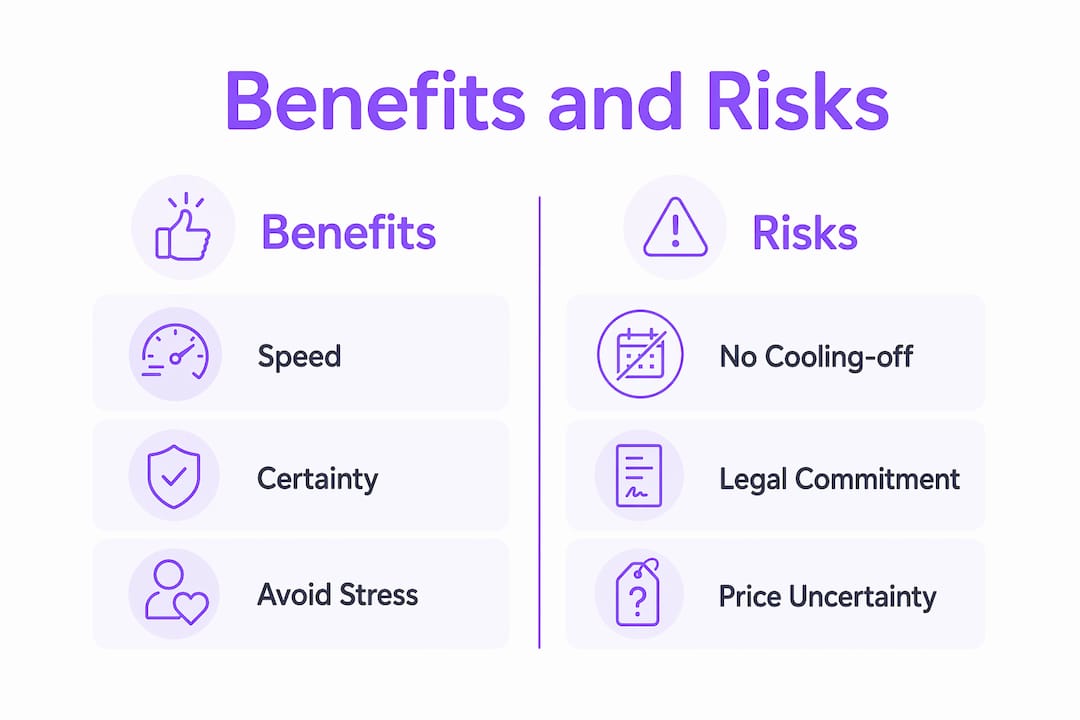
For sellers, the appeal is straightforward. Accepting a pre-auction offer removes the uncertainty of auction day. You know the price, you know the buyer, and you can plan your next move. SmartAuctionUK highlights that seller trade-offs are real: fewer competing bidders can mean a lower final price than a competitive auction might have produced. If your property is in a high-demand area with strong buyer interest, accepting early may cost you tens of thousands of dollars.
For buyers, the benefit is avoiding the pressure and unpredictability of auction day. You secure the property on your terms, without the risk of being outbid at the last moment. The downside is that you carry the full weight of an unconditional commitment. Coast Buyers Agency notes that pre-auction offers reduce uncertainty but depend entirely on your readiness and the strength of your offer.
Pro Tip: If you are a seller weighing up a pre-auction offer, research comparable recent sales in your suburb before deciding. If similar properties are selling above their guide price at auction, holding out for auction day may be worth the risk.
For sellers who prioritise speed over maximum price, a pre-auction offer can be the right call. You can read more about selling before auction and what it means for your outcome.
How to make a successful pre-auction offer in NZ
Making a pre-auction offer that a vendor will seriously consider requires preparation, not just a strong number. Follow these steps to give yourself the best chance of success.
- Confirm the vendor is open to offers. Contact the agent directly and ask. Some vendors instruct their agents not to accept pre-auction offers, so there is no point proceeding without this confirmation.
- Complete your due diligence in full. Order a building inspection, review the LIM report, and have your solicitor check the title before you submit anything. Once you sign, you are committed.
- Arrange unconditional finance. Speak to your bank or mortgage broker and get pre-approval confirmed in writing. New Zealand auction practice requires a 10% deposit on acceptance, so your funds must be accessible immediately.
- Submit a strong offer. PropertyAuctionAgent advises that strong unconditional bids should be at or above the guide price and submitted through the auctioneer or agent to be taken seriously. A lowball offer will almost always be declined.
- Include proof of finance. Attach your pre-approval letter or evidence of funds to demonstrate you can settle without delay.
- Negotiate through the agent. All communication should go through the agent or auctioneer. Direct contact with the vendor is inappropriate and can complicate the process.
Pro Tip: Submit your offer with a short acceptance deadline, such as 48 hours. This creates a sense of urgency without being aggressive, and it protects you from being used as leverage to attract other buyers.
Understanding the due diligence period is critical before you commit to any pre-auction offer. Skipping this step is the most common and costly mistake buyers make.
How do pre-auction offers compare with other sale methods in NZ?
Pre-auction offers sit between private treaty sales and full auctions in terms of speed, certainty, and flexibility. Understanding where they fit helps you choose the right approach for your situation.
| Sale method | Timeline | Conditions allowed | Cooling-off rights | Competition |
|---|---|---|---|---|
| Private treaty | Weeks to months | Yes | Yes (usually) | Low to moderate |
| Pre-auction offer | Days to weeks | Rarely | Often none | Low |
| Auction | Fixed date | No | No | High |
| Direct cash sale | Days | No | No | None |
A private treaty sale gives you more room to negotiate conditions and timelines, but it takes longer and carries no urgency for the vendor. An auction creates maximum competition and often achieves the highest price, but it is unpredictable and unconditional. A pre-auction offer sits in the middle: faster than private treaty, less competitive than auction, but carrying the same unconditional obligations.
One scenario worth knowing: auctioneers sometimes proceed with an auction even after a pre-auction offer is submitted, using the offer as the opening bid. Michael Hossaini explains this brought-forward auction process allows higher bids to compete, which can push the final price above what the pre-auction buyer offered. If you are a buyer, this is a risk to factor in.
For a full comparison of your options, the property sale options guide covers each method in detail, including the trade-offs for New Zealand homeowners.
Key takeaways
A pre-auction offer is a binding, unconditional commitment that carries auction-level legal obligations, making full due diligence and financial readiness non-negotiable before you sign.
| Point | Details |
|---|---|
| Pre-auction offer definition | A formal written offer made before auction day that cancels the auction if accepted. |
| Legal risk is real | Cooling-off rights are often lost, especially if accepted close to the auction date. |
| Unconditional is standard | Finance, building inspection, and solicitor clauses are typically waived to mirror auction terms. |
| Sellers trade price for speed | Accepting early may mean missing higher competitive bids from auction day. |
| Preparation is non-negotiable | Complete due diligence, arrange finance, and get legal advice before submitting any offer. |
My honest view on pre-auction offers in the NZ market
I have seen pre-auction offers go very well and very badly, and the difference almost always comes down to preparation. Buyers who rush into a pre-auction offer because they are excited about a property, without completing their due diligence or confirming their finance, are taking on a level of risk that most of them do not fully appreciate until it is too late.
The unconditional nature of these offers is not a formality. It is a hard legal commitment. If your finance falls through after acceptance, or your building inspection would have revealed a major defect, you have no easy exit. That is a serious position to be in.
From a seller’s perspective, I think pre-auction offers are underused as a tool for achieving a fast, certain sale. If you are in a situation where speed matters more than squeezing out the last dollar, a strong pre-auction offer from a credible buyer is worth serious consideration. The key is knowing your market. If comparable properties are selling well above guide at auction, holding out makes sense. If the market is softer and buyer numbers are thin, a solid pre-auction offer may be the best outcome you will get.
My advice to both buyers and sellers: get a property solicitor involved before you sign anything, and do not let the excitement of securing a deal override your financial judgement. The best pre-auction transactions happen when both parties are fully informed and genuinely ready to proceed.
— Aaron
Sell your property quickly with Easysale
If you are a New Zealand homeowner who wants to skip the auction process entirely and receive a fast, fair cash offer, Easysale can help. Whether you are downsizing for retirement or need to sell a property quickly due to life changes, Easysale provides a straightforward three-step process with no real estate agent fees and no commission.
Easysale buys properties across New Zealand in any condition, with no obligation and no pressure. If you are weighing up a pre-auction offer against other options, or simply want a certain outcome without the stress of auction day, get a cash offer from Easysale and settle on your preferred timeline. For properties sold as-is, Easysale also purchases damaged homes at fair value, removing the need for costly repairs before sale.
FAQ
What is a pre-auction offer in simple terms?
A pre-auction offer is a formal written offer made to a vendor before the scheduled auction date. If the vendor accepts, the auction is cancelled and the sale proceeds under the agreed contract terms.
Can you make a conditional pre-auction offer?
Pre-auction offers in New Zealand are generally expected to be unconditional, mirroring auction bid conditions. Conditional offers are rarely accepted because they undermine the certainty that makes a pre-auction offer attractive to vendors.
Do you lose cooling-off rights with a pre-auction offer?
Yes, in most cases. If a pre-auction offer is accepted close to the auction date, cooling-off rights are lost. Buyers must complete all due diligence before signing, as there is typically no legal exit once the contract is accepted.
How much should a pre-auction offer be?
A pre-auction offer should be at or above the guide price to be taken seriously. A lowball offer signals a lack of commitment and will almost always be declined in favour of waiting for auction day competition.
What happens if the vendor does not accept a pre-auction offer?
If the vendor declines, the auction proceeds as scheduled on the original date. The buyer can then choose to bid at auction or withdraw from the process entirely.
Recommended
