
What Is a Property Investor? 130,000+ NZ Owners Explained


Facing financial stress or needing to sell your home quickly? Understanding property investors in New Zealand could be your fastest path to a sale. Over 130,000 New Zealanders own investment properties, making investors a significant market segment ready to buy homes without agent involvement. These buyers often purchase properties as-is, offering quick settlements that traditional sales cannot match. For homeowners needing immediate solutions, investors provide a practical alternative worth exploring.
Table of Contents
- Introduction To Property Investors In New Zealand
- How Property Investors Make Money
- Types Of Property Investors And Their Strategies
- Benefits Of Selling Directly To Property Investors
- Common Misconceptions About Property Investors
- Financial And Regulatory Considerations For Property Investors
- Risks And Challenges Faced By Property Investors
- How EasySale Helps You Sell Directly To Property Investors In Nz
Key Takeaways
| Point | Details |
|---|---|
| Investor Income Sources | Property investors earn returns through rental income yields and capital gains from property value appreciation. |
| As-Is Purchases | Many investors buy properties in any condition, eliminating repair requirements and speeding up sales for urgent sellers. |
| Cost and Time Savings | Selling directly to investors avoids agent commissions and reduces sale timelines from months to days or weeks. |
| Market Factors | Interest rates and government regulations significantly influence investor buying power and offer amounts in 2026. |
| Strategy Variety | Different investor types use buy-and-hold, renovation, or development strategies that affect their property preferences and purchase speed. |
Introduction to Property Investors in New Zealand
A property investor is someone who purchases real estate primarily to generate income or profit, rather than to live in the property. Unlike homeowners who buy for personal residence, investors treat properties as financial assets designed to build wealth through rental returns or resale gains. This fundamental distinction shapes how investors approach purchases, often prioritizing financial performance over emotional attachment.
New Zealand’s investment property market is substantial and growing. In New Zealand, over 130,000 Kiwis own investment properties, demonstrating property investment’s popularity and significance in wealth-building. This large investor base creates constant demand for properties across all price ranges and conditions, providing homeowners with ready buyers outside traditional channels.
Common property investors in New Zealand include:
- First-time investors building rental portfolios for long-term income
- Experienced landlords expanding multi-property holdings
- Property developers purchasing for renovation or subdivision
- Cash buyers seeking quick acquisitions without bank financing
- Syndicates pooling resources for larger investments
For sellers facing urgent circumstances, this investor prevalence means multiple potential buyers exist who can move quickly without requiring agent listings or lengthy marketing periods. Understanding the role of property investors in NZ helps homeowners position their properties for faster sales and better negotiate terms that meet immediate needs.
How Property Investors Make Money
Property investors generate returns through two primary mechanisms that drive their purchasing decisions and determine which properties they target. Understanding these financial strategies helps sellers recognize what makes their property attractive to investor buyers.
Property investors make returns primarily through rental income (yield) and capital gains by selling properties at higher values than purchase prices. Rental yield represents the annual income percentage relative to property value. For example, a $500,000 property generating $26,000 yearly rent produces a 5.2% gross yield, providing steady cash flow that covers mortgage payments and expenses.

Capital gains occur when property values appreciate over time. An investor buying at $500,000 and selling five years later at $600,000 realizes a $100,000 gain. Combined with rental income collected during ownership, total returns often exceed what stocks or bonds deliver, making property investment particularly attractive in New Zealand’s historically strong housing market.
Using leverage, investors can amplify returns by investing a smaller deposit against the full property value. A 20% deposit ($100,000) on a $500,000 property allows full exposure to market gains. If the property appreciates 10% to $550,000, the investor gains $50,000 on their $100,000 investment, effectively a 50% return before accounting for rental income and costs.
| Return Type | Example Calculation | Investor Benefit |
|---|---|---|
| Rental Yield | $26,000 ÷ $500,000 = 5.2% | Regular cash flow to cover expenses |
| Capital Gain | $600,000 - $500,000 = $100,000 | Profit upon resale after value growth |
| Leveraged Return | $50,000 gain ÷ $100,000 deposit = 50% | Amplified returns using borrowed funds |
Pro Tip: Investors evaluate total return potential, not just your asking price. Properties offering strong rental yields or renovation opportunities may attract premium offers even if the home needs work, because investors calculate profit differently than homeowners.
Understanding investor financial strategies and investment return methods helps sellers highlight features that maximize investor appeal, from rental income potential to development possibilities.
Types of Property Investors and Their Strategies
Property investors employ diverse strategies that significantly affect their buying speed, risk tolerance, and property condition requirements. Recognizing these approaches helps sellers identify which investor type best matches their circumstances and urgency.
Property investors use strategies including buy-and-hold, renovation, and development that affect risk and involvement levels. Each strategy appeals to different investor profiles and produces varying timelines and property preferences:
- Buy-and-Hold Investors: Purchase properties to rent long-term, focusing on steady rental income and gradual capital appreciation. These investors typically prefer properties in good condition requiring minimal immediate work. They may take slightly longer to complete purchases as they carefully evaluate rental yield potential and tenant appeal.
- Renovation Investors: Acquire properties needing cosmetic or structural improvements, fix them up, then either sell for profit or rent at higher rates. These investors actively seek damaged or dated properties that homeowners struggle to sell traditionally. They often move very quickly because they have renovation budgets and teams ready to deploy.
- Property Developers: Buy land or older homes for subdivision, rebuilding, or significant redevelopment. They target properties with development potential rather than current condition. Purchase timelines vary based on project complexity and council approval requirements, but initial offers can be very fast.
- Cash Buyers: Investors with liquid capital who can purchase without mortgage financing. This group includes all strategy types but distinguishes itself through exceptionally fast settlements, sometimes completing in days. They particularly value speed and simplicity over finding the perfect property.
Different investor buying strategies mean sellers can target investors whose approach matches their property condition and timeline needs. A damaged property might be perfect for renovation investors, while a well-maintained rental could attract buy-and-hold investors seeking immediate income. Understanding investor buying timelines helps set realistic expectations for your sale.
Benefits of Selling Directly to Property Investors
Direct sales to property investors offer compelling advantages for homeowners needing quick, hassle-free transactions without traditional agent involvement. These benefits particularly matter when facing financial pressure, property damage, or life circumstances requiring immediate action.
Selling directly to property investors enables homeowners to bypass real estate agents, avoiding commission fees and streamlining the sale process, especially for urgent sales. Traditional agent sales typically cost 2% to 4% in commissions plus marketing expenses, while direct investor sales eliminate these fees entirely, putting more money in your pocket.
| Sale Aspect | Traditional Agent Sale | Direct Investor Sale |
|---|---|---|
| Commission Fees | 2-4% of sale price ($10,000-$20,000 on $500,000) | $0 |
| Sale Timeline | 60-120 days average | 7-30 days typical |
| Property Condition | Usually requires repairs and presentation | Sold as-is with no fixes needed |
| Buyer Financing | Often contingent on mortgage approval | Usually cash or pre-approved |
| Marketing Costs | Photos, staging, advertising ($2,000-$5,000) | None |
Practical benefits of direct sales to investors include:
- No repair requirements: Investors buy properties in any condition, eliminating costly pre-sale renovations
- Faster settlements: Cash buyers can close in days rather than months
- Certainty: Reduced risk of sale falling through due to buyer financing issues
- Privacy: No open homes or multiple property viewings
- Flexibility: Settlement dates that match your moving timeline
- Simplicity: Straightforward process without complex agent agreements
Pro Tip: Prepare clear property information including rates, body corporate fees, and any known issues to help investors make quick cash offers. Transparency speeds the process and builds trust, often resulting in better offers because investors can calculate returns accurately without contingencies.
For homeowners seeking fast property sale tips, understanding the benefits of selling to property investors makes direct investor sales an attractive alternative to traditional listings, particularly when speed and certainty matter most.
Common Misconceptions About Property Investors
Several persistent myths about property investors prevent homeowners from confidently engaging with this buyer segment. Correcting these misconceptions helps sellers make informed decisions and potentially access faster sales.
Myth: Investors only buy perfect, move-in ready properties. Fact: Many investors specifically target properties needing work because renovation opportunities create profit potential. Damaged, dated, or neglected homes often attract more investor interest than pristine properties because the purchase price accounts for required improvements.
Myth: Selling to investors always means accepting below-market prices. Fact: While investors need profit margin, their offers account for saved agent fees, faster timelines, and as-is purchases. When you factor in avoided commissions ($10,000-$20,000), repair costs, and holding expenses, net proceeds often match or exceed traditional sales.
Myth: Investor purchases take as long as traditional sales. Fact: Cash investors frequently complete purchases in 7 to 21 days, far faster than the 60 to 120-day traditional timeline. Even investors using financing often move more quickly than owner-occupiers because they have established lending relationships and experience.
Myth: All investors are long-term landlords who move slowly. Fact: Renovation investors and developers often act extremely quickly to secure properties before competitors. Their business models depend on rapid acquisition and turnaround, making them ideal buyers for urgent sellers.
Myth: Working with investors is risky or complicated. Fact: Reputable investors provide clear offers, transparent processes, and proper contracts. Many are more straightforward than traditional sales because they focus on numbers rather than emotional factors.
Understanding these realities about myths about property investors helps sellers approach investor buyers with realistic expectations and confidence, potentially unlocking faster, simpler sales than they initially thought possible.
Financial and Regulatory Considerations for Property Investors
External financial and regulatory factors significantly influence investor behavior, affecting their purchasing power, property preferences, and offer amounts. Understanding these considerations helps sellers interpret market conditions and investor responses.
NZ investors receive tax deductions on mortgage interest and maintenance, but face phased restrictions on interest deductibility. Recent regulatory changes have gradually reduced the percentage of mortgage interest investors can deduct, impacting after-tax returns. In 2026, these restrictions continue affecting investor calculations, potentially reducing maximum offer prices compared to previous years.
Interest rate movements create immediate impacts on investor affordability and activity. Higher rates increase mortgage costs, reducing the rental yield after expenses and limiting how much investors can borrow. Conversely, rate decreases improve investor returns and buying capacity, often increasing market activity and competition for properties.
Key financial factors for investors include:
- Borrowing capacity: Banks typically require larger deposits from investors (30-40%) than owner-occupiers (10-20%)
- Debt servicing: Lenders assess investor loans more strictly, requiring properties to generate sufficient rental income to cover mortgage payments
- Tax obligations: Investors must account for income tax on rental profits and potentially capital gains tax if selling within specific timeframes
- Regulatory compliance: Healthy Homes Standards and tenancy law requirements add costs that investors factor into purchase prices
- Market cycles: Investors adjust strategies based on whether markets favor buyers or sellers
These regulations affecting NZ investors explain why investor offers may fluctuate with market conditions. Sellers benefit from understanding that lower offers sometimes reflect external constraints rather than property issues, helping them negotiate more effectively.
Risks and Challenges Faced by Property Investors
Property investors face genuine risks that influence their buying decisions, offer amounts, and negotiating positions. Recognizing these challenges helps sellers evaluate investor buyers realistically and understand factors affecting offer prices.
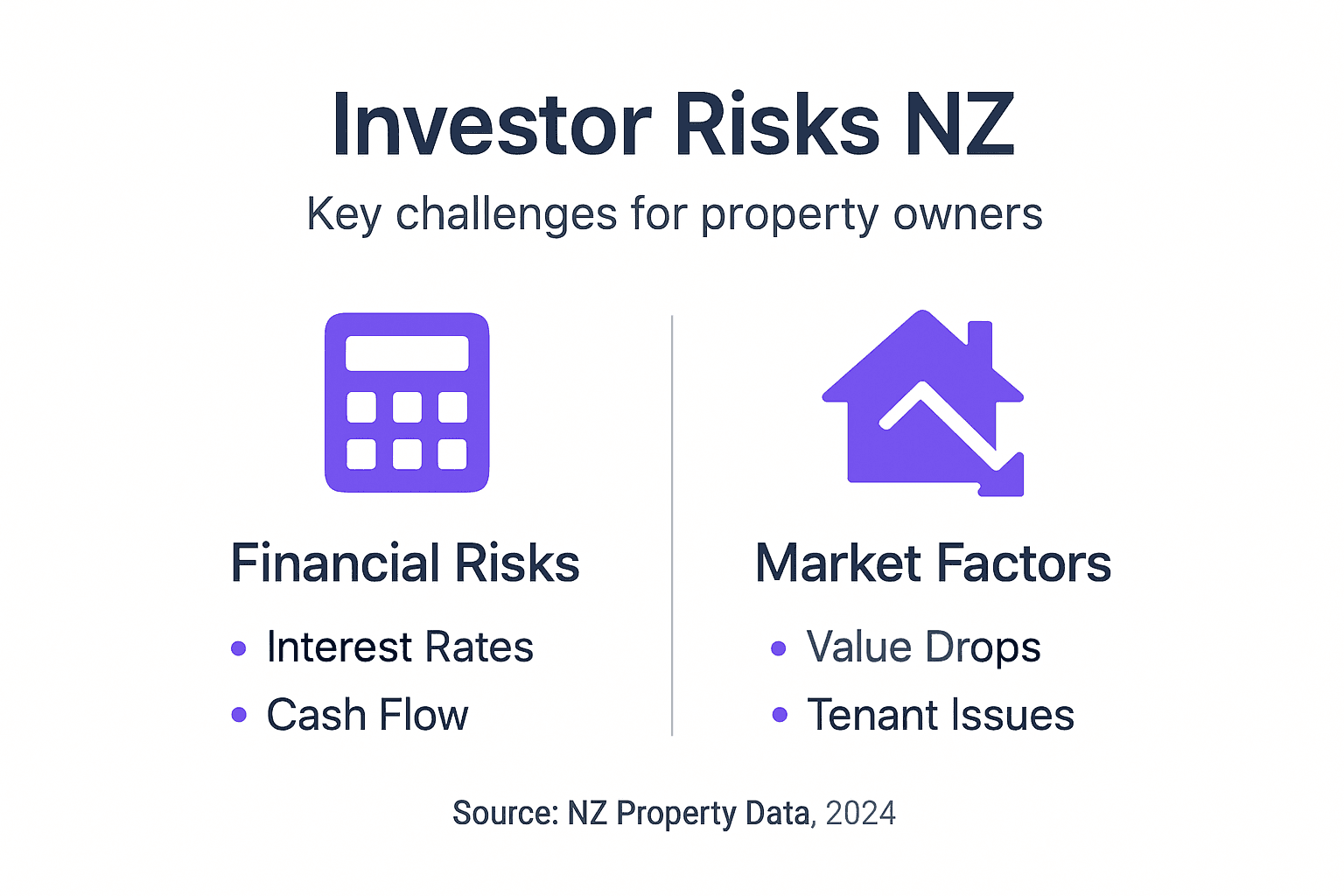
Investors navigate multiple risk categories that impact their willingness to purchase and maximum affordable price. Interest rate volatility remains a primary concern, as unexpected rate increases directly reduce profitability and can turn positive cash flow properties into loss-making investments. Market demand fluctuations affect both rental income stability and resale values, creating uncertainty around projected returns.
A 0.5% rise in interest rate on a typical $300,000 loan can increase monthly mortgage repayments by $110, impacting investors’ affordability and investment decisions. This seemingly small rate change reduces annual cash flow by $1,320, potentially eliminating profit margins on modestly yielding properties. For investors managing multiple properties, rate increases across their portfolio can quickly create financial stress.
Key risks affecting investor risks and challenges include:
- Capital risk: Property values may decrease rather than appreciate, particularly in declining markets or oversupplied areas
- Vacancy risk: Periods without tenants eliminate rental income while expenses continue
- Maintenance costs: Unexpected repairs or property damage can consume years of profit
- Regulatory changes: New laws or standards may require costly upgrades or reduce allowable deductions
- Tenant issues: Problem tenants can cause property damage, non-payment, or lengthy tribunal processes
- Liquidity constraints: Property cannot be quickly converted to cash if emergency funds are needed
Understanding how interest rate impact on investors affects their purchasing power helps sellers set realistic price expectations and negotiate effectively. Investors must maintain profit margins to justify risk, explaining why their offers may be lower than owner-occupier prices but still represent fair value given the speed and certainty they provide.
How EasySale Helps You Sell Directly to Property Investors in NZ
Understanding property investors is valuable, but connecting with the right buyer quickly matters most when you need immediate solutions. EasySale provides a direct bridge between urgent sellers and ready investors throughout New Zealand.

We buy properties directly as investors ourselves, eliminating agent commissions, lengthy marketing, and sale uncertainty. Our fast property buying services deliver cash offers within 24 hours of property assessment, with settlements completed on your preferred timeline, often within 7 to 21 days. Whether your home needs repairs, faces financial pressure, or simply requires a quick, private sale, we purchase in any condition without requiring fixes or improvements.
Our nationwide service means location never prevents a fast sale. From Auckland to Invercargill, we assess properties fairly and provide transparent offers that account for your situation. You can sell your house privately in NZ without open homes, agent meetings, or complex negotiations. We even buy damaged houses as-is, handling properties other buyers reject.
Pro Tip: Get your free, no-obligation cash offer today by submitting basic property details online. You will know within 24 hours exactly what we can pay, with no pressure and no commitment required.
FAQ
What does a property investor do?
A property investor purchases real estate to generate income through rental payments or profit from selling at a higher price after value appreciation. Unlike homeowners who buy primarily for personal residence, investors treat properties as financial assets designed to build wealth. They may employ various strategies including long-term rentals, renovations for resale, or property development depending on their experience and goals.
Can I sell my house as-is to a property investor in New Zealand?
Yes, many investors specifically seek properties needing repairs or renovation because improvement opportunities create profit potential. Selling as-is to investors eliminates the need for costly pre-sale repairs, professional cleaning, or staging. This approach makes selling faster and less stressful, particularly for homeowners facing financial constraints or urgent timelines who cannot afford or wait for property improvements.
How quickly can property investors complete a home purchase?
Investor sales typically close much faster than traditional agent-listed sales, with cash buyers often completing purchases within 7 to 30 days. Speed depends on whether the investor uses cash or financing, property complexity, and required due diligence. Investor purchase timelines significantly outpace the 60 to 120-day average for traditional sales, making them ideal for homeowners needing urgent solutions.
What impact do interest rates have on property investors’ purchase offers?
Rising interest rates increase mortgage costs, directly reducing investors’ borrowing capacity and profit margins. This constraint typically leads to lower offer prices or decreased buying activity as investors adjust to reduced returns. Conversely, falling rates improve investor affordability and returns, often increasing competition and offer amounts. Understanding interest rate effects on investors helps sellers interpret market conditions and set realistic price expectations for their property.


