
What Agent Fees Cost Kiwi Sellers: 15% GST, Dollars, and When Cash Wins

Agents typically charge a percentage fee plus GST on top, because that fee funds marketing, agency overheads and the skill it takes to negotiate a higher sale price, which is explained in detail by what an office space rental agency actually does. The rate is not fixed by law and it is always negotiable. Before you sign anything, ask for a written dollar estimate at your expected sale price and a clear list of what marketing that figure actually buys.
TL;DR:Agencies charge a negotiable percentage fee plus 15% GST, with tiered or flat structures affecting the total cost at your expected sale price.The commission covers marketing, legal paperwork, buyer screening, and negotiation, with additional costs for premium listings or auctions billed separately.Calculating your effective rate involves applying the agency’s fee structure to your appraisal price, adding GST, and dividing by that price to compare costs accurately.Negotiating the total dollar amount and specific marketing services in writing can help reduce fees without sacrificing service quality, but beware of reduced attention at lower rates.Alternatives such as private sales, flat-fee agents, or cash buyers can lower costs or increase speed but often involve less marketing reach or lower final prices.
EasysaleSell Without Agent FeesEasysale helps New Zealand homeowners explore a quick property sale, with cash offers and settlement on their preferred timeline.Explore Easysale
Table of Contents
- Why do real estate agents charge so much? Typical rates and the GST trap
- What that commission actually pays for
- How commission is calculated, step by step
- Negotiating your fee without losing the service
- Alternatives when a full commission doesn’t suit your situation
- A practical view from years of watching both sides of this decision
- A no-obligation cash offer, without the commission conversation
- Where to check the details yourself
- Sources
Why do real estate agents charge so much? Typical rates and the GST trap
Commission in New Zealand generally sits at a rate set by each agency rather than following a fixed national scale, according to Paul Sumich’s breakdown of agent costs. That headline number is only half the story. GST at 15% is added on top of the quoted commission, increasing the effective cost beyond the headline fee.
Many agencies use tiered structures rather than a flat rate, charging a higher percentage on the first portion of the sale price and a lower percentage on the balance, with a minimum fee sometimes included.
- A flat percentage fee example on a sale price results in commission plus GST totaling just over the base commission.
- A tiered structure might charge different rates on portions of the sale price, resulting in a different effective cost.
Effective rate is the number that actually matters: total commission payable divided by your expected sale price. Two agencies quoting different “headline” percentages can end up costing near-identical dollars, or wildly different ones, once you run the tiered math. Ask every agency to convert their structure into one dollar figure at your own appraisal price before you compare anyone.
What that commission actually pays for
The fee covers real operating costs: office premises, admin staff, compliance systems and trust-account obligations every agency must maintain under New Zealand law. On the vendor-facing side, it pays for the work you actually see, and plenty you don’t.
- Professional photography, floor plans and listing copy
- Portal fees for sites like Trade Me Property and realestate.co.nz
- Buyer enquiry screening and open home staffing
- Negotiation between multiple interested parties
- Sale and purchase agreement paperwork and legal liaison
Where things get murky is the “extras” that sit outside the base commission. Premium or featured listings, professional staging, and auctioneer fees for an auction campaign are often billed separately, and some agencies still add a flat administration fee, commonly around $500, according to Settled’s guidance on selling with an agent.
Pro Tip: Ask for a line-by-line marketing budget before signing, not a vague “we’ll advertise it well.” A written figure protects you if the campaign turns out thinner than promised.
How commission is calculated, step by step
Work out your own effective rate before you sign with anyone. It takes four steps.
- Get the agency’s honest appraisal of your likely sale price, not an inflated number designed to win the listing.
- Apply their fee structure (flat percentage, or each tier) to that price to get commission before tax.
- Add 15% GST to that figure.
- Divide the GST-inclusive total by the appraisal price to get your effective rate as a percentage.
A worked example: a $600,000 appraisal with a tiered fee of 4% on the first $300,000 and 2% on the rest gives $12,000 plus $6,000, or $18,000 before GST.
A commission negotiation calculator confirms the same principle: GST is calculated on top of whatever commission figure is agreed, never absorbed into it. Ask every agency for this exact dollar estimate at their own appraisal price, not a generic percentage.
Negotiating your fee without losing the service
Commission is genuinely up for discussion, and most agencies expect a seller to push back. What you request in writing matters more than what you ask for verbally.
- The total dollar estimate including GST, not just the percentage
- A full breakdown of what marketing spend is included in that figure
- The minimum fee that applies if your property sells for less than expected
- Cancellation terms if you switch agencies or sell privately mid-listing
A calculator modelling this shows that a 0.5% reduction saves 0.5% of your sale price, and the GST component increases that saving by a further 15% in GST-inclusive terms, per Calculate.co.nz’s commission tool.
The trade-off is real. Agencies often split commission between the office and the individual salesperson, so a heavily discounted rate can quietly shrink how much attention your listing gets. Before you accept a lower number, ask directly: “Is the marketing plan and time commitment identical at this fee?” If the answer is vague, you’ve found where the savings actually came from. Our breakdown of how commission affects net proceeds walks through more real-dollar scenarios.
Alternatives when a full commission doesn’t suit your situation
Traditional full-service agents aren’t the only route to a sale, and each alternative carries a different balance of cost, control and certainty.
- Private sale: you skip commission entirely, but you take on marketing, buyer screening, negotiation and legal coordination yourself, and a mispriced listing can cost more in a lower sale price than the fee ever would have.
- Limited-service or flat-fee agents: predictable, often lower cost, but usually less negotiation muscle and a thinner marketing push than a full-service campaign.
- Direct cash buyers: no commission, fast and certain settlement, but typically a lower final price than an open-market campaign might achieve given time.
Our guide to selling privately in New Zealand and this comparison of agent alternatives go deeper on which fits which seller.
A practical view from years of watching both sides of this decision
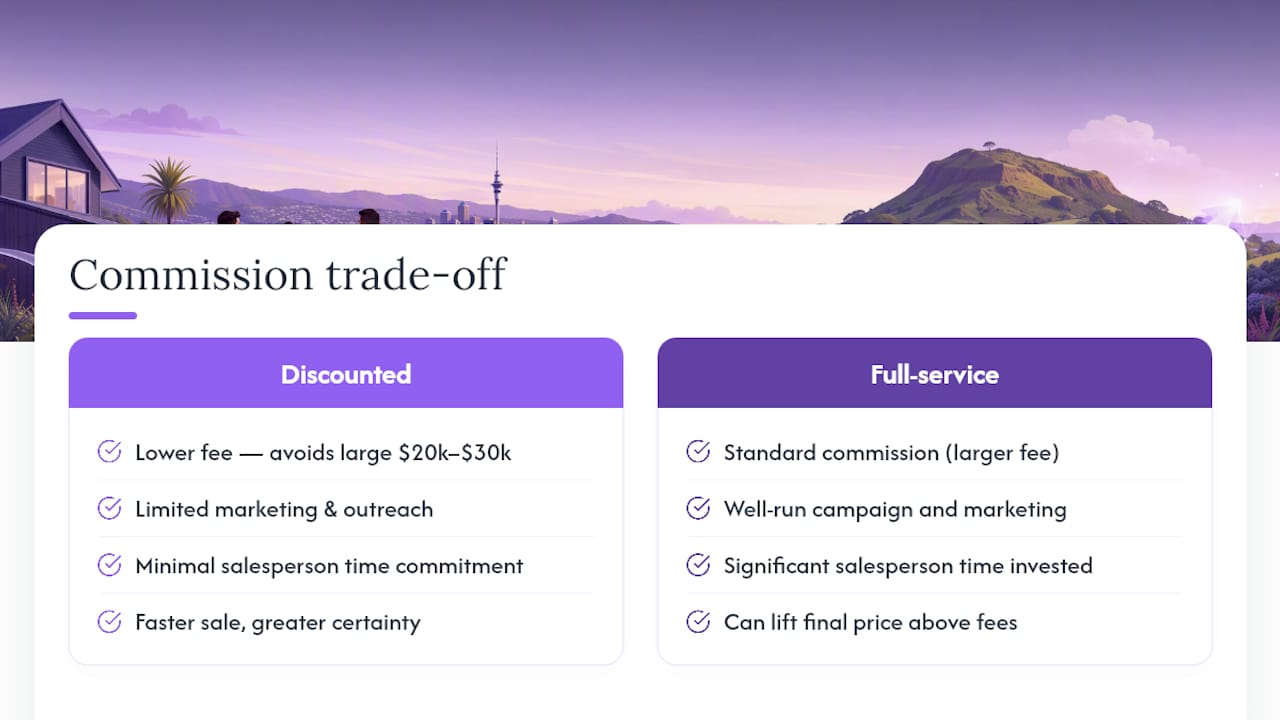
Most sellers who come to us asking about commission aren’t trying to be difficult. They’ve just done the maths and realised $20,000 or $30,000 is a lot to hand over, especially on a modest sale price. In plenty of those cases, a full-service agent earns every dollar: a well-run campaign on a desirable property in a strong market genuinely lifts the final price beyond what the commission costs.
Where a direct cash sale makes more sense is different: a property needing real repair work, a seller relocating for a job within weeks, or someone managing a deceased estate who has no appetite for months of open homes. Speed and certainty are worth something too, and for those sellers, commission was never really the question.
— Aaron
A no-obligation cash offer, without the commission conversation
There are alternatives to full-service agencies for sellers who want a number in hand without months of open homes, marketing spend or a commission bill at settlement. Some services buy properties in any condition, including homes with damage, unconsented work, tenants in place, or inherited estates that need sorting quickly.
The process is typically short: sellers provide property details, receive a no-obligation cash offer, and choose a settlement date that suits their circumstances. There is no agent commission, no staging required, and no waiting on buyer finance. This option often suits sellers under time pressure, those with properties needing work before going to market, or anyone seeking a private, low-fuss sale. If a damaged property is part of your decision, our page on buying houses as-is covers how that works. To see what a cash offer on your property might look like, start with our private house sale page and request your offer.
Where to check the details yourself
For the legal detail on agency agreements, read the Real Estate Authority’s guidance and Settled’s consumer explainer. Model your own savings with Calculate.co.nz’s commission calculator.
This article is general information, not a substitute for advice from a qualified financial advisor. Consult a qualified financial professional about your own circumstances before acting on anything here.
Sources
- Agency agreements | The Real Estate Authority
- Settled
- How much does a real estate agent cost to sell a house in New Zealand
- Real Estate Commission Negotiation Calculator NZ 2026
Recommended
