
Cash Offer in 24 Hours for As Is NZ Homes, Sell Your Home on Your Own

The quickest way to sell your home on your own in New Zealand is to accept a vetted cash offer from a direct buyer and have a lawyer complete the sale. Skipping agent listings this way typically shaves weeks off a traditional campaign. Your only real job is choosing a buyer you trust and instructing a lawyer early, because that’s what keeps deposits safe and settlement on track.
TL;DR:Buyers should provide proof of funds and deposit the earnest money into a lawyer’s trust account before proceeding to prevent late deal failures.Having all required legal documents ready, including title, LIM report, and consent certificates, streamlines the process and avoids delays.Sellers must disclose all known issues, such as hazard claims or unpermitted work, even when selling “as is,” to avoid future legal disputes.Expect a cash sale to close within days to weeks after confirming buyer funds and hiring a lawyer, with costs mainly involving legal fees and discharge charges.Negotiations should be documented in writing, with clear responses and deadlines to secure a legal and enforceable agreement.
EasysaleSell Your NZ Property SimplyEasysale helps New Zealand homeowners sell properties in any condition through a straightforward cash offer process without real estate agents.Request a cash offer
Table of Contents
- Quick checklist before you contact a buyer
- What happens from first enquiry to settlement?
- What are your legal disclosure duties when selling as-is?
- What documents do cash buyers usually ask for?
- How do you verify a cash buyer before you commit?
- How long does a direct cash sale take, and what does it cost?
- Negotiation tips when dealing directly with a buyer
- How do you handle offers and counteroffers securely?
- What are the red flags to watch for?
- Author perspective: when speed beats price
- Get a no-obligation cash offer from easySale
- Resources worth checking before you sell
- Sources
- FAQ
Quick checklist before you contact a buyer
Before you pick up the phone, spend an afternoon getting your numbers and paperwork straight. Buyers move fast when sellers turn up prepared, and a scattered seller is the most common reason offers stall.
Work through this list first:
- Set your minimum acceptable price and your preferred settlement date, even if you’re flexible on both.
- Pull together your title, LIM report, building consents or code compliance certificates, and mortgage discharge details.
- Gather any NHC or EQC insurance and claim paperwork if the property has ever had a natural hazard claim.
- Note whether the property is tenanted, vacant, or occupied by family, since this affects settlement timing.
- Have photo ID ready for AML checks. Your lawyer will need it before they can act.
Pro Tip: Photocopy or scan your ID and title documents now, before a buyer is even on the table. It saves a frantic scramble once an offer lands and the clock starts ticking.
What happens from first enquiry to settlement?
A direct cash sale follows a predictable sequence, and knowing it in advance means fewer surprises.
- Submit your details and get a written offer. Share the property address, condition, and any known issues. A genuine buyer responds with a written offer that spells out price, conditions (if any), and a proposed settlement date. Ask for this in writing, never a verbal figure.
- Review the offer and instruct a lawyer. Don’t sign anything before a lawyer or conveyancer has looked at the Sale and Purchase Agreement. Settled.nz advises private sellers to have a lawyer prepare or check the agreement rather than relying on a buyer’s template alone.
- Deposit goes into trust, ID checks happen. Your lawyer holds the buyer’s deposit in a trust account and runs AML/CFT identity checks on both parties. This step exists whether or not an agent is involved, and it’s what keeps the transaction compliant.
- Conditions are satisfied. If the offer carries any conditions (finance, due diligence, a builder’s report), these get worked through against the agreed dates. Cash offers with no conditions skip this step entirely, which is one reason they close faster.
- Exchange and settle. Once everything checks out, contracts are exchanged and settlement happens on the agreed date. Funds move, title transfers, and you hand over keys.
The lawyer carries most of the legal weight here. Your role is supplying accurate information early and responding to requests without delay, which is usually the difference between a two week settlement and a six week one.
What are your legal disclosure duties when selling as-is?
New Zealand law doesn’t let an “as is, where is” clause erase your disclosure duties. You still have to tell the buyer about anything you know that could affect their decision, whether that’s a leaky home history, unconsented work, or a boundary dispute.
The disclosure rule in numbers: Government guidance is unambiguous that vendors must disclose all known relevant property issues, and failing to do so can lead to legal action or the sale agreement collapsing after the fact.
An “as is” clause covers the property’s physical condition, not your knowledge of it. If you know about a damp problem, a consent that was never signed off, or a fence sitting over the boundary line, that goes in writing to the buyer before contracts are signed. Document it clearly, hand over any supporting paperwork you have, and let your lawyer confirm the disclosure is properly recorded in the agreement. This single step protects you from a claim landing months after settlement, and it costs you nothing but honesty.
What documents do cash buyers usually ask for?
Buyers move faster when the paper trail is already in your hands. The fewer questions they need to chase down themselves, the sooner they’ll remove conditions and confirm an unconditional offer.
Have these ready, roughly in order of how often they’re requested:
- Certificate of title and current mortgage balance (your lawyer or bank can supply this quickly).
- LIM report from your local council, along with any building consents and code compliance certificates for work done on the property.
- NHC or EQC claim history, insurer correspondence, and evidence of repairs if the property has ever been through a natural hazard claim. Settled.nz notes that selling after a natural disaster requires specific disclosure of these claims, and unresolved claims can be transferred to the new owner if documented properly.
- Engineer or builder reports, if you’ve had any done, even informally.
- Tenancy agreements and keys, or proof of ID if you’re selling as a trustee or executor of an estate.
How do you verify a cash buyer before you commit?
Not every buyer who says “cash offer” actually has the funds sitting ready. This is the single biggest cause of a sale falling through late, so a bit of scepticism upfront saves real heartache.
Run through these checks before you accept anything:
- Ask for proof of funds or written confirmation from the buyer’s solicitor that financing is in place.
- Insist the deposit is paid into a lawyer’s trust account, never a private bank account, no matter how convincing the buyer sounds.
- Request the buyer’s full legal name and ID, and ask if they can point to previous purchases or references.
- Favour offers with few or no conditions over ones stacked with finance approvals and due diligence periods, since every condition is a chance for the deal to stall.
Pro Tip: If a buyer hesitates when you ask for proof of funds, treat that as your answer. A funded buyer will produce this without pushback because they’ve done it before.
Government guidance backs this up directly: lawyers performing AML/CFT identity checks and holding deposits in trust is what keeps a sale compliant even with no agent in the picture.
How long does a direct cash sale take, and what does it cost?
Speed is the entire point of this route, but it comes with trade-offs worth naming honestly.
- Timeline: Often days to a few weeks once the buyer has funds confirmed and your lawyer is engaged. easySale’s own guidance on as-is sales points to many sellers closing within a matter of days to weeks when dealing with genuine cash buyers.
- Costs: Expect legal or conveyancing fees, a mortgage discharge fee if you still have a loan, and small admin costs. There’s no agent commission to pay.
- Trade-off: Direct buyers typically offer below full market value in exchange for the speed and certainty they provide. You’re trading top dollar for a guaranteed, fast settlement.
Negotiation tips when dealing directly with a buyer
Negotiating one-on-one with a buyer feels different from an agent-run campaign, but a few habits keep you in a stronger position.
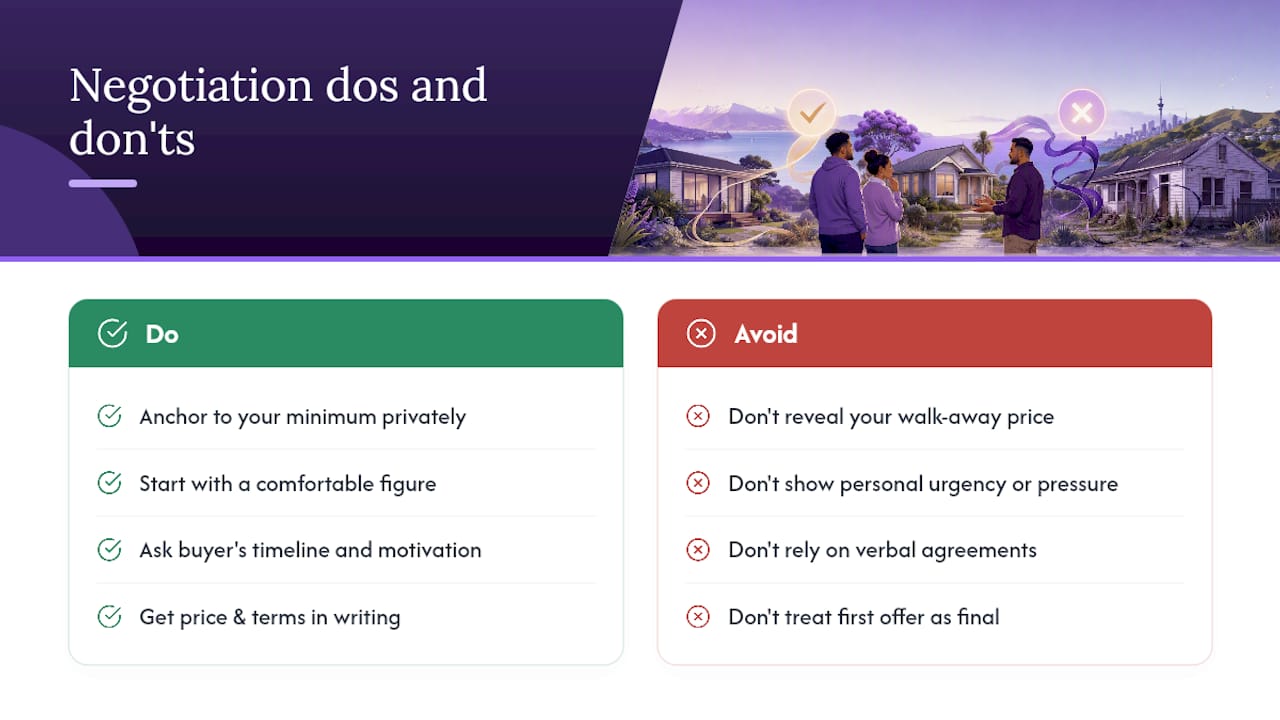
Anchor to your minimum price before the conversation starts, and don’t reveal it. State a figure you’re comfortable with and let the buyer respond, rather than opening with your walk-away number. Once they counter, you still have room to move.
Ask what’s driving their timeline. A buyer who needs to settle within a fortnight for their own reasons often has more flexibility on price than one who’s simply shopping for a bargain. Understanding their motivation tells you how firm to hold your ground.
Get every material term in writing as you go, even during informal back-and-forth. Price, settlement date, and any conditions should be documented before you agree verbally, because a verbal “yes” from either side means nothing once a lawyer starts drafting the agreement.
Don’t let urgency on your end show too plainly. If you’re selling because of a deceased estate, a damaged property, or a tenancy that’s become unmanageable, that pressure is real, but broadcasting it invites a lower opening offer. Keep the conversation focused on the property and the terms, not your personal circumstances.
Finally, treat the first offer as a starting point, not a final answer, unless it already meets your minimum. Most direct buyers expect some negotiation and build a small margin into their opening figure for exactly that reason.
How do you handle offers and counteroffers securely?
Every offer and counteroffer should exist in writing, with a clear paper trail your lawyer can review at any point.

When an offer arrives, don’t respond with a verbal counter over the phone, even if it feels faster. Email or text your counter figure and terms, then confirm your lawyer has seen both the original offer and your response before anything progresses further.
Set a response deadline on your counteroffers. Giving a buyer 24 to 48 hours to respond keeps momentum without pressuring you into a rushed decision, and it filters out buyers who aren’t genuinely ready to transact.
Never accept a revised price or condition change without running it past your lawyer first, even if the change seems minor. A shifted settlement date or an added due diligence clause can matter more than it looks on the surface.
Keep a simple record of every version of the offer, including the date and who sent it. If a dispute arises later about what was agreed, this record is what your lawyer relies on to sort it out. Once you’ve accepted final terms, the Sale and Purchase Agreement should reflect exactly what was negotiated, not a rough summary of it.
What are the red flags to watch for?
Selling directly cuts out a lot of hassle, but it also removes the layer of scrutiny an agent would normally apply to a buyer. A few warning signs deserve your full attention.
Be wary of a buyer who resists a lawyer being involved at all, or who pushes you to sign something before you’ve had it checked. This is one of the clearest signs a deal isn’t as solid as it sounds. Similarly, a buyer who wants the deposit paid into a personal account rather than a trust account is asking you to bypass the exact protection that keeps a sale legitimate.
Watch for offers that seem unusually high with no clear explanation, especially if they come with pressure to sign quickly before you can get independent advice. Genuine buyers don’t need to rush you past your own lawyer.
If you previously had the property listed with a real estate agent under a sole agency agreement, check whether that agreement has properly expired before you sell privately. Selling while still technically bound to an agency can trigger a commission claim even though the agent didn’t find the buyer, an issue worth understanding before you proceed.
Finally, treat vague or missing answers about funding as a hard stop. A buyer who can’t produce proof of funds within a day or two, after you’ve asked more than once, likely doesn’t have them.
Author perspective: when speed beats price
Selling fast makes sense when you’re settling an estate, facing an urgent mortgage deadline, or holding a property too damaged to list conventionally. In those situations, certainty is worth more than chasing an extra few thousand dollars over several months.
Ask yourself plainly: can you afford to wait three to six months for a traditional sale, and do you have the capacity to manage repairs, tenants, or agent negotiations in the meantime? If the honest answer is no, a direct cash sale is a rational choice, not a compromise. easySale has worked with sellers in exactly these circumstances, buying properties in whatever condition they’re in.
— Aaron
Get a no-obligation cash offer from easySale
If everything above sounds like more than you want to manage alone, that’s precisely the gap easySale fills. Where a private sale still asks you to vet buyers, chase paperwork, and negotiate directly, easySale removes those jobs entirely by buying your property straight from you, commission-free.

The process runs in three steps: you submit your property details, easySale sends back a no-obligation cash offer, and you settle on a timeline that suits you, not the buyer’s convenience. easySale buys homes in any condition, including tenanted, inherited, or damaged properties, without asking you to fix a single thing first. There’s no agent involved and no commission to pay out of your sale price.
If you’d rather skip the negotiation and verification steps altogether, get a fair cash offer within 24 hours and see what a straightforward, no-pressure sale actually looks like.
Resources worth checking before you sell
Read the government’s guidance on selling your house and Settled.nz’s notes on selling privately and selling after natural disaster. easySale’s step-by-step guide covers real seller examples too.
This article is general information, not a substitute for advice from a qualified financial advisor. Consult a qualified financial professional about your own circumstances before acting on anything here.
Sources
FAQ
Can I sell my house privately without a real estate agent in NZ?
Yes. You can sell directly to a cash buyer or through a private listing, though a lawyer or conveyancer should still handle the Sale and Purchase Agreement and deposit.
Do I still have to disclose defects if I sell “as is”?
Yes. An “as is, where is” clause covers the property’s condition, not your legal duty to disclose known issues like unconsented work or hazard history.
How fast can a direct cash sale actually settle?
Many direct sales settle within days to a few weeks once the buyer’s funds are confirmed and a lawyer is engaged, according to easySale’s guidance on as-is sales.
Where should the buyer’s deposit be held?
The deposit should always go into a lawyer’s trust account, never a private bank account, which keeps the transaction compliant and protects both parties.
Will I get full market value from a direct cash buyer?
Usually not. Direct buyers typically offer below full market value in exchange for speed, certainty, and skipping repairs, agent fees, and a lengthy campaign.
Recommended
