
Property chains: Risks and solutions for NZ home sellers

TL;DR:Property chains link multiple transactions, increasing risk of delays or collapse.Chain failures often occur due to buyer finance issues or legal delays.Selling chain-free ensures faster, more certain settlement, especially for urgent sales.
You’re days away from settling your home sale when the phone rings. Your buyer’s own sale has fallen through. Suddenly, your carefully planned move, your new home deposit, your fresh start — all of it is on hold, and you had no idea your sale was tied to someone else’s deal. This is the reality of property chains, and it catches thousands of New Zealand homeowners off guard every year. If you’re selling under pressure due to financial stress, relationship changes, or a property that needs work, understanding property chains is not optional. It could be the difference between a smooth settlement and months of costly uncertainty.
Table of Contents
- What is a property chain?
- Why property chains often fail
- How property chains impact urgent home sales
- Spotting and avoiding chain risks in your sale
- What most Kiwi sellers miss about property chains
- Sell chain-free: Fast-track your property sale
- Frequently asked questions
Key Takeaways
| Point | Details |
|---|---|
| Property chains explained | A property chain is a series of linked transactions where delays or issues in one affect everyone involved. |
| Risks in urgent sales | Homeowners under time or financial pressure are especially vulnerable to property chain failures. |
| How to reduce risk | Target buyers who don’t rely on selling another property, such as cash buyers or direct-buy services, to avoid chain complications. |
| Take action early | Ask clear questions about buyer readiness to spot risks and protect your sale from unexpected collapse. |
What is a property chain?
Now that you know what’s at stake, let’s break down exactly what a property chain is and how it works in plain language.
A property chain occurs when multiple property transactions are linked together, each depending on the others to proceed successfully. In simple terms, your ability to settle your sale depends on your buyer’s ability to complete their own situation, which may itself depend on another transaction further along the line.
Here’s how a typical property chain is structured:
- First-time buyer: Enters the chain at the start because they have no property to sell first. They represent the cleanest starting point.
- Existing homeowner selling to upsize: Needs their current home sold before they can purchase a new one, creating a middle link in the chain.
- Downsizer or retiree: Selling a larger property to move into something smaller, adding another linked transaction.
- Investor or developer: May enter the chain at various points, sometimes able to proceed independently if they have cash available.
Each of these parties is waiting on someone else. As this dependency builds, the chain grows longer and more fragile. As noted in property chain terminology, understanding how these links connect is foundational to planning your sale well.
The critical vulnerability is clear: as chain risk research shows, if any party withdraws or encounters problems, the dependency can cause the whole chain to fail or delay, because other parties are waiting for linked completions.
Comparison: Chain vs. chain-free sales
| Factor | Chain sale | Chain-free sale |
|---|---|---|
| Settlement certainty | Lower | Higher |
| Typical timeframe | 3 to 6+ months | Weeks to 2 months |
| Risk of collapse | High | Very low |
| Stress for urgent sellers | Significant | Minimal |
| Negotiation complexity | High | Simple |
“The longer the chain, the higher the chance that at least one link will break. Every additional transaction added to the sequence is another point of potential failure.” — Property sales guidance
For New Zealand homeowners facing urgent life changes, this is particularly important. If you’re selling because of financial pressure, a relationship breakdown, or because your property has sustained damage and you need to move quickly, being caught in a long chain is a serious risk to your plans. Knowing your chain position before you accept any offer gives you much more control over your outcome.
Why property chains often fail
Having defined property chains, it’s important to recognise why they’re often risky for sellers, especially when time and certainty matter.
Property chains fail for a wide range of reasons, and the frustrating part is that the cause often has nothing to do with you or your property. Here are the most common points of failure:
- Buyer finance issues: A buyer’s mortgage approval may fall through after their bank reassesses the property value or their personal financial circumstances change. This is one of the leading causes of chain collapse in New Zealand.
- Legal or conveyancing delays: Solicitors and conveyancers working on multiple transactions can slow the entire chain. A single missing document at one point can stall every settlement in line.
- Changes in personal circumstances: Job losses, health issues, relationship breakdowns, or simply a change of heart can lead any party in the chain to withdraw their offer or delay settlement.
- Failed property inspections: If a building report uncovers significant issues at any property in the chain, that buyer may renegotiate or walk away entirely.
- Valuation gaps: If a bank values a property lower than the agreed purchase price, the buyer faces a funding shortfall and the deal may need to be renegotiated or abandoned.
As noted, chain failure research confirms that if any party withdraws or encounters problems, the dependency can cause the whole chain to fail or delay, because other parties are waiting for linked completions. This is not a rare event. It happens regularly, and the financial and emotional cost to sellers caught in collapsed chains is real.
When a chain collapses, you face re-listing your property, potentially at a lower price, while carrying ongoing holding costs such as mortgage payments, rates, and insurance. For sellers already under pressure, this kind of setback can have serious consequences.
Pro Tip: When reviewing sale options for NZ homeowners, always ask a potential buyer directly: “Do you have a property to sell before you can complete this purchase?” Their answer will tell you immediately whether you’re entering a chain.
“Buyers who are not dependent on selling their own home first offer sellers the greatest certainty and the shortest path to settlement.”
The risk increases with chain length. A two-party transaction (you and a cash buyer) has minimal failure risk. A five-party chain has five separate points where something can go wrong. For sellers who need a clean, timely outcome, a shorter chain or no chain at all is always the better position.
How property chains impact urgent home sales
Now let’s focus on homeowners who need to sell urgently and see how property chains can shape their outcomes.
Urgent sales are a specific category, and they deserve specific attention. Whether you’re dealing with the aftermath of a relationship separation, mounting mortgage arrears, a health situation that requires you to relocate, or a property that has been damaged beyond your means to repair, time is your most valuable resource. Property chains directly threaten that resource.
How chain delays affect urgent sellers
| Situation | Impact of chain delay |
|---|---|
| Financial stress or mortgage arrears | Delays increase debt and stress |
| Relationship breakdown | Prolongs an already difficult period |
| Damaged or unmaintained property | Ongoing costs continue accumulating |
| Job relocation | Can jeopardise new employment arrangements |
| Health-related move | Delays access to necessary care or support |
As outlined in detail, chain dependencies can extend timelines and create a higher fall-through risk for New Zealand homeowners facing urgency due to job loss, relationship changes, financial stress, or selling a damaged property.
A standard chain-involved sale in New Zealand can take anywhere from three to six months or longer if complications arise. For someone under genuine financial or personal pressure, that timeline is simply not acceptable.
Here’s what you can do to protect yourself:
- Ask buyers about their position early. Before accepting any offer, find out whether your buyer needs to sell their own home first.
- Prefer buyers with pre-approved finance. Pre-approval reduces the chance of last-minute finance failure derailing your settlement.
- Consider investor or direct buyers. These buyers often have access to cash or pre-arranged funding and do not need to sell a property first.
- Avoid extended settlement conditions where possible. Long settlement periods increase the window of opportunity for something to go wrong.
Pro Tip: For properties with visible damage or maintenance issues, targeting private property sales to investors or buyers who specialise in renovation properties can reduce your chain risk significantly, since these buyers often operate with their own funds rather than dependent bank finance.
Understanding the NZ property sale process end to end also helps you identify at which stage your chain risk is highest, so you can plan accordingly and respond faster if a problem develops.
Spotting and avoiding chain risks in your sale
Understanding the risks is just the start. Here’s how you can actively spot and steer clear of chain problems.
There are clear, practical steps you can take to identify chain risk before it becomes a problem. Acting early gives you options. Waiting until a chain collapses leaves you with very few.
Step-by-step: How to identify chain risk in your sale
- Ask every buyer directly about their situation. Find out whether they are a first-time buyer, a cash buyer, or someone who needs to sell their own property first before they can proceed.
- Request written confirmation of their financial position. A pre-approval letter from their bank or a signed confirmation from their financial adviser gives you confidence they can follow through.
- Clarify settlement preferences. Buyers seeking very long settlements or making their offer subject to the sale of another property are introducing chain risk from the outset.
- Check with your real estate agent or solicitor. They can often find out more about a buyer’s situation and alert you to red flags you may not see directly.
- Reassess offers that seem conditional. An unconditional offer, especially from a cash buyer, is almost always more valuable than a slightly higher conditional offer tied to a long chain.
Signs of chain risk to watch for:
- Buyer requests a settlement date beyond 60 to 90 days without clear reason
- Offer is made subject to the sale of the buyer’s existing property
- Buyer is vague or evasive about their financial readiness
- Buyer is waiting on a valuation or finance approval that has not yet been confirmed
- Long chains involving multiple parties, all waiting on each other
Many sellers look to reduce dependencies by targeting buyers who can complete without needing to sell their own property. This is the single most effective strategy for reducing chain risk.
Options for a chain-free sale include direct purchase services, property investors, and specialist buyer companies. Understanding how direct property purchase works in New Zealand will help you evaluate whether this route suits your timeline and circumstances.
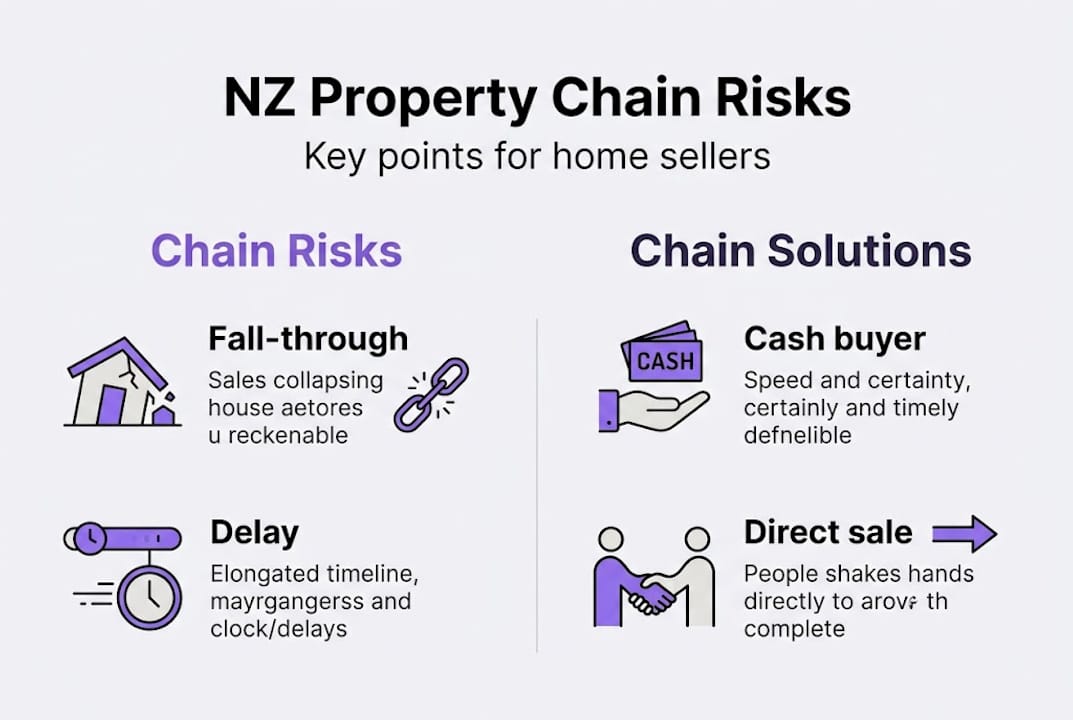
Pro Tip: Always ask your property buying service whether their offer is unconditional and cash-backed. An unconditional offer removes chain risk entirely and gives you a clear, reliable path to settlement.
Transparent communication is your greatest tool here. Tell your agent your priorities clearly. If speed and certainty matter more than squeezing out the highest price, say so. That clarity allows your agent to screen buyers accordingly and bring you offers that match your actual needs.
What most Kiwi sellers miss about property chains
While guides cover the theory, here’s what our experience tells us most New Zealand sellers actually overlook.
Most homeowners only discover they were part of a property chain after their deal has already collapsed. They assumed that once an offer was accepted, the sale was effectively done. That assumption is costly.
The second thing sellers miss is that chain dependencies can extend timelines and create a higher fall-through risk — particularly for those dealing with job loss, relationship changes, financial stress, or a damaged property. The urgency of your situation does not reduce the risk. It actually raises the stakes.
There’s also a widespread reluctance to consider direct sale or investor offers because they’re perceived as lower-value options. But value is not only about the sale price. Certainty, speed, and the elimination of holding costs have real financial worth. A direct sale that completes in three weeks, with no chain, no agent fees, and no risk of collapse, may deliver more effective financial value than a higher listed price that drags on for five months through a complex chain.
Our advice: be honest with yourself about what you actually need. Review NZ property sale terms carefully when evaluating offers, and prioritise the outcome that matches your real circumstances, not just the headline number.
Sell chain-free: Fast-track your property sale
If you’re facing change or uncertainty, there are clear next steps beyond the property chain headache.
At easySale.co.nz, we work with New Zealand homeowners who need a reliable, fast result without the complexity of traditional sales. Whether you’re downsizing, managing financial pressure, or simply need to move on quickly, a chain-free sale removes the biggest source of uncertainty in the process.
Our fast property sale service gives you a no-obligation cash offer, a straightforward process with no agent commissions, and a settlement timeline that suits you. We buy properties in any condition across New Zealand, which means no waiting, no chains, and no guessing. If you’re exploring chain-free retirement and downsizing sales or simply need clarity on your options, we’re here to help. Reach out today to get a fair cash offer and take the first step toward a settled outcome on your terms.
Frequently asked questions
Can I sell my house in New Zealand without being part of a property chain?
Yes, you can sell chain-free by choosing cash buyers, investors, or companies that buy directly. Many sellers reduce dependencies by targeting buyers who can complete without needing to sell their own property first.
How does a failed property chain affect my home sale?
If the chain falls through, your sale may be delayed or cancelled, forcing you to re-list or renegotiate. Research confirms that chain collapse occurs when any party withdraws or encounters problems, stalling all linked completions.
What can I do to reduce the chance of delays in my property sale?
Choose buyers who do not need to sell their own property, confirm their financial readiness upfront, and communicate clearly with all parties. Sellers who reduce dependencies by targeting unconditional buyers consistently experience faster, more reliable settlements.
Are property chains more risky for urgent or distressed sales?
Yes, urgent sales are especially vulnerable to chain risks because delays may cause significant personal or financial harm. For homeowners facing urgency, chain dependencies can extend timelines and create a higher fall-through risk, making chain-free options a practical priority.


