
Property defects explained: what NZ sellers must know

TL;DR:Selling a property with defects in New Zealand involves choosing between repairing, disclosing, or selling as-is based on your timeline and budget. Legal obligations require full disclosure of known issues, especially latent defects, to avoid liability and post-sale disputes. Transparency with buyers helps maintain trust, speeds up the sale process, and reduces risks, especially when using cash sale options for quick transactions.
A property defect in New Zealand is any physical, legal, or compliance issue that affects a property’s condition, value, or lawful use. That covers everything from a cracked foundation to an unconsented deck to a council requisition sitting on the title. If you need to sell quickly, your three realistic options are: repair before listing, fully disclose and price accordingly, or sell as-is to a cash buyer.
The fastest compliant route depends on your timeline and budget. If you have weeks, not months, selling as-is to a direct cash buyer is often the most practical choice. If you have time and the repair cost is manageable, fixing the issue first usually returns more at settlement.
- Repair before listing: best when the defect is minor and the cost is recoverable in the sale price.
- Disclose and price competitively: suits sellers with moderate defects who want a traditional sale without the repair cost.
- Sell as-is to a cash buyer: suits sellers who need speed, certainty, or cannot fund repairs. See why selling a damaged property can still be the right call.
Table of Contents
- What counts as a property defect in New Zealand?
- What are your legal obligations as a seller in New Zealand?
- How do defects affect your sale price, buyers, and timeline?
- What are your practical options for selling a defective property quickly?
- A step-by-step checklist for documenting defects and disclosing them
- How to manage offers and timelines when defects exist
- When should you call a lawyer, building specialist, or testing service?
- Key takeaways
- The case for selling as-is, from a buyer’s perspective
- Sell your property as-is with Easysale
- Useful NZ sources and further reading
What counts as a property defect in New Zealand?
Property defects fall into two legal categories. Patent defects are visible on a reasonable inspection: peeling paint, a sagging gutter, obvious damp staining. Latent defects are hidden and not discoverable without specialist investigation, such as moisture trapped inside a monolithic cladding system or substandard wiring behind walls. Latent defects carry higher legal risk because a buyer cannot see them and may later argue they were concealed.
The main defect categories Kiwi sellers encounter:
- Structural: foundation cracking, subsidence, earthquake damage, unconsented alterations that affect load-bearing elements.
- Weathertightness (leaky buildings): monolithic cladding, inadequate ground clearance, missing flashings around windows and penetrations. The REA’s inspection guidance identifies specific risk features including recessed windows, concealed guttering, and complex roof designs.
- Moisture and mould: sub-floor dampness, condensation damage, mould growth in enclosed spaces such as wardrobes and wall cavities.
- Electrical and plumbing: old conduit wiring, Dux Quest plumbing (a stigmatised product), non-compliant switchboards.
- Pest: borer, rodent damage, or timber decay from untreated infestations.
- Meth contamination: residue from manufacturing or heavy use, which requires specialist testing and remediation.
- Unconsented or non-compliant work: additions, garages, or decks built without a building consent or without a code compliance certificate (CCC).
- Council notices and requisitions: outstanding demands from a local authority, RMA notices, or earthquake-prone building notices.
Latent defects are the ones that generate post-sale disputes. A seller who knows about a latent defect and says nothing is exposed to a misrepresentation claim, which carries consequences well beyond a simple price adjustment.
What are your legal obligations as a seller in New Zealand?
New Zealand has no single statutory vendor disclosure law, but that does not mean silence is safe. Strong disclosure obligations arise from two sources: the standard ADLS/REINZ Agreement for Sale and Purchase and the Contract and Commercial Law Act 2017.
Under the standard agreement, vendors warrant in writing that they have disclosed all known notices, demands, and requisitions from authorities affecting the property. Failing to give that disclosure can make you liable for compensation. The New Zealand Law Society’s Property Law Section guidelines go further, advising lawyers to discuss unconsented work, contamination, outstanding CCCs, and anything that might result in proceedings against the buyer.
Misrepresentation is the only legal ground that allows a buyer to cancel a sale after it has gone unconditional. Under Consumer Protection guidance, a buyer can cancel post-settlement if the misrepresentation was significant enough to have affected their decision or is costly to fix. Active concealment, such as painting over damp before an open home, can meet that threshold.
Settled.govt.nz advises sellers to discuss known problems with their agent and seek legal advice before signing an agency agreement, because agency forms commonly ask vendors to confirm there are no undisclosed defects. Your agent also carries independent duties: under REA Rule 10.7, licensees must disclose known defects and take steps to warn buyers if they reasonably suspect hidden issues exist.
Pro Tip: Keep a dated, written list of every known issue. If a buyer later raises a misrepresentation claim, documented evidence of what you knew and when is your strongest protection. See the legal considerations for NZ sellers for a practical checklist.
How do defects affect your sale price, buyers, and timeline?
Defects change buyer behaviour in predictable ways. Understanding those patterns helps you set realistic expectations before you list.
Typical buyer reactions:
- Buyers withdraw offers or reduce them sharply after a building report reveals latent issues.
- Conditional periods lengthen as buyers seek specialist reports (moisture testing, meth testing, electrical checks).
- Cash buyers and investors remain interested but price in remediation costs, often offering below market value.
- Mainstream buyers may walk away entirely from properties with weathertightness or meth issues.
Major structural or leaky-home defects typically attract the steepest price adjustments because remediation costs are high and financing can be difficult. Minor cosmetic defects have far less impact. Transparent disclosure often preserves buyer trust and opens the door to a price concession rather than a cancelled deal.
Typical timeline additions when defects are present:
| Stage | What it involves | Typical added time |
|---|---|---|
| LIM ordered by buyer | Council records, consents, requisitions | 10–15 working days |
| Building or moisture report | Specialist inspection and written report | 5–10 working days |
| Meth or electrical testing | Specialist sampling and lab results | 5–10 working days |
| Conditional period extension | Buyer requests more time to assess | 5–10 working days |
| Council enquiry or consent search | Resolving unconsented work queries | 2–8 weeks |
| Repair before settlement | Agreed works completed and signed off | 2–12 weeks |

Each stage compounds. A sale with latent defects can easily run 8–16 weeks longer than a clean transaction.
What are your practical options for selling a defective property quickly?
Four routes are available to Kiwi sellers. The right one depends on your timeframe, available funds, and risk tolerance.
- Repair before listing. Fix the defect, obtain the CCC or sign-off, and market the property at full value. Best when the repair cost is modest and recoverable. Slowest route: allow 4–16 weeks depending on the work involved.
- Disclose and price competitively. List the property with full written disclosure and set the asking price to reflect the defect. Buyers know what they are getting, conditional periods are shorter, and you avoid post-sale claims. Suits sellers with moderate defects and a 6–12 week window.
- Market to investors. Investors and developers actively seek properties with issues. They price in the risk but move faster than owner-occupier buyers. Expect offers below market value, but settlement can happen in 4–6 weeks with fewer conditions.
- Sell as-is to a cash buyer. The fastest route. A direct cash buyer purchases the property in its current condition, with no agent fees and a settlement timeline you control. The trade-off is a lower net price. You still need to disclose known defects honestly.
Pro Tip: Even a small targeted repair, such as fixing a leaking skylight or replacing a faulty switchboard, can meaningfully improve buyer confidence and reduce the discount buyers demand. A focused building inspection report aimed at supporting a fast sale is often more useful than a full remediation assessment.
A step-by-step checklist for documenting defects and disclosing them
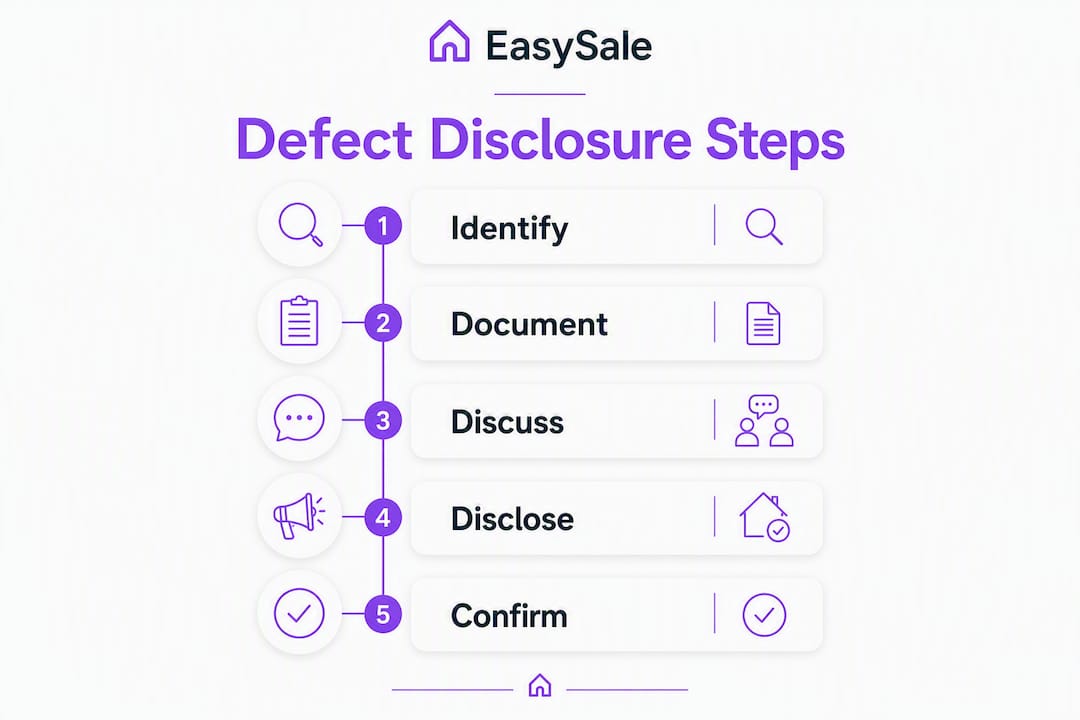
- Self-audit the property. Walk through every room, the sub-floor, and the roof space. Note every visible issue in writing with the date.
- Collect consents, CCCs, and invoices. Gather building consents, code compliance certificates, and repair invoices. These convert a defect into a documented repair history.
- Order a LIM. A Land Information Memorandum shows council-recorded consents, requisitions, and notices. Order it early so you know what the buyer will see. See property documents in NZ sales for a full breakdown.
- Commission a targeted building or damp report if you suspect latent weathertightness or moisture issues. A short, focused report is more useful for a fast sale than a comprehensive remediation plan.
- List every known issue in writing before signing the agency agreement. Include it in your disclosure schedule and in correspondence with buyers.
- Disclose formal notices immediately. Any council requisition, earthquake-prone building notice, or RMA demand must be disclosed under the standard sale agreement. There is no discretion here.
- Review the sale and purchase agreement with a lawyer before signing. Confirm the warranty clauses reflect your actual disclosures.
Pro Tip: Document every conversation with your agent about what to disclose and how to price the defect. A written record protects both of you if a buyer later disputes what was known at the time.
How to manage offers and timelines when defects exist
Negotiation with defects present is straightforward when you are transparent from the start.
- Use clear marketing language. State the known issues in the listing rather than waiting for a building report to surface them. Buyers who proceed past that point are self-selecting for your property.
- Offer a price credit rather than a repair promise. A defined price reduction is cleaner than a repair obligation that can delay settlement or generate disputes about workmanship.
- Set realistic conditional periods. Allow buyers enough time to get specialist reports without extending the conditional period indefinitely. Ten working days is a reasonable starting point for a building report condition.
- Use lawyer-reviewed contract wording. If repairs are agreed before settlement, have your lawyer draft a clear clause specifying the scope, completion date, and what happens if the work is not finished. A holdback of funds at settlement is one option Consumer Protection recommends when work cannot be completed beforehand.
- Know your walk-away point. Decide before offers come in what net price you will accept given the defect. Buyers sense hesitation, and a clear position speeds negotiation.
When should you call a lawyer, building specialist, or testing service?
Some situations genuinely require expert input before you proceed.
- Get a property lawyer if there is significant unconsented work, a previous sale fell through because of a defect, or you are uncertain whether a known issue triggers the warranty clauses in the sale agreement. The understanding property compliance guide covers consent and CCC issues in plain language.
- Order a LIM before listing if you have not seen one recently. It takes 10–15 working days and costs vary by council, but it tells you exactly what a buyer’s due diligence will uncover.
- Commission a targeted building or damp inspection if the property has monolithic cladding, a complex roof design, or any history of moisture issues. A registered building inspector can give you a written assessment you can share with buyers.
- Arrange meth testing if the property has been tenanted or if there is any history suggesting contamination. Accredited testers follow NZS 8510 standards.
- Book an electrical safety check if the wiring is old conduit or the switchboard has not been updated in decades.
Pro Tip: Ask your inspector to frame the report around what a buyer needs to know to proceed, not a full remediation scope. A shorter, targeted report is faster to produce, cheaper, and more useful in a sale context.
Key takeaways
Selling a defective property in New Zealand is manageable when you document everything, disclose honestly, and choose the sale route that matches your timeline.
| Point | Details |
|---|---|
| Disclose in writing | List every known defect before signing the agency agreement to satisfy ADLS/REINZ warranty obligations. |
| Order a LIM early | A LIM reveals council records and requisitions; order it before listing so there are no surprises during due diligence. |
| Match route to timeline | Repair suits a 4–16 week window; disclose and price suits 6–12 weeks; a cash buyer suits sellers who need weeks, not months. |
| Document everything | Invoices, CCCs, and a dated defect list are your best defence against a post-sale misrepresentation claim. |
| Easysale option | Easysale buys NZ properties in any condition with no agent fees; sellers must still disclose known defects honestly. |
The case for selling as-is, from a buyer’s perspective
Sellers sometimes worry that disclosing defects will kill a deal or brand the property as unsellable. That concern is understandable, but it tends to be overstated. Cash buyers and investors who purchase as-is properties are not looking for perfection. They are looking for honest information so they can price the risk accurately and proceed with confidence.
What a cash buyer actually checks is straightforward: the title, the LIM, the known defect list, and a rough remediation estimate. A seller who hands over a clear written disclosure, a recent LIM, and any available repair invoices makes that process faster and easier. The result is a quicker offer, fewer conditions, and a smoother path to settlement.
Sellers who try to minimise or obscure issues, on the other hand, create the opposite outcome. A buyer who discovers a problem during due diligence that was not disclosed will either walk away or demand a much steeper discount than the defect warrants. Honest disclosure usually preserves sale speed and reduces post-sale risk. The role of transparency in home sales covers this in more detail if you want to read further.
Sell your property as-is with Easysale
If speed is your priority and repairs are not practical, Easysale offers a direct cash-buying service for New Zealand homeowners. There are no agent fees, no open homes, and no drawn-out conditional periods.

The process is straightforward: submit your property details online, receive a no-obligation cash offer, and settle on a timeline that suits you. Easysale buys properties in any condition, including those with weathertightness issues, unconsented work, or other defects that make a traditional sale complicated.
One important point: using a cash-sale route does not remove your obligation to disclose known defects honestly. You still need to satisfy the warranty clauses in the sale agreement. The trade-off is real too: a cash offer will typically be below what a fully repaired property would fetch on the open market. What you gain is speed, certainty, and no commission.
Get a fair cash offer within 24 hours and find out what your property is worth as-is.
Useful NZ sources and further reading
- Settled.govt.nz — Disclosure for sellers: Plain-language guidance on what sellers must disclose and when to seek legal advice.
- Real Estate Authority (REA): Covers licensee disclosure duties under Rule 10.7 and inspection guidance for agents.
- Consumer Protection — solving issues with the owner or agent: Explains misrepresentation, buyer remedies, and the value of resolving issues before settlement.
- Mortlock McCormack — ADLS/REINZ vendor warranties: Detailed explanation of the warranty clauses sellers sign in the standard sale agreement.
- Building Performance — implied warranties and defects: Covers the Building Act’s implied warranties and the 12-month defect repair period for residential building work.
- Easysale — sell your house privately: Direct cash offers for NZ properties in any condition, with no agent fees and flexible settlement.
This article provides general information only and is not legal advice. Confirm your specific disclosure obligations and legal position with a qualified New Zealand property lawyer before signing any agreement.
Recommended
