
Understanding family trust property sales in NZ

TL;DR:Selling family trust property requires confirmation of trustee authority, strict adherence to fiduciary duties, and proper tax planning. To ensure a smooth process, trustees should gather essential documents early, communicate transparently with beneficiaries, and seek professional legal and tax advice before listing. Disputes can be minimized through proactive management, mediation, and clear documentation throughout the sale.
A family trust property sale is a legal transaction where the trustee sells trust-owned real estate on behalf of the beneficiaries, with every step governed by the trust deed, fiduciary duties, and applicable tax law. Understanding family trust property sales matters whether you are a trustee preparing to list a property or a beneficiary trying to make sense of what happens to the proceeds. The process is more structured than a standard private sale, and the consequences of getting it wrong, from personal liability to delayed settlements, are real. This guide walks you through authority, obligations, tax, and practical steps so you can move forward with confidence.
Who can sell property held in a family trust?
The trustee is the only person with legal authority to sell property held in a family trust. That authority comes directly from the trust deed, which sets out the powers granted to the trustee and any conditions that apply. Before a sale can proceed, you need to confirm that the trustee named on the property title is still in that role and has the capacity to act.
Key steps to establish and confirm trustee authority include:
- Review the trust deed to confirm the trustee’s powers include selling real estate and whether any co-trustee consent is required.
- Obtain a certificate of trust (sometimes called an abstract of trust). The buyer’s solicitor or conveyancer will request this to verify trustee authority without needing to see the full trust document.
- Confirm succession if the original trustee has died or stepped down. You will need death certificates, resignation deeds, or appointment deeds to prove the current trustee is lawfully in that role.
- Address vacancies promptly. If the sole trustee dies or becomes incapacitated and no replacement has been appointed, property transfer cannot proceed until a new trustee is formally appointed by deed. This is one of the most common causes of settlement delays.
- Check for co-trustee requirements. Some trust deeds require two or more trustees to sign off on a sale. Missing a signature can void the transaction.
Most revocable living trusts empower a successor trustee to sell real estate without court approval after the original grantor’s death, which simplifies the process considerably. However, this only applies when the succession is clearly documented.
Pro Tip: Prepare your trustee documentation, including the certificate of trust, trustee ID, and any succession deeds, before you list the property. Conveyancers and solicitors will ask for these early, and having them ready prevents costly delays at settlement.

What are the fiduciary duties when selling trust property?
Trustees carry a strict legal obligation to act in the best interests of all beneficiaries equally. This is not a guideline. It is a fiduciary duty, and breaching it can expose you to personal liability. Understanding these legal responsibilities for trustees is non-negotiable before you proceed with a sale.
The core duties include:
- Sell at fair market value. A trustee cannot sell below market value to favour one beneficiary or for personal benefit. Selling below fair market value exposes the trustee to personal lawsuits for breach of fiduciary duty. Obtain an independent valuation before listing.
- Treat all beneficiaries fairly. Decisions must be prudent and balanced. Favouring one beneficiary over another, even with good intentions, is a breach.
- Avoid conflicts of interest. A trustee who stands to personally benefit from the sale must disclose this and, in most cases, step aside or seek legal advice before proceeding.
- Keep clear records. Document every decision made during the sale process, from valuation to offers received to the final settlement figure.
- Handle proceeds correctly. Sale proceeds must go directly into a trust bank account. Mixing personal and trust funds risks allegations of self-dealing and complicates accounting to beneficiaries.
Pro Tip: If beneficiaries are in dispute about the sale, get a written record of all communications and consider engaging a mediator before the property is listed. Resolving disagreements early is far less costly than litigation after settlement.
Distributing proceeds must also follow the terms of the trust deed. Some deeds specify how capital gains are to be allocated between beneficiaries. Others give the trustee discretion. Either way, the distribution must be documented and communicated clearly to all parties.
What are the tax implications for family trust property sales in NZ?
Tax treatment for trust-held property is one of the most misunderstood aspects of the family trust sale process. The rules differ depending on the type of trust, how long the property has been held, and how proceeds are distributed.
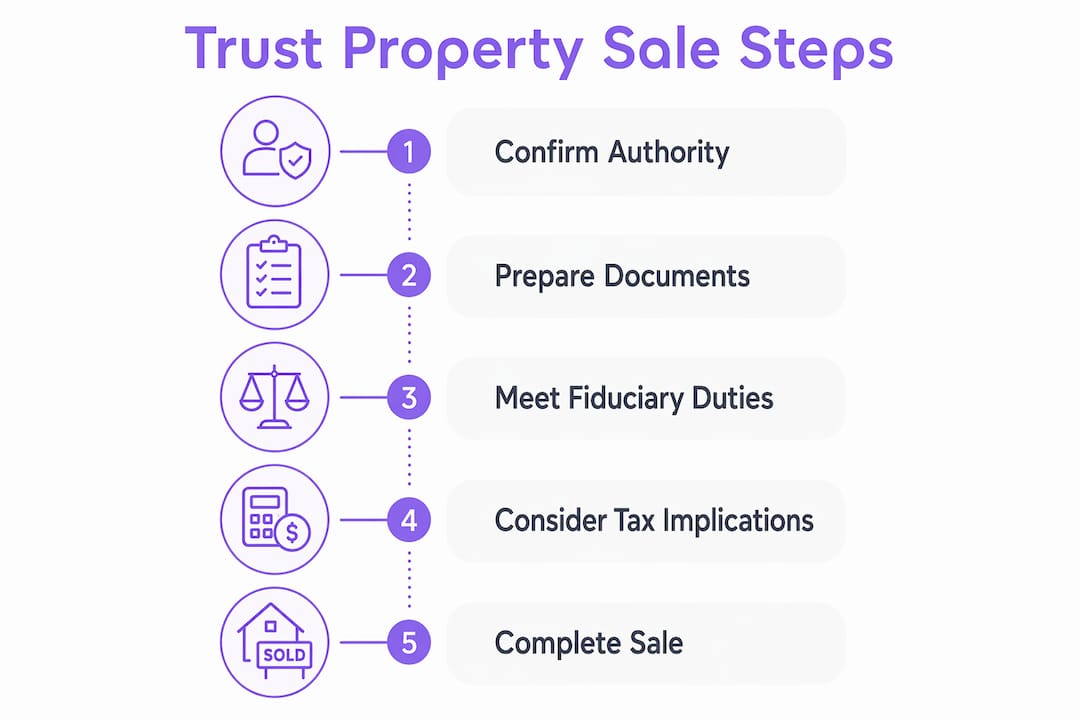
New Zealand does not have a broad capital gains tax (CGT) in the same form as some other countries, but property sales can still trigger tax obligations under the bright-line test. If the property was acquired on or after 27 March 2021 and sold within ten years, the gain is taxable as income. For new builds, the bright-line period is two years. This applies to trust-held property in the same way it applies to individually owned property.
The table below summarises key tax considerations across different trust and sale scenarios:
| Scenario | Tax consideration |
|---|---|
| Property sold within bright-line period | Gain taxable as income under NZ bright-line rules |
| Revocable trust distributing gains to beneficiaries | Beneficiaries taxed at their individual income tax rates |
| Irrevocable trust retaining gains | Trust taxed as a separate entity, often at the trustee tax rate of 39% in NZ |
| Property held as main home by beneficiary | Main home exclusion may apply, reducing or eliminating tax liability |
| Property used as rental or investment | No main home exclusion; full bright-line rules apply |
Irrevocable trusts are treated as separate taxpayers. Transitioning assets into irrevocable trusts often leads to the loss of individual CGT exemptions, so the tax consequences must be carefully planned before any transfer or sale. In New Zealand, the trustee tax rate currently sits at 39 cents in the dollar, which makes distributing income to beneficiaries on lower marginal rates a common and legitimate tax planning strategy.
You should also be aware that the tax implications of selling trust property can vary significantly depending on whether the trust is revocable or irrevocable, and whether the property qualifies for any exclusions. Consulting a tax adviser or accountant before listing is not optional. It is the most cost-effective step you can take.
How to sell family trust property: practical steps
Executing a family trust property sale without delays requires preparation across legal, financial, and practical fronts. The following steps apply whether you are selling through a real estate agent or directly to a cash buyer.
- Confirm title. Check the property title at Land Information New Zealand (LINZ) to confirm the property is registered in the trust’s name. The trustee signs all sale documents in their capacity as trustee, not as an individual.
- Obtain an independent valuation. This protects you as a trustee by demonstrating you sought fair market value. It also gives you a credible starting point for negotiations.
- Prepare the property. Attend to any repairs or maintenance that could affect the sale price or a buyer’s due diligence. Trustees have a duty to maximise value for beneficiaries.
- Engage professionals with trust experience. Work with a solicitor and, if using an agent, a real estate professional who has handled trust sales before. The family trust real estate process has specific documentation requirements that not all agents are familiar with.
- Prepare your documentation package. This should include the certificate of trust, trustee identification, any succession deeds, and the trust deed (or relevant extracts). Your conveyancer will need these before settlement.
- Do not remove the property from the trust before sale. Selling with the property still in the trust name is the correct approach. Transferring it out first creates unnecessary probate exposure and additional costs.
- Deposit proceeds into the trust account. Once settlement occurs, funds must go directly into the trust’s bank account. From there, distributions to beneficiaries are made according to the trust deed.
- Document the distribution. Provide beneficiaries with a clear written statement of how proceeds were calculated and distributed. This protects you from future disputes.
Pro Tip: Ask your solicitor to prepare a trustee resolution approving the sale before you sign any sale and purchase agreement. This creates a clear paper trail and confirms all trustees have authorised the transaction.
How to handle disputes and challenges in trust property sales
Disputes in family trust property sales are more common than most people expect, and they rarely resolve themselves without intervention. The most frequent flashpoints are beneficiary disagreements about timing, price, or distribution of proceeds.
If beneficiaries cannot agree on whether to sell, the trustee must act in accordance with the trust deed and their fiduciary duties, not simply follow the majority view. In some cases, this means proceeding with a sale even when one beneficiary objects, provided the decision is prudent and well-documented. If trustee authority is contested, or if a trustee has died with no replacement in place, a trustee vacancy must be resolved by formal deed before any sale can proceed legally.
Practical strategies for managing conflict include:
- Communicate early and often. Share valuation reports, sale timelines, and proposed distribution calculations with all beneficiaries before the property is listed.
- Use mediation before litigation. A professional mediator is far less expensive than a court application and often resolves disputes within days.
- Seek legal advice when authority is unclear. If there is any doubt about whether the trustee has the power to sell, or whether a co-trustee’s consent is needed, get a legal opinion in writing before proceeding.
- Document everything. Every decision, every communication, and every instruction should be in writing. This is your protection if a beneficiary later claims the process was unfair.
When disputes escalate beyond mediation, the High Court of New Zealand has jurisdiction to resolve trustee disputes and can appoint replacement trustees if necessary.
Key takeaways
Selling property held in a family trust requires the trustee to confirm legal authority, meet fiduciary duties, manage tax obligations, and follow a documented process to protect both beneficiaries and themselves.
| Point | Details |
|---|---|
| Trustee authority must be confirmed | Obtain a certificate of trust and verify succession before listing the property. |
| Fiduciary duties are legally binding | Sell at fair market value and deposit proceeds directly into the trust account. |
| Tax obligations vary by trust type | Irrevocable trusts face higher tax rates; consult a tax adviser before sale. |
| Documentation prevents delays | Prepare trustee ID, succession deeds, and trust certification early in the process. |
| Disputes require early intervention | Use mediation and transparent communication to resolve beneficiary disagreements before they escalate. |
What I have learned from watching trust sales go wrong
I have seen trustees who are genuinely well-intentioned make costly mistakes simply because they did not know what they did not know. The most common misunderstanding is that being a trustee is largely administrative. It is not. The moment you sign a sale and purchase agreement on behalf of a trust, you are personally accountable for every decision that led to that moment.
The trustees who navigate this process well share one habit: they ask for professional advice before they need it, not after something has gone wrong. A conversation with a solicitor before listing costs a fraction of what it costs to defend a breach of fiduciary duty claim after settlement. The same applies to tax advice. Discovering a bright-line liability after the sale has settled is a painful and avoidable experience.
What I find most underestimated is the human side of trust sales. Beneficiaries are often family members with different financial situations, different emotional connections to the property, and different expectations about timing. Clear, written communication from the trustee at every stage does more to preserve those relationships than any legal document. People feel respected when they are kept informed, even when the news is not what they hoped for.
If you are a trustee facing this process for the first time, approach it with both diligence and empathy. The legal framework exists to protect everyone involved. Use it.
— Aaron
Selling your family trust property with Easysale
If you are a trustee looking to sell a trust-held property quickly and without the complexity of a traditional listing, Easysale offers a direct cash buying service designed for exactly this situation.

Easysale buys properties across New Zealand in any condition, with no real estate agent fees and no open homes. You submit your property details, receive a fair cash offer within 24 hours, and settle on a timeline that works for the trust. For trustees managing a private trust property sale or those handling an estate, this removes the uncertainty of the open market and the pressure of drawn-out negotiations. Easysale also works with trustees selling inherited or deceased estate properties, making the process straightforward from first contact to settlement.
FAQ
Who has the legal right to sell a family trust property?
Only the trustee has the legal authority to sell property held in a family trust. The trustee signs all sale documents in their capacity as trustee, as confirmed by the trust deed and the certificate of trust.
Does the property need to be transferred out of the trust before selling?
No. The property should be sold while still titled in the trust’s name. Removing it from the trust before sale creates unnecessary probate exposure and additional administrative costs.
What happens if a trustee dies before the property is sold?
If the sole trustee dies and no replacement has been appointed, the sale legally cannot proceed until a new trustee is formally appointed by deed. This is one of the most common causes of delays in family trust property sales.
Are there tax obligations when selling trust property in New Zealand?
Yes. If the property falls within the bright-line period (ten years for most properties, two years for new builds), any gain is taxable as income. Irrevocable trusts are taxed at the trustee rate of 39 cents in the dollar unless gains are distributed to beneficiaries on lower marginal rates.
What documents does a conveyancer need for a trust property sale?
Your conveyancer will typically require a certificate of trust, trustee identification, any succession or appointment deeds, and a trustee resolution approving the sale. Having these prepared before listing prevents delays at settlement.
Recommended
