
Distressed property explained: solutions for NZ homeowners
TL;DR:Distressed properties include urgent sales due to financial, physical damage, or legal issues, not just mortgage arrears.Main sale routes are mortgagee sale, council buy-out, and urgent private sale, each differing in control and speed.Acting quickly, consulting professionals, and understanding rights can improve outcomes and protect homeowners.
Many Kiwi homeowners assume that a “distressed property” only means one thing: a family behind on mortgage payments, weeks away from losing their home to the bank. That assumption is understandable, but it leaves out a significant portion of real situations New Zealand homeowners face every year. Storm damage, council risk reclassification, sudden health crises, or inherited properties in poor condition can all push a home into distressed territory just as quickly as missed loan repayments. This guide will clarify exactly what the term covers, walk you through the most common sale types, and give you practical steps to protect your interests and move forward with confidence.
Table of Contents
- What is a distressed property?
- Common types of distressed sales in New Zealand
- How distress affects sale price, buyer rights, and protections
- What to do if your property is at risk: practical steps
- A fresh perspective: why being proactive matters more than the sale method
- How EasySale can help New Zealanders facing distress
- Frequently asked questions
Key Takeaways
| Point | Details |
|---|---|
| Multiple causes | Properties become distressed due to financial problems, storm events, or urgent council reclassification—not just missed payments. |
| Sale options | Mortgagee sales, council buy-outs, and urgent private sales are all common options for distressed properties in New Zealand. |
| Lower buyer protection | Distressed sales usually involve reduced guarantees, making it important to understand your rights and risks up front. |
| Proactive action | Taking quick action and seeking advice early gives you more control and better outcomes when facing property distress. |
What is a distressed property?
A distressed property is any home that must be sold urgently, typically because of financial pressure, physical damage, or legal circumstances that make holding onto it impractical or impossible. The urgency is the defining feature, not just the reason behind it.
In New Zealand, the causes fall into several broad categories:
- Mortgage arrears and the threat of a mortgagee sale initiated by a lender
- Storm or natural disaster damage that renders a property unliveable or uninsurable
- Council risk reclassification, where a local authority designates a property as high-risk after an event like flooding
- Legal pressures, including relationship property disputes, bankruptcy proceedings, or estate settlements
- Life changes, such as a sudden illness, job loss, or the need to relocate urgently
What surprises many homeowners is the council reclassification trigger. After Auckland’s devastating 2023 storms, many properties were assigned risk categories that effectively made them unsaleable on the open market. As noted in the Auckland Council storm-affected buy-out scheme, distress is sometimes classification-driven, with council buy-outs serving as the primary sale mechanism in those cases.
| Cause of distress | Example trigger | Common sale outcome |
|---|---|---|
| Mortgage arrears | Missed repayments for 3+ months | Mortgagee sale or urgent private sale |
| Storm or flood damage | Cyclone Gabrielle, Auckland floods | Council buy-out or as-is private sale |
| Legal proceedings | Relationship breakdown, bankruptcy | Court-ordered or urgent private sale |
| Inherited property | Deceased estate with maintenance issues | Private sale, often below market value |
| Council reclassification | High flood or landslide risk designation | Council buy-out or discounted private sale |
Understanding the impact of damage on sales is especially important if your property has suffered physical deterioration, because the condition of a home directly shapes which buyers will consider it and at what price.
The key takeaway here is that distress is about urgency and circumstances, not moral failure. Recognising your situation clearly is the first step to handling it effectively.
Common types of distressed sales in New Zealand
With a clear view of what distressed property means, you will want to understand the typical sale paths available and how they compare.
There are three primary routes a distressed sale can take in New Zealand. Each comes with different levels of control, speed, and financial outcome.
1. Mortgagee sale
A mortgagee sale happens when your lender, usually a bank, exercises its legal right to sell your home to recover the outstanding loan balance. This is not the first step a lender takes. Most banks prefer to negotiate repayment arrangements before escalating to this point.
The mortgagee, not the homeowner, controls the sale process. They appoint an agent, set the timeline, and accept or reject offers. As the original homeowner, you have limited input once the process starts. The property is typically sold at auction and marketed as an as-is purchase, meaning buyers accept the property without the usual guarantees or warranties that apply in a standard sale.
2. Council buy-out
After severe weather events, some properties are reclassified into risk categories that reflect the likelihood of future damage. In Auckland, for example, storm-affected homes in the highest-risk categories have been eligible for structured government-funded purchase. The offer is based on the property’s pre-event market valuation, meaning the council attempts to compensate you fairly for what your home was worth before the disaster struck.
This process is more structured than a mortgagee sale and includes dispute resolution options if you disagree with the valuation or categorisation. However, it is only available to eligible properties in specific risk zones.
3. Urgent private sale
This is the option where you, as the homeowner, choose to sell quickly without waiting for council processes or lender intervention. Urgent private sales can arise from any combination of financial, physical, or personal circumstances. The seller retains full control over who they sell to and on what terms.
Understanding fast sale offers is valuable here, because private cash buyers often provide the most straightforward path in this scenario.
| Sale type | Speed | Seller control | Price certainty | Buyer protections |
|---|---|---|---|---|
| Mortgagee sale | Moderate | Low | Low | Minimal, as-is |
| Council buy-out | Slow to moderate | Moderate | Moderate | Structured process |
| Urgent private sale | Fast | High | Moderate to high | Negotiable |
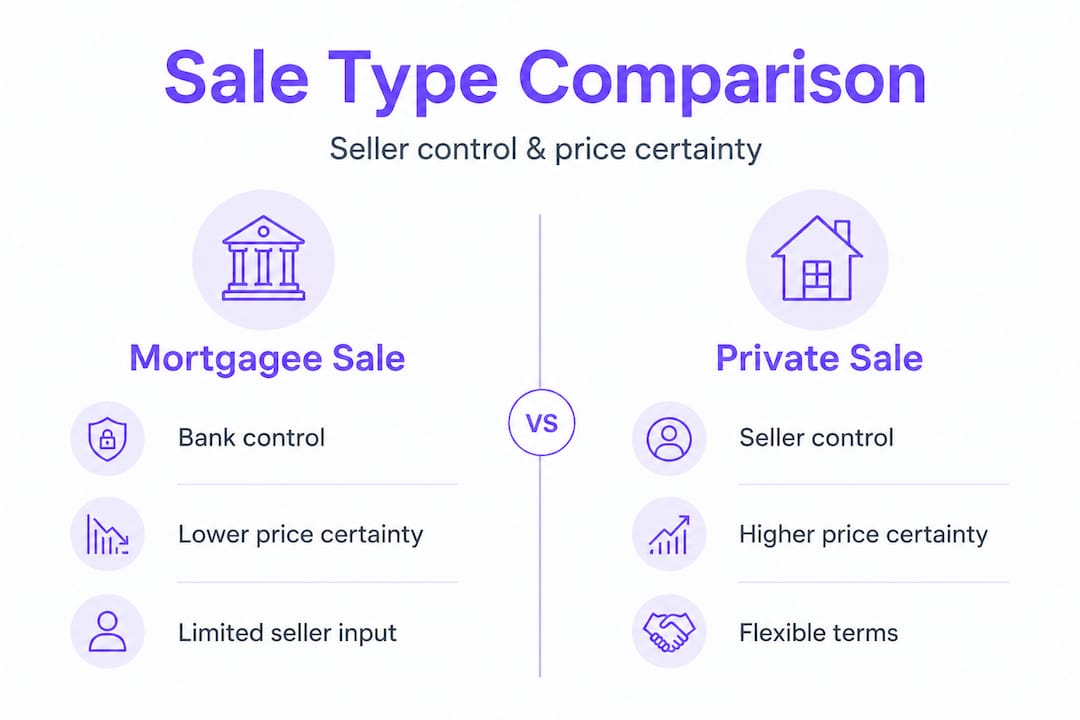
It is worth noting that quick sale types vary considerably in how they are structured, so understanding your options before committing to any one path can save you considerable time and money.
According to legal commentary on mortgagee sale implications, “distressed” implies reduced buyer protections and higher uncertainty, especially in mortgagee sales where transactions are conducted as-is and normal guarantees may not apply.
Pro Tip: If you are facing financial pressure, contact your lender before you miss a payment. Many banks have hardship options that can delay or prevent a mortgagee sale altogether. The earlier you act, the more choices you retain.
How distress affects sale price, buyer rights, and protections
Understanding your main sale options leads naturally to what those routes mean for your final outcome, particularly when it comes to the fairness and certainty of the deal.
Selling under distress almost always affects your price. That is not a judgement; it is a market reality. Buyers factor in urgency, condition, and the complexity of purchasing a distressed property when making offers. Here is what you need to understand clearly:
Sale price impact:
- Distressed properties typically sell for 10 to 25 per cent below comparable open-market properties, depending on the cause and condition
- Properties sold as-is with visible damage or deferred maintenance attract fewer buyers, which reduces competitive pressure
- Mortgagee auctions can result in significantly lower prices if buyer interest is limited on the day
Buyer rights and protections in distressed sales:
- In a mortgagee sale, the standard vendor warranties that protect buyers in a normal sale are largely absent
- Buyers purchase knowing they are accepting more risk, and this reduced protection is reflected in the price they are willing to pay
- In a private urgent sale, you have the ability to negotiate what warranties or conditions are included in the contract
As legal guidance on mortgagee sale implications makes clear, distressed sales often involve reduced protections with no normal guarantees or warranties for buyers. This directly affects what buyers are willing to offer and how quickly they will commit.
“Sellers who understand the protections they are giving up, and the ones they can retain through a private sale, consistently achieve better outcomes than those who simply accept whatever process is initiated on their behalf.”
This is where explained sale options NZ can be genuinely useful. Knowing the difference between a mortgagee sale and a private sale before the pressure is on allows you to make faster, clearer decisions when the time comes.
For those considering a private transaction, private sale protections outlines what safeguards you can still negotiate even in an urgent scenario. You are not required to give everything up simply because you need to move quickly.
Pro Tip: Before signing any sale and purchase agreement under distress, ask your solicitor to confirm exactly which warranties are included and which have been excluded. A single clause can make a significant financial difference.
Certainty of outcome is another critical factor. Mortgagee auctions can and do fall through if bidding does not reach the lender’s reserve. Council buy-out processes can take months. An urgent private sale with a committed cash buyer offers the highest certainty of a completed transaction.
What to do if your property is at risk: practical steps
Once you know what might happen in a distress scenario, it is critical to focus on immediate, practical steps you can take to regain control.
Here is a clear sequence to follow:
- Contact your lender or council immediately. If mortgage arrears are the issue, call your bank before the situation escalates. Mortgagee sales are usually a last resort and communication with your lender can sometimes prevent them entirely. If your property has been storm-affected, contact your local council to understand your risk category and eligibility for any support programmes.
- Gather your key documents. Collect your insurance policies, all bank communications, council correspondence, building reports, and any property valuation documents. Having these ready speeds up every subsequent step, whether you are negotiating with a lender, applying for a council buy-out, or engaging a private buyer.
- Assess your full range of options. A private sale, council buy-out, negotiated payment schedule, or bridging finance could all be viable depending on your specific circumstances. Do not assume the first path presented to you is the only one. The Auckland Council buy-out process for high-risk storm-affected homes, for example, includes structured steps and opportunities for dispute resolution that many homeowners are unaware of.
- Get independent legal advice. Before signing anything under pressure, speak to a property solicitor who is not connected to the buyer or lender. Legal advice protects you from clauses you might not notice under stress.
- Be alert to scams. Distressed sellers are unfortunately targeted by predatory buyers who offer below-fair prices and obscure the terms. Always verify credentials, check reviews, and request written offers with clear terms before proceeding. Use the step-by-step sale process as a reference for what a legitimate process should look like.
- Consider a direct sale to a reputable buyer. Understanding the purpose of a direct home sale can clarify why this route is often the most practical for homeowners who need speed and certainty combined.
Pro Tip: Even if you feel overwhelmed, write down a list of questions before any call or meeting with a lender, council officer, or buyer. Having a script prevents you from agreeing to something in the moment that you later regret.
A fresh perspective: why being proactive matters more than the sale method
Having stepped through immediate actions, let us take a step back for some perspective on the underlying factors that can make all the difference.
Most Kiwis in a distressed property situation focus heavily on the sale method. Should I pursue a mortgagee sale? Wait for a council offer? Find a private buyer? These are valid questions, but in our observation, the sale method is rarely what determines whether a homeowner ends up in a strong or weak position. Timing and communication are what actually drive outcomes.
Time works against you in distress scenarios in a very specific way. Every week you delay contacting your lender is a week of accruing interest, penalty fees, and reduced negotiating leverage. Every week you wait to understand your council risk category is a week of not knowing whether a buy-out is even possible. And every week you spend hoping the situation resolves itself is a week a motivated buyer could have already committed to purchase.
The homeowners we have seen navigate distressed sales most effectively are not necessarily the ones who chose the “best” sale type. They are the ones who acted decisively early, asked for help without shame, gathered their documents, and understood their rights before making any commitments. They also tended to be the people who recognised that a slightly lower sale price achieved quickly and cleanly was a far better outcome than a drawn-out process that eroded their mental health, finances, and options simultaneously.
The role of cash buyers in this context is often misunderstood. A reputable cash buyer is not simply looking to exploit urgency. They provide certainty, speed, and a simplified process that genuinely serves sellers who need to move forward without delay. The value is not just financial; it is practical and emotional too.
If you take one thing from this guide, let it be this: do not wait until you have run out of options before seeking help. The earlier you act, the more paths remain open.
How EasySale can help New Zealanders facing distress
If you are already considering your options or need a quick solution, support is available for nearly all distressed sale situations.
At EasySale, we work directly with New Zealand homeowners facing a wide range of distress scenarios, including storm damage, urgent financial pressure, inherited properties, and sudden life changes. Our process is designed to remove the complexity and stress that typically accompanies an urgent sale.

We provide a fair, fast cash offer based on your property’s details and circumstances. There are no real estate agents involved, no commission fees, and no need to prepare your home for open homes. If you want to sell your house privately in NZ without the usual delays, or if you need to sell an inherited or deceased estate property, our team can guide you through each step with clarity and care. We settle on your preferred timeline, so you remain in control of when and how the process concludes.
Frequently asked questions
Can I avoid a mortgagee sale if I’ve missed payments?
Yes. Mortgagee sales are usually a last resort, and contacting your lender early gives you the best chance to negotiate alternative arrangements before the process is initiated.
What is a council buy-out for storm-affected properties?
A council buy-out is a structured process where the local council purchases high-risk storm-affected properties at a price based on pre-event market valuations. The Auckland Council buy-out scheme includes valuations and opportunities for dispute resolution if you disagree with the offer.
Are buyer protections different with distressed sales?
Yes. As noted in guidance on mortgagee sale implications, distressed sales, particularly mortgagee sales, are typically conducted as-is with fewer legal guarantees than a standard property transaction.
How quickly can I sell a distressed property in New Zealand?
Sale timelines vary considerably depending on the method. A direct cash offer from a private buyer can close within days to a few weeks, while council buy-out processes and mortgagee sales typically take several months.
Do I need a lawyer if selling under distress?
Independent legal advice is strongly recommended before signing any sale and purchase agreement under distress, as a solicitor can identify clauses or exclusions that could have significant financial or legal consequences for you.
Recommended
